
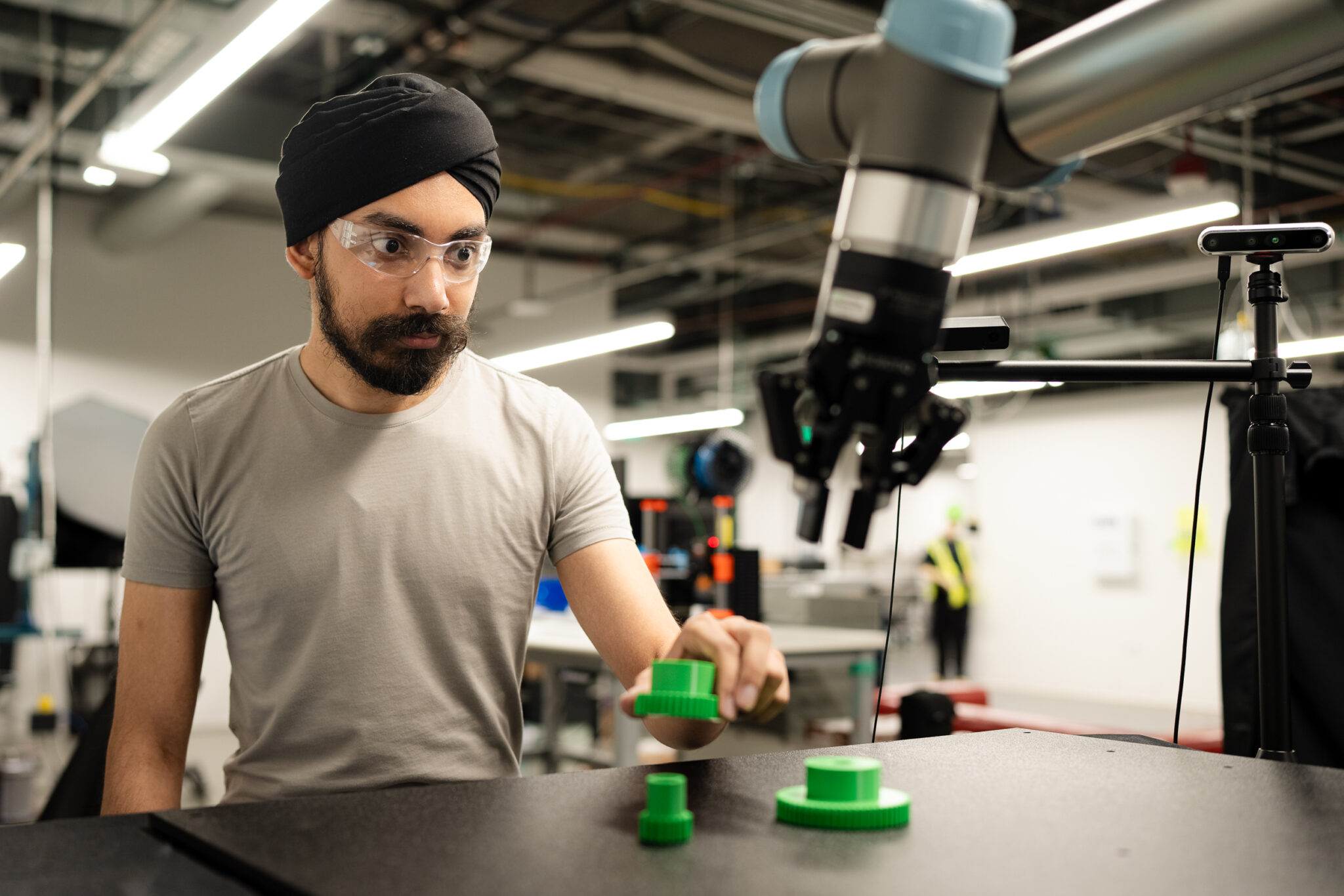
“We wanted to see what would happen if we just released some software as open source that uses the NVIDIA Jetson platform and NVIDIA CUDA libraries for robotics. Would there be any value there?” Singh recalled. “And the answer was, of course, yes, because developers always want to be able to unlock the full power of their GPUs.”
Physical AI has long been a field of extraordinary imagination and stubborn, physics-bound realities. A clip of a robot dancing or executing complex balletics can travel the internet in hours. Building a system that works repeatedly, across sensors, platforms, factories and labs, is slower business.
For Singh and the Isaac ROS team, the next era of robotics relies on a full stack: simulation, training, accelerated computing, AI models, middleware and edge deployment.
Isaac ROS supports manipulation, mobility and humanoids. It gives developers packages for perception, object detection, mapping, collision detection and motion planning, and it can run on workstations, NVIDIA DGX Spark personal AI supercomputers as well as NVIDIA Jetson edge systems.
“Compared with the original Isaac SDK, Isaac ROS is completely modular,” Singh said. “We ship the software like a bunch of LEGO bricks — you get to assemble them however you want, and you can easily combine our packages with existing ROS code written by you or others in the global robotics community.”
NVIDIA is making it easier for many robot builders to move faster, Singh said, and to do so on a foundation they can inspect, adapt and trust.
“The main reason open source is valuable is because it gives people confidence that they can build upon this stack at this very initial stage,” Singh said. “Because the entire landscape can shift so rapidly, developers need the confidence that this platform is still going to be there to modify and improve two or three years into the future.”
That confidence matters because robotics is changing quickly. Humanoid robots, in particular, have moved from science fiction to an active engineering frontier.
Singh’s team has been making Isaac ROS better suited to this moment, including for developers using AI agents and for humanoid systems that need an end-to-end software stack.
NVIDIA’s long history of work in robotics and farsighted vision for the field is what initially attracted Singh to the company — and made him all the more confident in his work upon joining.
“NVIDIA was here and working on this problem before anybody else thought it was important,” he said. “We already had a stake in the ground.”
Open source, in Singh’s view, is a way of sharing both confidence and responsibility. If a robotics startup builds on a closed system, it must trust that the system will still match its needs years later. With open software, developers can inspect the code, change it, contribute fixes and carry it forward. One company’s bug fix becomes another company’s acceleration.
“When more people can build robots,” Singh said, “the future gets here faster.”
Key considerations
- Investor positioning can change fast
- Volatility remains possible near catalysts
- Macro rates and liquidity can dominate flows
Reference reading
- https://blogs.nvidia.com/blog/nvidia-life-jaiveer-singh/#primary
- https://blogs.nvidia.com/blog/author/nvidiawriters/
- https://blogs.nvidia.com/blog/nvidia-life-jaiveer-singh/#disqus_thread
- AMD Ryzen 7 5800X3D is back in stock with up to $173 in savings, thanks to these Newegg deals — free $70 MSI MAG cooler brings costs well below MSRP for the sta
- AMD RX 9070 GRE collapses to $499 to save 1440p gaming — RDNA 4 price slips 9% to steal a piece of Nvidia's mid-range pie
- Drop's $130 desktop PC speakers are now just $23 — save a massive 82% on these dual-orientation BMR1 V2 speakers
- Sotheby’s video showcases working Apple-1 serial number 01-0033 — part of its upcoming History of Science & Technology sale
- Intel's new space-grade Starfire chip is a Panther Lake SoC that puts an 18A CPU into orbit — chip designed for the US government leverages Intel 3 for the GPU
Informational only. No financial advice. Do your own research.