
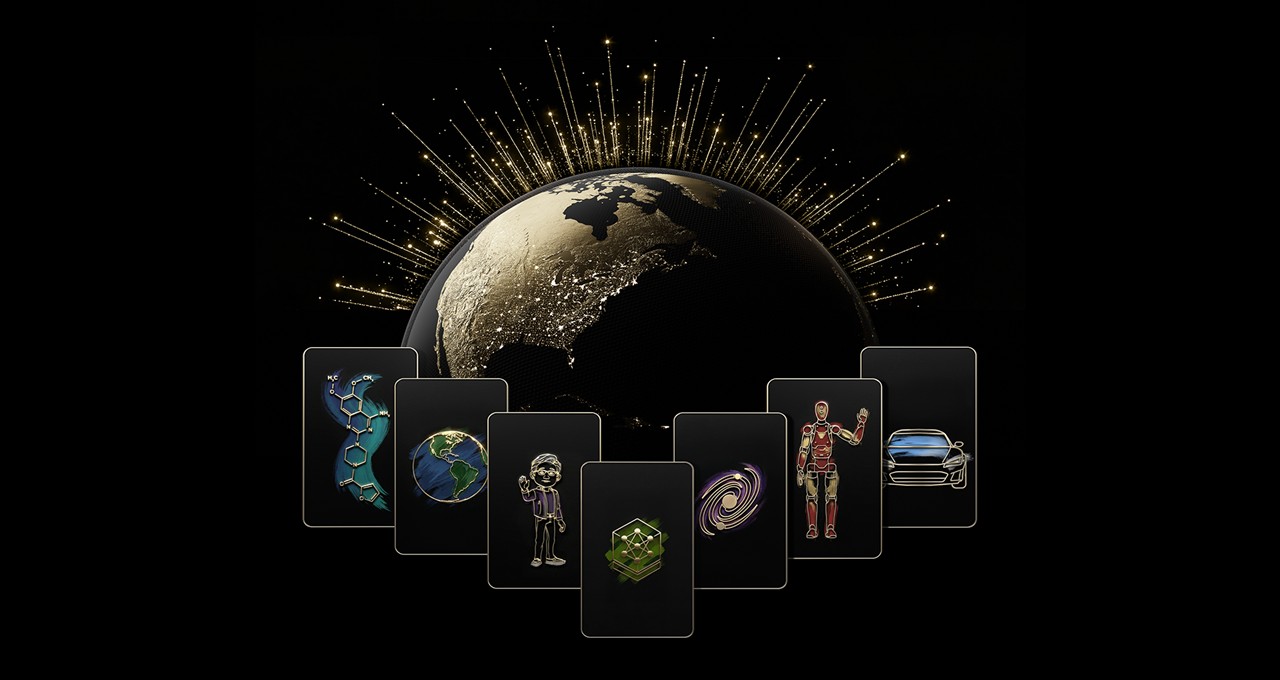
Every year, the International Conference on Machine Learning (ICML) reveals where thousands of AI researchers have decided to put their work.
This year’s accepted papers reveal a clear direction: open frontier models and open AI infrastructure have become foundational to how modern AI science gets done.
NVIDIA had 74 papers accepted at ICML 2026. Approximately 2,000 accepted papers cite NVIDIA GPUs, and 145 cite NVIDIA Nemotron — a family of open models, including open datasets — as the foundation for new research. Hundreds more draw on NVIDIA Cosmos , NVIDIA Isaac GR00T , BioNeMo and other NVIDIA open model families, spanning physical AI, robotics, autonomous vehicles and biomedical research.
Areas including vision and video generation, reinforcement learning for large language models ( LLMs ) and agent training as well as AI inference remained prominent themes across this year’s papers, reflecting sustained investment these fields command — while several new areas also broke through.
Robot world models drew significant attention, with papers like DreamDojo pushing the boundary of how AI systems learn to reason about and act in physical environments. DreamDojo, for example, learns how the physical world behaves from human video and builds on NVIDIA Cosmos open frontier models to predict how a robot would handle objects and operate in environments it was never trained on. It lets researchers evaluate policies, plan actions and teleoperate a virtual robot, accelerating development without the costs and risks of physical deployment.
AI for life sciences was fueled by NVIDIA BioNeMo open models and research contributions that help researchers understand protein function, molecular behavior and genetic code. Papers like FLIP2 introduce public benchmarks for testing how well AI predicts the effects of protein mutations. KERMT is a new BioNeMo open model for predicting molecular properties important to drug discovery.
Synthetic data generation (SDG) drew particular interest at ICML this year with several Nemotron and physical AI open datasets, reflecting a broader shift in how researchers are thinking about training at scale without relying solely on human-labeled data.
Open infrastructure gives researchers the tools to accelerate breakthroughs.
Key considerations
- Investor positioning can change fast
- Volatility remains possible near catalysts
- Macro rates and liquidity can dominate flows
Reference reading
- https://blogs.nvidia.com/blog/open-models-icml-2026/#primary
- https://blogs.nvidia.com/blog/author/jjkim/
- https://blogs.nvidia.com/blog/open-models-icml-2026/#disqus_thread
- Fire hydrant signs with Starlink antennas tested for emergency Wi-Fi in disaster-prone Japan— existing widespread grid of street-level furniture can be used for
- How Nations Are Deploying AI for Strategic Priorities
- Fill your Steam library without spending a single dime — scratch your shopping itch with the Steam Summer Sale Simulator
- Enthusiast hides gaming PC inside living room fan using 3D-printed parts — disassembled AtomMan G7 cooled by Dreo tower fan that shifts air at 28 feet per secon
- Electric drone breaks world air speed record at 434 mph, designed for anti-aircraft interceptor roles — German firm convincingly smashed the official 409 mph re
Informational only. No financial advice. Do your own research.