
ASML's roadmap for chipmaking lithography tools examined — from DUV to Low-NA, High-NA, Hyper-NA, and beyond
IBM and Lam Research team up on High NA EUV dry resist to push chip scaling past 1nm
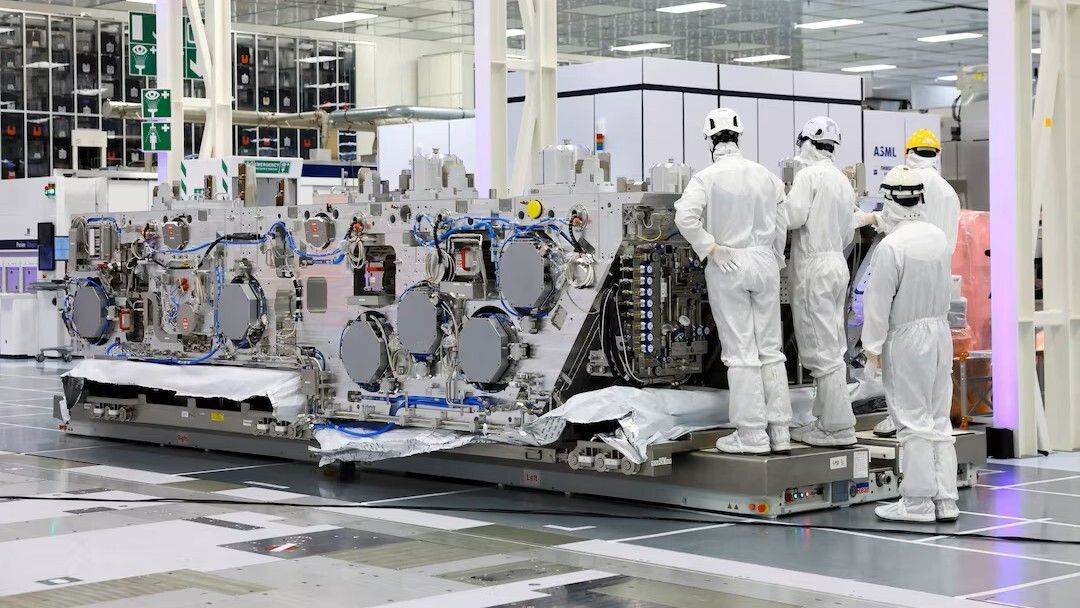
Even among mainstream semiconductor manufacturers, High-NA EUV technology is only just entering commercial deployment. Intel installed the industry's first commercial High-NA EUV lithography tool late last year, while imec received the technology in its 300mm cleanroom in March 2026 — two months ago. The machines themselves reportedly cost hundreds of millions of dollars apiece and represent one of the most complex manufacturing systems ever built.
The fact that imec has already applied High-NA EUV to quantum hardware — before most chipmakers have even integrated it into standard production flows — suggests quantum computing may be converging directly with the semiconductor industry's existing manufacturing roadmap rather than evolving as a separate technology stack entirely. That possibility can have significant implications. Instead of waiting for quantum-specific fabrication ecosystems to mature independently, silicon quantum hardware may be able to exploit the extremely advanced infrastructure of a multibillion-dollar industry , potentially significantly compressing quantum computing timelines. Although this does not mean manufacturable quantum computers are suddenly close.
While imec's prototype remains far from a large-scale fault-tolerant quantum computer, it still represents a functioning silicon quantum dot spin qubit device — a type of quantum hardware designed to store and manipulate information using the quantum spin states of trapped electrons. These qubits belong to a class of quantum architectures viewed as promising candidates for tackling computational problems that quickly overwhelm even the world's most powerful supercomputers due to their enormous combinatorial and quantum-mechanical complexity.
That is the gap imec is now targeting. By demonstrating that High-NA EUV lithography can pattern silicon quantum dot spin qubits at gate gaps of just 6 nanometers on a 300mm fab-compatible process, imec has shown for the first time that the semiconductor industry's most advanced manufacturing tool can be brought to bear on this class of quantum hardware — moving the architecture from lab-scale demonstration toward something that could eventually be manufactured like a chip.
If sufficiently scaled and stabilized, silicon quantum dot spin qubit systems could accelerate progress in molecular simulation, advanced materials discovery, pharmaceutical research, cryptography, logistics optimization, and complex physical-system modeling — fields whose computational demands can be prohibitively difficult for classical supercomputers, regardless of how powerful those machines become.
Rather than serving consumers directly, these systems would likely be deployed by hyperscalers, governments, national laboratories, pharmaceutical firms, and defense organizations tackling computational problems where even incremental breakthroughs could have massive scientific or strategic consequences. The technology would most probably be accessed through cloud-based quantum infrastructure rather than on-premises hardware.
Etiido Uko is a news contributor for Tom's Hardware covering the latest updates in big tech and the PC industry. He is a mechanical engineer and senior technical writer with over nine years of experience in documentation and reporting. He is deeply passionate about all things engineering and technology, and is an expert in gadgets, manufacturing, robotics, automotive, and aerospace. ","collapsible":{"enabled":true,"maxHeight":250,"readMoreText":"Read more","readLessText":"Read less"}}), "https://slice.vanilla.futurecdn.net/13-4-23/js/authorBio.js"); } else { console.error('%c FTE ','background: #9306F9; color: #ffffff','no lazy slice hydration function available'); } Etiido Uko Social Links Navigation News Contributor Etiido Uko is a news contributor for Tom's Hardware covering the latest updates in big tech and the PC industry. He is a mechanical engineer and senior technical writer with over nine years of experience in documentation and reporting. He is deeply passionate about all things engineering and technology, and is an expert in gadgets, manufacturing, robotics, automotive, and aerospace.
Key considerations
- Investor positioning can change fast
- Volatility remains possible near catalysts
- Macro rates and liquidity can dominate flows
Reference reading
- https://www.tomshardware.com/tech-industry/semiconductors/SPONSORED_LINK_URL
- https://www.tomshardware.com/tech-industry/semiconductors/imec-builds-worlds-first-high-na-euv-fabricated-quantum-dot-qubit-device-breakthrough-could-pull-quantum-computing-onto-the-same-manufacturing-roadmap-as-next-gen-ai-processors-compressing-timelines#main
- https://www.tomshardware.com
- Commercial satellite supplying intel to Ukraine is cornered by four Russian spacecraft — US Space Force can only watch as Russia threatens 'quasi-civilian' targ
- NVIDIA and ServiceNow Partner on New Autonomous AI Agents for Enterprises
- Save up to $200 on a 13-inch or 15-inch MacBook Air with M5 chip and 16GB of RAM — Memorial Day discounts get you Apple's latest and best consumer laptop for as
- Arctic Freezer 36-S Review: Small size, effective performance, low price
- Samsung $400,000 worker bonuses near approval after clearing legal challenge — non-chip employees in line for just $4,000 launch last-minute bid to scupper deal
Informational only. No financial advice. Do your own research.