
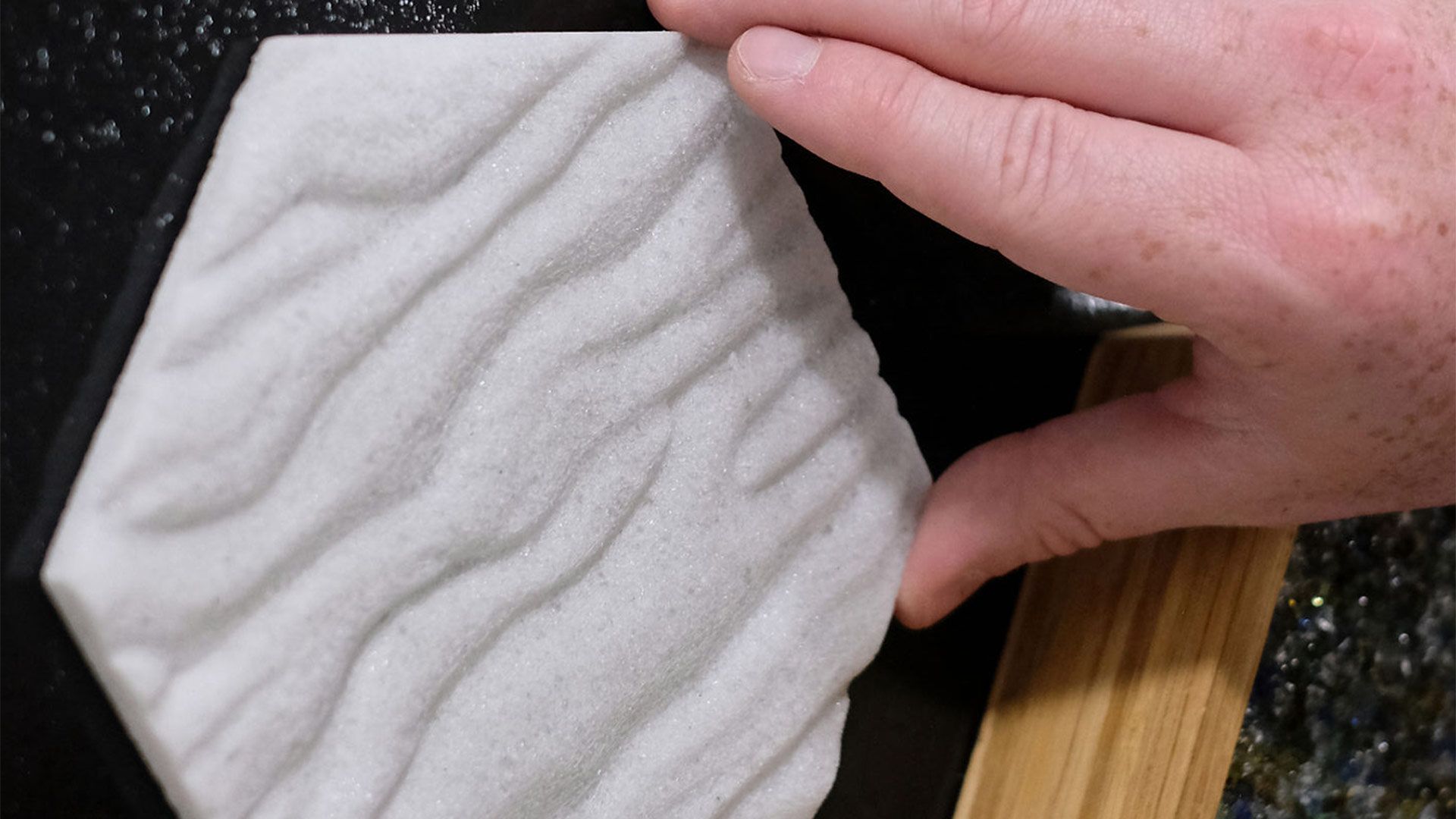
Resulting ‘binder jet’ 3D printing process is already being used for countertops, floor tiles, architectural wall accents, and more.
When you purchase through links on our site, we may earn an affiliate commission. Here’s how it works .
Watch On In the video above, we hear how Vitriform3D collects and recycles glass from Knoxville residents and businesses to provide the bulk of raw materials to drive forward its business.
Ordinarily, glass recyclers are quite fussy with colors and grades of glass, etc., and a lot of energy is used to melt and reform post-consumer glass to make new products/packaging. Vitriform3D doesn’t seem as particular, as all its process requires is crushed bottles. We see in the video, and on the firm’s website, that it does sometimes separate certain colors before crushing, as that provides more interesting ‘inks’ for its 3D printing process.
New metal 3D printer shrinks industrial tech down to workbench size with laser powder bed fusion system
3D-printed rocket fuel successfully tested, could enable lighter missiles and faster production rates
Researchers find a way to heat 3D printer filament using microwaves, enabling fusing circuits inside printed objects
Binder jet technology is the patent-pending process behind Vitriform3D’s products that embody a philosophy of “sustainability that sparkles.” Using this method, the firm has already enjoyed success in producing and marketing a range of kitchen countertops, floor tiles, architectural wall accents, and more.
“You take a thin layer of material, most times it's powder. It can be metal powder, it can be ceramic powder,” explains Ryan Dehoff from ORNL’s MDF in the video, embedded above. “We lay that powder out in a very thin sheet. And then we essentially take an ink jet [printer] head, and we put some sort of binder agent where we want to print or glue that material together.” From then on, all the binder jet 3D printer needs to do is repeat the process, again and again, building up a 3D object. Optimizing the binder agent's chemical formula has been one of the more important parts of this project.
It is noted that binder jet tech isn’t limited to glass . The process can use “almost any material” in powder form as the major constituent, according to the video. Glass is a particularly innovative choice, though, because of its physical properties, colors, and abundance.
Overall, the binder jet process sounds like something that would scale up well. We’d also welcome the patent-pending process scaling down to the desktop/hobbyist 3D printer space.
Get Tom's Hardware's best news and in-depth reviews, straight to your inbox.
Key considerations
- Investor positioning can change fast
- Volatility remains possible near catalysts
- Macro rates and liquidity can dominate flows
Reference reading
- https://www.tomshardware.com/3d-printing/SPONSORED_LINK_URL
- https://www.tomshardware.com/3d-printing/innovative-startup-pioneers-3d-printing-with-recycled-glass-new-binder-jet-process-combines-powder-with-adhesive-agent-in-layering-technique#main
- https://www.tomshardware.com/subscription
- AMD expands its Ryzen 9000 PRO lineup with six new SKUs, now featuring 3D V-Cache for the first time — new workstation CPUs have up to 170W TDPs, available with
- Amazon employees admit to using AI unnecessarily to pump up internal usage scores — workers complain of intense pressure to use AI tools
- Linked and Loaded: Gaijin Single Sign-On Now Available on GeForce NOW
- Google reportedly in talks with SpaceX to launch its orbital data centers — partnership could mark a historic turning point and boost upcoming IPO
- NVIDIA and ServiceNow Partner on New Autonomous AI Agents for Enterprises
Informational only. No financial advice. Do your own research.