
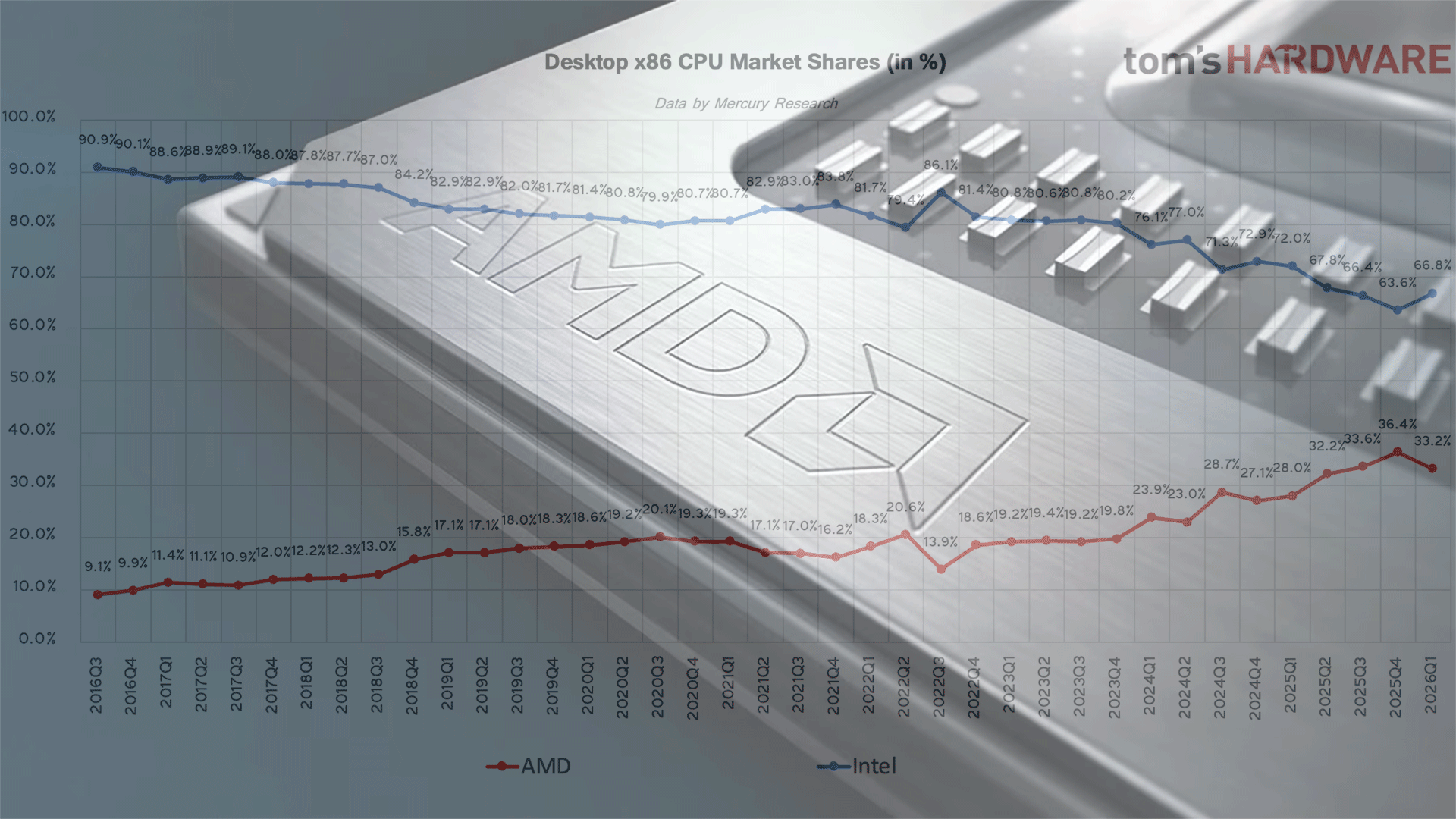
Intel's sequential market share gains were driven entirely by a substantial increase in desktop CPU shipments, while AMD continued to gain ground in notebooks, albeit at a much slower pace than in previous quarters. Mercury Research believes that weaker demand for mobile CPUs may have enabled Intel to allocate more silicon to desktop processors, a market that the company had undersupplied for some time.
However, the outlook for both companies' client CPU businesses is rather gloomy, as rising component costs (especially DRAM and 3D NAND prices) are weighing on PC demand. Both AMD and Intel anticipate a sequential decline in client CPU shipments of more than 20% in the fourth quarter and further declines in the year to come. Meanwhile, one has to keep in mind that CPUs sold in Q4 are meant for systems to be shipped in Q1, which is traditionally weak. Hence, while the 20% YoY decline is extraordinary, a substantial part of that decline is seasonal.
In the desktop PC segment, Intel made a spectacular comeback in Q3 2026, reclaiming 5% of the market in one quarter. Intel's desktop CPU unit share climbed to 70.1%, up 5% sequentially and 3.7% in the same quarter a year ago. By contrast, AMD's share dropped to 29.9%, down from 34.9% in Q2 2026 and 33.6% in Q3 2025, meaning the company wiped out its market share gains over the past year.
Mercury Research speculates that weaker demand for notebook processors enabled Intel to allocate more silicon to mainstream desktop CPUs, a market that both companies have underserved for some time. Another factor behind AMD's poor performance was its greater exposure to the gaming PC market, which suffered from limited availability of gaming graphics cards and unusually high costs for other components, such as memory modules and SSDs.
Yet, desktops became the only major x86 CPU market segment where AMD lost unit share both sequentially and year-over-year.
In the mobile PC segment, both AMD and Intel saw a substantial decline in CPU shipments in Q3 2026 as the market contracted more than 10% sequentially, according to Mercury Research. However, AMD's shipments declined slightly less than Intel's, which enabled the company to increase its mobile CPU unit share to a record 29.2%, up from 28.9% in Q2 2026 and 21.9% in Q3 2025. Intel remained the dominant supplier with a 70.8% share, down from 71.1% in the previous quarter and 78.1% a year earlier.
Although AMD's sequential market share gain of 0.2% was negligible, its 7.2% YoY gain was impressive, especially given Intel's historically strong position in the notebook market. Mercury Research attributes the sharp sequential decline in mobile CPU shipments partly to PC makers pulling forward their CPU procurements into the unusually strong second quarter.
Unfortunately for both AMD and Intel, the outlook for the fourth quarter is gloomy, as rising memory and other component prices drive up notebook prices and reduce end-user demand.
Unlike the bleak client CPU market, server CPUs are thriving, with shipments of data center processors reaching 8.13 million units in Q3 2026, according to Jon Peddie Research. The market again grew 20% year-over-year, the highest annual growth rate in nearly five years, according to Mercury Research.
In the server CPU segment, AMD continued its winning spree as its unit share reached a record 35.5%, up from 34.5% in Q2 2026 and 27.8% in Q3 2025. Intel remained the dominant supplier with a 64.5% share, down 1% sequentially and 7.7% year-over-year.
Interestingly, Intel managed to slow AMD's advance in the core data center CPU market by apparently substantially increasing shipments of its Xeon SP processors, McCarron believes. When the comparison is limited to AMD's EPYC and Intel's Xeon SP processors, AMD's unit share reached 46.8%, up just 0.4% sequentially, which represents AMD's smallest sequential gain over the past year, as the company's quarterly share gains by this metric averaged 3% over the preceding three quarters.
Unlike the client CPU market, the outlook for the server processor market remains particularly favorable for both AMD and Intel. The ongoing buildout of AI infrastructure drives demand not only for conventional data center-grade processors, but also for workstation-class CPUs used in smaller departmental AI servers.
Shipments of x86 CPUs declined both sequentially and year-over-year in Q3 2026 to 68.93 million units as rising component prices weighed on client PC demand, while server CPU shipments grew more than 20% year-over-year.
Intel regained overall x86 CPU market share from AMD for the first time since Q2 2025, largely thanks to a spectacular comeback in the desktop CPU segment, where its share reached 70.1%. Meanwhile, AMD gained 0.3% of the mobile CPU market, now commanding 29.2%, its highest share ever. Furthermore, AMD reached a record unit share in the server CPU segment, where it now commands 35.5%.
Both companies expect client CPU shipments to drop by more than 20% sequentially in Q4, whereas demand for server processors continues to grow due to the ongoing buildout of AI infrastructure.
Follow Tom's Hardware on Google News , or add us as a preferred source , to get our latest news, analysis, & reviews in your feeds.
Anton Shilov Social Links Navigation Contributing Writer Anton Shilov is a contributing writer at Tom’s Hardware. Over the past couple of decades, he has covered everything from CPUs and GPUs to supercomputers and from modern process technologies and latest fab tools to high-tech industry trends.
Key considerations
- Investor positioning can change fast
- Volatility remains possible near catalysts
- Macro rates and liquidity can dominate flows
Reference reading
- https://www.tomshardware.com/pc-components/cpus/SPONSORED_LINK_URL
- https://www.tomshardware.com/pc-components/cpus/intel-reclaims-overall-cpu-market-share-for-the-first-time-since-2025-massive-desktop-gains-offset-amds-record-server-and-mobile-growth#main
- https://futureplc.com/privacy-policy/
- Mechatronics student builds 3D printer made from 92% LEGO for less than $180
- Enthusiast builds a working 486 DX2 retro PC on a breadboard in just 16 days, immediately runs Doom
- Commemorative plaque at Denny’s booth where Nvidia was born has been removed (Update: Plaque Now Restored)
- Mass smuggling of up to 1.5 million Nvidia AI GPUs could be the underlying cause of Jensen Huang's departure, analysts claim
- FBI disrupts North Korean FaceStealer campaign behind $5 billion Binance hack
Informational only. No financial advice. Do your own research.