
When you purchase through links on our site, we may earn an affiliate commission. Here’s how it works .
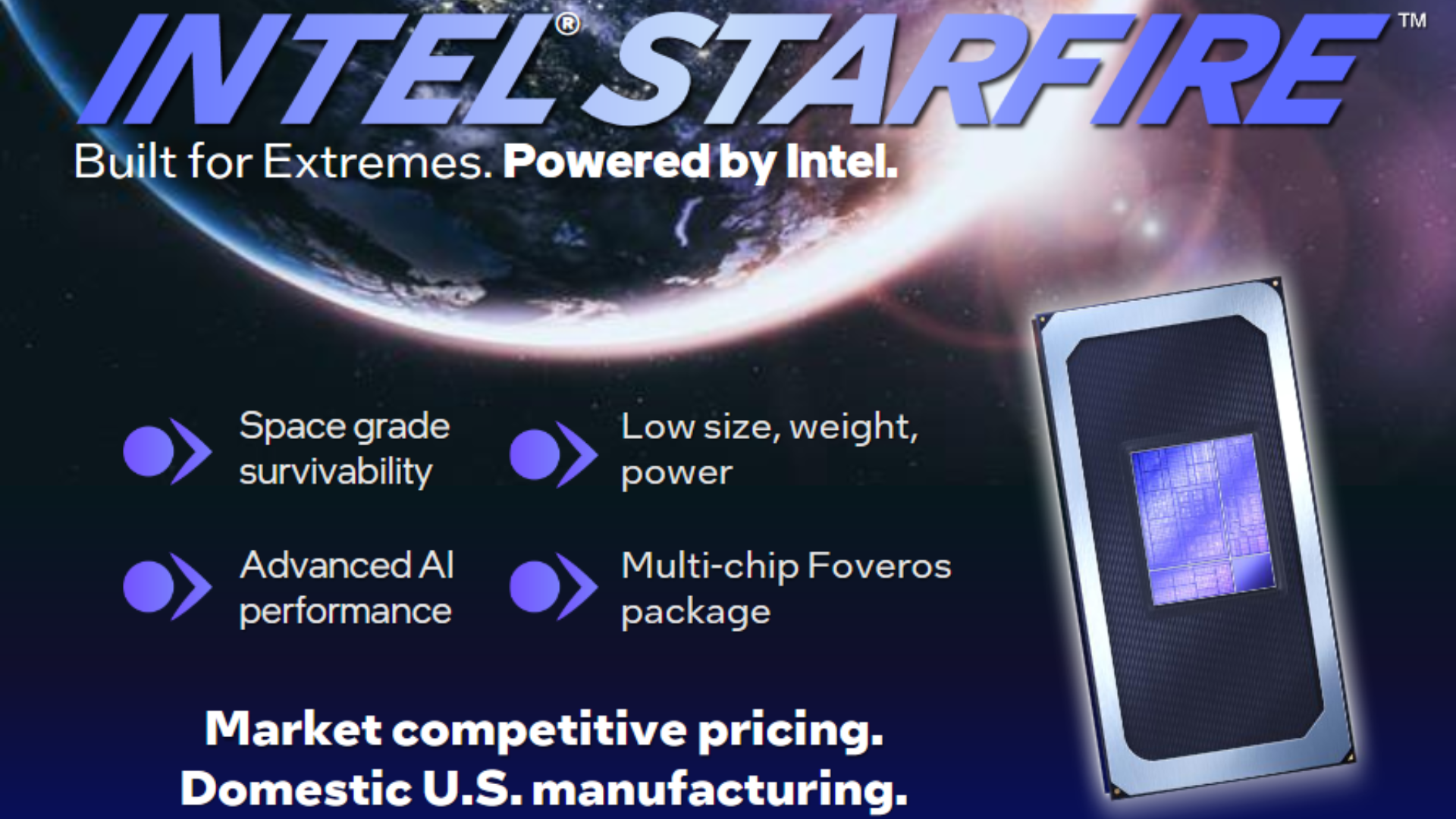
Both SKUs share the same layout of four Intel 18A P-cores, four low-power efficiency cores, a three-tile NPU also on 18A, and a four-core Xe GPU with 64 execution units built on Intel 3. The Low Power part runs its P-cores at 1.0 GHz, efficiency cores at 850 MHz, and the GPU between 800 MHz and 1.0 GHz. The Performance part clocks the P-cores to 3.1 GHz, efficiency cores to 2.1 GHz, and the GPU to 2.0 GHz. Both carry 12 PCIe Gen4 lanes, support LPDDR5 or DDR5, and are rated for a 10-plus year lifetime.
Intel builds the CPU and NPU on 18A and the GPU on the older Intel 3, the same node division it used for Clearwater Forest , the 288-core Xeon that stacks 18A compute tiles on Intel 3 base tiles. Smaller transistors hold less charge per stored bit, which makes leading-edge silicon more prone to radiation-induced bit flips, so committing 18A to orbit leans on RibbonFET and design-level hardening rather than a mature, inherently more tolerant node.
The market Starfire is targeting has run on BAE Systems' RAD750 for two decades. That radiation-hardened PowerPC part clocks 110 to 200 MHz, carries 10.4 million transistors, and is built on 150nm or 250nm lithography, per public specifications, and it flies on the Mars rovers, Kepler, and Fermi, among more than 150 spacecraft. BAE's multi-core RAD5545 and the Microchip-built processor NASA is developing to reach 100 times the throughput of current spaceflight chips are the more recent step up. Starfire's up to 75 TOPS and dedicated NPU put it in a different bracket, built for on-orbit AI inference rather than telemetry and control.
Intel lists the radiation data, covering total ionizing dose, single-event latch-up, and single-event effects, as characterization in process, so the part isn't radiation-qualified yet, and it notes the specs are subject to change. Intel Government Technologies is handling Starfire, with samples in Q3 2026 and a pitch of market-competitive pricing and domestic manufacturing. Intel Foundry is the only U.S.-based maker of leading-edge logic, holds Trusted Foundry status, and has tied its 18A and packaging roadmap to Pentagon programs including RAMP-C and SHIP, though 18A yields aren't expected to reach industry-standard levels until 2027 .
Intel Xeon 6+ ‘Clearwater Forest’ puts 18A in the data center with up to 288 cores, 576 MB of L3 cache
Intel's long-lost data center prototype 'Arctic Sound' Xe-HP multi-tile GPU surfaces in new engineering sample
NASA partners with Microchip to build next-generation spaceflight chips with 100x the power of current offerings
Follow Tom's Hardware on Google News , or add us as a preferred source , to get our latest news, analysis, & reviews in your feeds.
Get Tom's Hardware's best news and in-depth reviews, straight to your inbox.
Key considerations
- Investor positioning can change fast
- Volatility remains possible near catalysts
- Macro rates and liquidity can dominate flows
Reference reading
- https://www.tomshardware.com/tech-industry/semiconductors/SPONSORED_LINK_URL
- https://www.tomshardware.com/tech-industry/semiconductors/intel-shows-off-starfire-space-grade-chip#main
- https://www.tomshardware.com/subscription
- Grab 32GB of Corsair Vengeance DDR5 for just $236, $150 cheaper than the best standalone price — epic Newegg combo deal saves you $234 overall and comes with an
- Upcoming MSI Afterburner update adds heatmap to V/F curve editor to show your GPU's boosting behavior — new feature shoots for better overclocks with more data
- Ireland’s data centers consumed nearly as much electricity as every home in the country combined in 2025 — server farms gulped 23% of national power despite yea
- Sega Dreamcast driver fixes appear in Linux 7.2-rc3 — fabled console remains in favor while iconic computing architectures like i486 fall by the wayside
- NVIDIA BioNeMo Agent Toolkit Brings Accelerated AI to Life Sciences Researchers in Claude Science
Informational only. No financial advice. Do your own research.