
Journalist 2: Just why it was taken out, what the thinking behind that was. Was it a security thing?
Tim Wilson: I have a lot of my own personal thoughts. If you step back to the data center a couple of years ago, the thesis was that what matters is maximum core performance and then core density in the socket. So if I can deliver maximum core performance and increase the number of cores in the socket, do I really need [SMT]? One or two physical cores are always better than two virtual cores built on one physical core. I fully expect we will see use cases and workloads where that decision is incredibly useful and valuable and gives real-world value, and we've heard from some customers that, for what they're doing, single-threaded is the right answer. Having said that, there's a big portion of work that is still very much multi-threaded, especially in the virtualized space, so completely eliminating it is a problem, because we cut off some not-insignificant portion of workloads, especially when you're in a virtualized, licensed environment where licensing is based on cores and threads. So there was a technical reason for why you'd want [SMT], and that technical reason probably still holds. […]
Journalist 2: Like a VMware thing, with a big price on cores. How are you going to market versus your main rivals, like AMD, and now Nvidia? What's the messaging going forward? From 18A to what's next, you'll be much better on the node side.
Tim Wilson: Our intention is to have leadership products with every generation, and we fully intend to do that going forward. Our go-to-market strategy is to sit down with customers and ask what they value, then go build leadership that meets those needs. With all our data center customers, we have deep discussions around the personality of the platform they want to build, beyond just cores and feeds and speeds. What is the system balance, the memory-to-compute ratio? How are they viewing multi-socket versus single-socket? What's the right number of cores for their workloads, for both private and public workloads, enterprise versus cloud? It's really sitting down in each of those and asking what the markets and customers buying our parts value, and how we optimize our products to meet their needs.
Journalist 2: Is that changing now with this agentic AI demand explosion? Are we going to see CPU racks with agentic AI as the primary use?
Tim Wilson: I'm sure you will, just like we've always built CPU racks. There are principles around CPU design that have always been true and will continue to be true. You want the highest-performance core you can build. Power efficiency is always going to matter as long as we're constrained by the amount of power you can bring inside a building's walls and the heat you can extract from them. Your memory-to-CPU harmonics, how much memory each workload takes, how much you allocate to each core, those are key. We've always designed for those parameters, and the end markets evolve over time.
Agentic AI is now exploding, but what's driving that explosion is not a new type of CPU. It's that the new AI workloads are not one call, one inference, one response. They're complex, execution-driven, multi-task queries that involve tens or hundreds of agents, and suddenly you need a control plane and an orchestrator, tasks the CPU is historically good at. How do I take a complex task and decompose it into subcomponents, figure out which can be parallelized and which depend on each other and need to be serialized, and pass those off to the GPU? I have to map memory to each of those subcomponents, and not all of them want the same memory, and I have to make calls to I/O, and in some cases to the OS or APIs.
Those are all things the control plane and orchestrator, the CPU, does really well. As you move away from a chatbot answer to "go do this analysis and give me a report on the actions I should take," that's a much different query, and the CPU plays a much bigger role. Data centers that have built on GPUs for the last three years are suddenly finding they're bottlenecked by the CPU. They have a massive GPU fleet that costs billions of dollars sitting idle, waiting for the CPU to respond. So do I see a future with agentic AI and CPU racks? Yes, but with characteristics very similar to the sorts of things we've always built into CPU racks. It's exploding because the things the CPU has always done well are the things in demand now.
Journalist 2: It seems like the whole storage infrastructure has to change, too.
Tim Wilson: That comes along with it. There's demand for storage, which drives I/O advancements and connectivity.
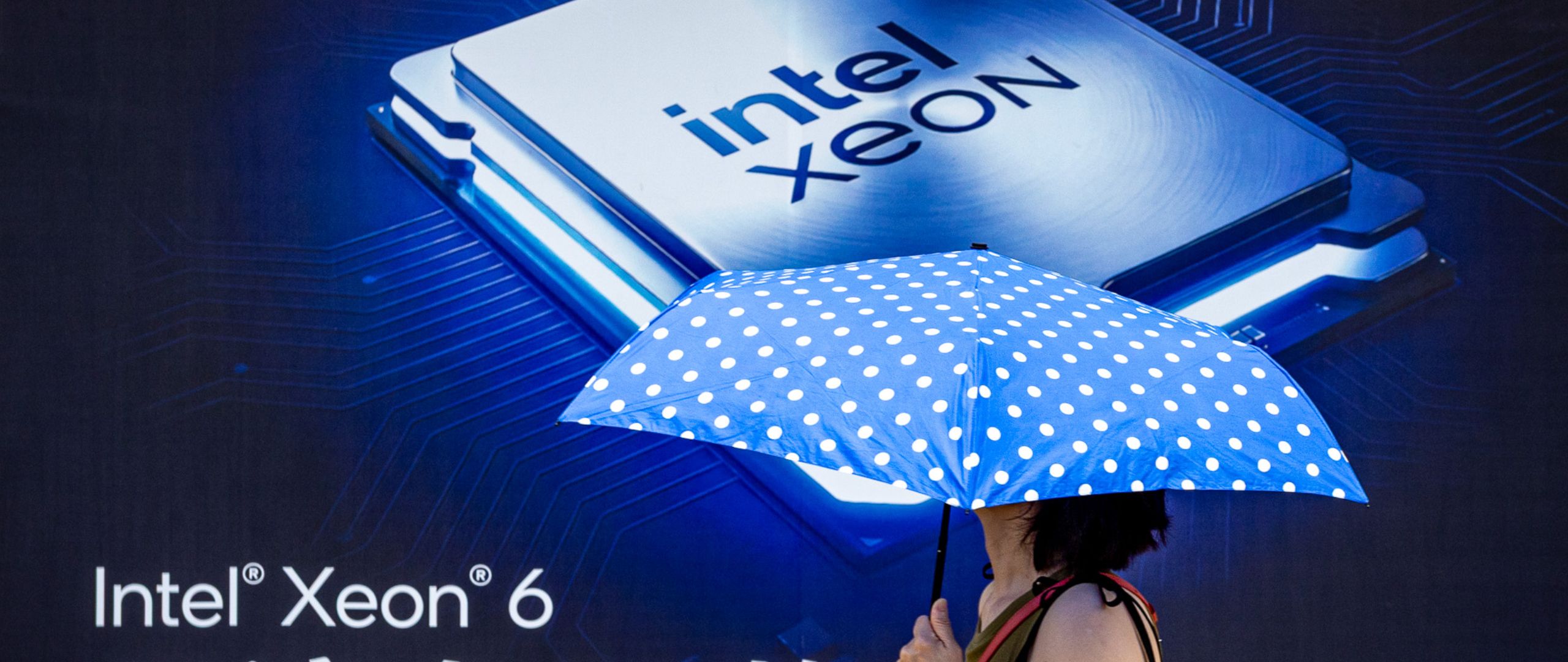
Clearwater Forest is a multi-process design: the compute tiles are built on I ntel's 18A node , with base tiles on Intel 3 and I/O tiles on Intel 7.
Journalist 2: Questions you probably want to ask but won't answer. 18A yield volume for Xeon 6+, progressing?
Kira Boyko: We're ramping well. We have strong demand throughout the lifetime of the product, and we're working from a capacity standpoint across all of our products to hit customers at the point in time they need most. Compute is 18A, but we also have base on Intel 3 and I/O on Intel 7, so it's a multi-process product. We're mapping demand against all of our other products to figure out where we need to build.
Journalist 2: How do you choose who gets the product in this compute-supply-constrained world? Is it whoever orders first? You're sold out right now.
Tim Wilson: We give as many CPUs to as many people as we can. It tends to be more business decisions than engineering decisions, so it's a combination of long-term deals and customer relationships. The biggest problem is not demand in any way, shape, or form. The biggest problem is how we satisfy demand across every single product. If I have people demanding Xeon 6 and Xeon 6+, and still Xeon 5, how do I balance all of those and match where the supply constraints are in the industry? In some cases, customers are struggling with mismatches. They can get the GPU but not the memory to pair with it, or the memory but not the CPU. There's a lot of matching going on in the industry.
Journalist 2: On the client side, people are demanding even older products because they've already verified them.
Kira Boyko: I've seen that on the data center side, too. They've verified and tested a product, so they want that product. In such a supply-constrained environment, people will buy whatever’s on the table. And 6+ has the benefit of some backward-compatibility elements, the socket compatibility, and again, using processes that are hardened on previous products, so we can mix and match in some cases. We have customers looking for multiple products on multiple processes, and it's working with them to understand exactly what they critically need, when, and how we best service that across all their orders.
Jake Roach: If I'm remembering correctly, it was the earnings call before the most recent one, where we talked about wafer allocation split between client and data center, with a greater emphasis on wafers going toward the data center. Is that still the plan?
Tim Wilson: That's definitely the plan, and we're always having those conversations. That's more of a foundry conversation than a product conversation. […] The whole ecosystem is sucking up all the wafers and memory, whether it's client, automotive, or any of the other industries. AI data center tends to take the supply because they're willing to pay the most, and the rest of the industries can't pay the price until supply balances out. We saw a similar effect during COVID, though that was supply-chain-driven rather than demand-driven. Those trade-offs, Gen 5 versus Gen 6 versus Gen 7, are a weekly conversation.
Kira Boyko: Daily, in some cases, on CPU allocations. […] Given the dynamic space, our customers are modifying on a regular basis. Can we shift? What do they really need, and when? If you're asking long-term whether we'll stay in these constraints, we do see a space where things will lighten up. It's not in the immediate timeframe.
Journalist 2: Dave talked about multi-year hyperscaler contracts. What's the latest on that? Are deals getting signed, and are you getting more requests for those kinds of contracts?
Tim Wilson: I doubt either of us is the right person, by the way. They don't trust us with a lot of that information.
Journalist 2: You're not talking with data center customers on the purchase side?
Kira Boyko: We're not in the contract negotiation.
Key considerations
- Investor positioning can change fast
- Volatility remains possible near catalysts
- Macro rates and liquidity can dominate flows
Reference reading
- https://www.tomshardware.com/tech-industry/SPONSORED_LINK_URL
- https://www.tomshardware.com/tech-industry/intel-xeon-6-plus-roundtable-transcript-computex-2026#main
- https://www.tomshardware.com
- Negative time experiment clears peer review as photons appear to leave an atom cloud before entering — groundbreaking quantum 'negative time' proven after 1 mil
- Tom's Hardware Unfiltered: Computex 2026, Day 1 — night markets, taking the MRT train, and a slew of demos
- DLSS 4.5 Ray Reconstruction update arrives in August for better ray tracing visuals — broader training data set and second-gen transformer architecture combine
- Asus' monstrous ROG Astral GeForce RTX 5090 Edition 20 includes expansive curved AMOLED display — also debuts 3,000W power supply and striking PC case
- Access Tom’s Hardware Premium’s Computex 2026 coverage for free — sign up for an account to read insider reports from the show
Informational only. No financial advice. Do your own research.