
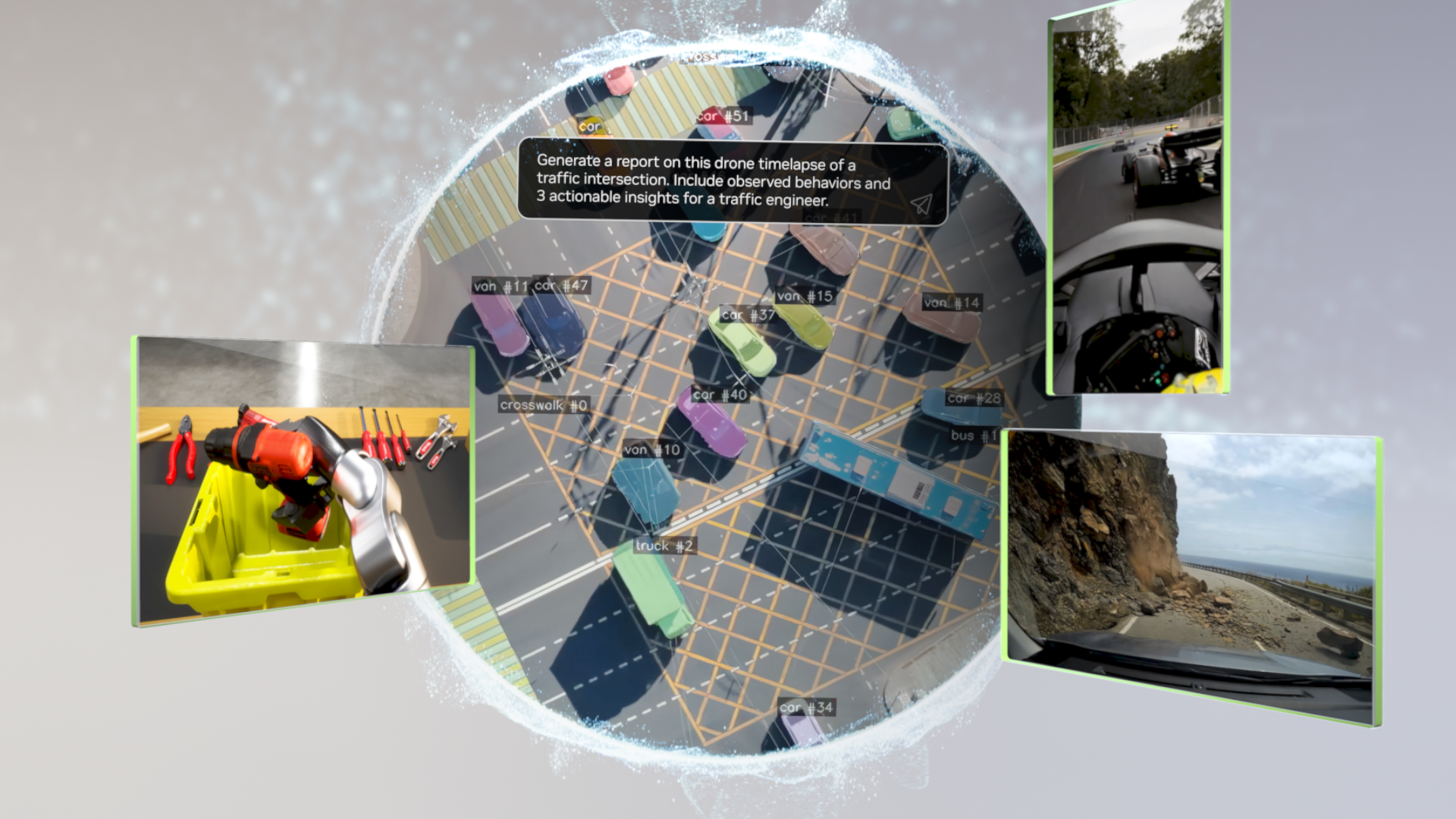
To make this possible, w orld models learn how physical environments behave, what may happen next and which following actions make sense. They can generate physically grounded world and action data, simulate future states and provide a foundation that teams can specialize for a robot, autonomous vehicle or vision AI system.
Open world models are already being used to generate training data, test policies and specialize physical AI systems. NVIDIA Cosmos 3 brings these capabilities together in an open model family, with leading benchmark results and adoption across robotics, autonomous vehicles and vision AI.
And NVIDIA Omniverse libraries, part of NVIDIA Agent Toolkit, provides prebuilt capabilities for building simulation-ready worlds that physical AI teams can use to train, test and validate systems before real-world deployment.
The data behind physical AI is difficult and expensive to collect at the scale required. Rare events and long-tail scenarios can be especially difficult to reproduce safely and repeatedly.
More useful data by learning physical relationships from large-scale multimodal scenarios.
More diverse environments that vary in weather, lighting, objects and trajectories.
A better foundation to build on and adapt to a particular robot, vehicle, sensor configuration, task or operating environment.
A general model hasn’t seen a team’s particular robot, sensors or operating environment. Closing that gap requires access to model weights, a license that permits adaptation and the tools needed for post-training.
NVIDIA Cosmos world foundation models are available under the Linux Foundation’s OpenMDW 1.1 license, enabling teams to post-train models on their own data and hardware. Specialization is where openness becomes a practical technical requirement.
Specializing a model is only part of the workflow. Teams also need environments to generate data, run simulations and test behavior.
Omniverse libraries help developers build simulation-ready environments, while OpenUSD provides the open framework for composing, reusing and exchanging complex 3D data across digital twins , simulations and synthetic data generation workflows. Together, Omniverse and OpenUSD cut the duplicated work that can otherwise pile up every time assets, sensor configurations or environmental conditions change.
NVIDIA Cosmos 3 — a frontier open physical AI foundation omni-model built on a mixture-of-transformers architecture — combines vision reasoning, world generation and action prediction, letting developers use one model family to understand scenes, generate synthetic data, simulate future states and build specialized world action models .
Developers can use Cosmos 3 as a vision language model , as a physics-grounded world simulator that predicts future world states and generates large-scale synthetic data, or as the backbone for world action models, instead of assembling and maintaining a separate model for each capability.
The family includes Cosmos 3 Super (64B) for high-fidelity world modeling, Cosmos 3 Nano (16B) for efficient reasoning and post-training, and Cosmos 3 Edge (4B) for on-device vision reasoning and robot policy deployment. Lightweight enough to run on edge GPUs, Cosmos 3 Edge can be deployed across NVIDIA RTX GPUs, NVIDIA DGX systems and NVIDIA Jetson, including Jetson Thor platforms.
Across benchmark evaluations, Cosmos 3 ranks No. 1 on Artificial Analysis for open weights text-to-image and image-to-video generation, on PAI-Bench for world generation and in the image-to-video category of Physics-IQ . For robot policy, it ranks No. 1 on RoboLab . Cosmos 3 Super is also the highest-ranked open model on VANTAGE-Bench for vision understanding.
In addition to Cosmos, NVIDIA’s physical AI stack includes Isaac GR00T for robotics, Alpamayo for autonomous vehicles and Metropolis for vision AI.
Across industries, developers are building on NVIDIA Cosmos for physical AI applications: Doosan Robotics, LG Electronics, Samsung Electronics and Skild AI in robotics; Li Auto, Xiaomi and Afari in autonomous vehicles; and Centific , Fogsphere , Linker Vision , Milestone Systems and Yuan for vision AI agents powering industrial AI and smart spaces applications.
The NVIDIA Cosmos Coalition extends this work by bringing together world model builders, AI developers and physical AI leaders to contribute models, research and evaluation methods. NVIDIA recently expanded the coalition to Japan , where robotics and manufacturing leaders intend to join and develop open world models for factories, logistics, agriculture, construction, healthcare and transportation.
Together, these implementations and collaborations are establishing open world models as an adaptable foundation for physical AI across robots, autonomous vehicles and vision AI systems.
Learn more about world models, OpenUSD and physical AI development by exploring these resources:
Explore the open Cosmos 3 model collection and datasets on Hugging Face and GitHub .
Read the Cosmos 3 technical report for full architecture details and evaluations.
Tune in to the Cosmos Labs livestreams .
Key considerations
- Investor positioning can change fast
- Volatility remains possible near catalysts
- Macro rates and liquidity can dominate flows
Reference reading
- https://blogs.nvidia.com/blog/open-world-models-physical-ai/#primary
- https://blogs.nvidia.com/blog/author/mingyuliu/
- https://blogs.nvidia.com/blog/open-world-models-physical-ai/#disqus_thread
- Anthropic co-designing custom AI inference chips to bypass costly Nvidia GPUs — Samsung reported as manufacturing partner for Claude maker
- AI Leaders Propose SAFE Guidelines for Cybersecurity Transparency
- Microsoft wants the next-gen Xbox Helix to play every Xbox game ever made as it urges publishers to opt in — New report also claims Xbox 360 games coming to PC
- AMD doubles data center revenue year over year, but gaming revenue plunged by 31% — CEO Lisa Su says prices have 'weighed on' consumer demand but is 'optimistic
- Built for Vera Rubin, NVIDIA Spectrum-6 Arrives in Gigascale AI Factories
Informational only. No financial advice. Do your own research.