
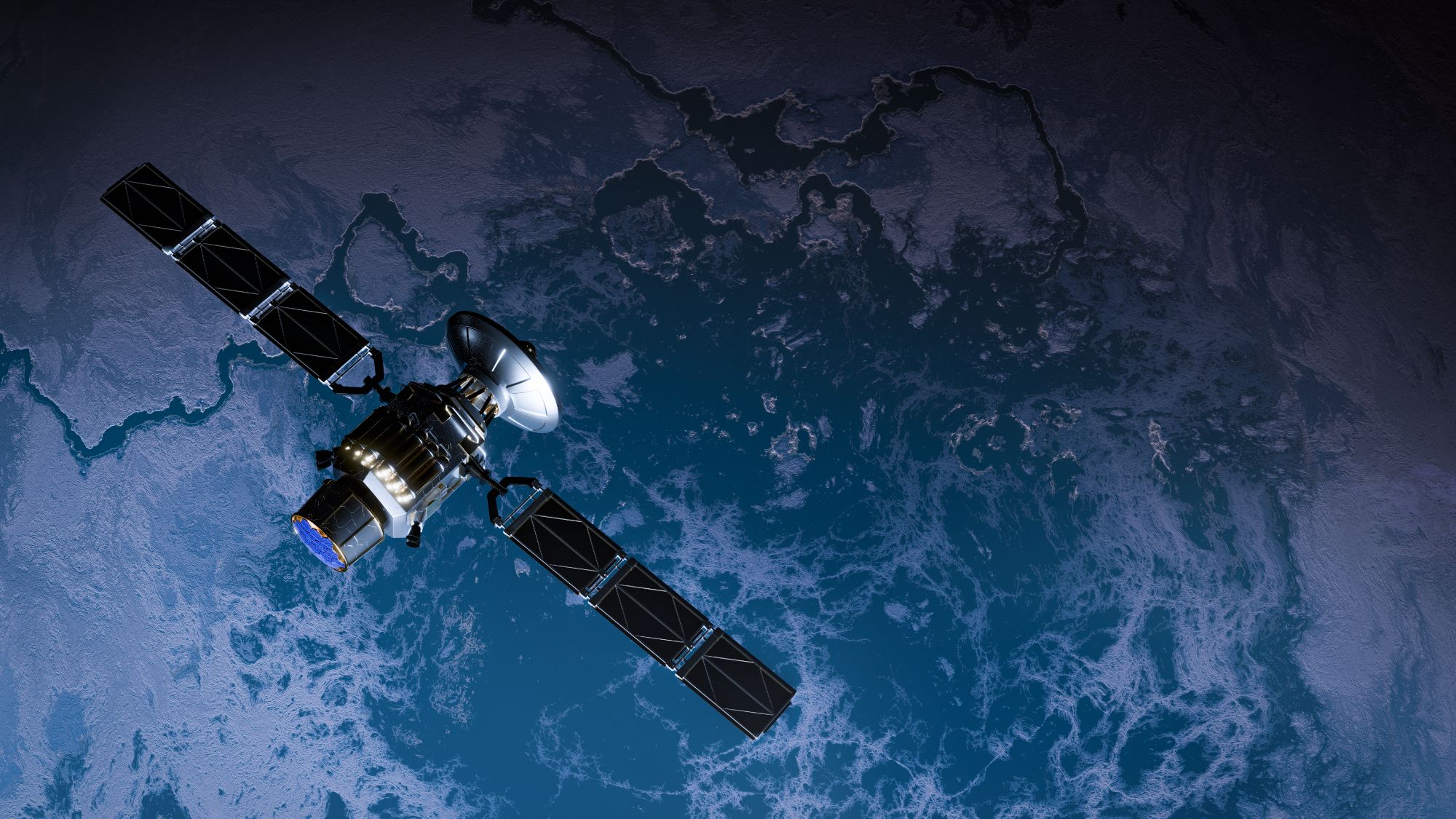
This gave Tehran enhanced satellite imaging capabilities and made it nearly impossible for Israel and the U.S. to target the infrastructure supporting it.
When you purchase through links on our site, we may earn an affiliate commission. Here’s how it works .
Iran’s Islamic Revolutionary Guards Corps (IRGC) Aerospace Force reportedly acquired a Chinese Earth-observation satellite in late 2024 after it was already launched into space from China, in what was called an “in-orbit delivery” deal. According to the Financial Times , leaked Iranian documents showed that it bought the TEE-01B Earth observation satellite in 2024 from Earth Eye Co., a Chinese commercial aerospace company “dedicated to advancing the export of China’s commercial space industry,” while it also received access to commercial ground stations located in China through Emposat, a satellite ground station services provider that allowed the IRGC to control its satellite remotely.
This gave the country the ability to capture satellite imagery at a resolution of 0.5 meters. By comparison, Iran’s existing Noor-3 satellite was only capable of a 5-meter resolution, while the older Noor-2 delivered 12 to 15 meters. The TEE-01B’s higher resolution allowed the IRGC to identify individual aircraft and ground vehicles, as well as use it to see infrastructure details. In fact, the leaked data included logs that showed the satellite capturing images of various U.S. bases in the Middle East, with some of them being hit by drone strikes soon after.
Earth Eye Co. is not a defense contractor, with the company website saying that its satellites are built for “agriculture, ocean monitoring, emergency management, natural resource supervision, and municipal transportation.” However, the remote sensing data that it gathers for civilian use can also be deployed for military operations. This dual-use application highlights the grey area between military and civilian hardware applications, especially as this Chinese satellite was used to target Iran’s neighbors — a somewhat sensitive issue for China as it’s the largest buyer of oil from the Middle East and is also one of the largest trading partners of the region.
You may like SMIC sent chipmaking tools to Iran's military, Trump administration officials say Iran threatens Nvidia, Microsoft, other tech companies with strikes over alleged attack on Tehran bank Iran issues direct strike threat to Nvidia, Microsoft, Apple, Google, 14 other US tech companies Despite Earth Eye Co.’s civilian nature, it’s clear that Iran intended to use the TEE-01B for military purposes, especially because it was purchased by the IRGC, the military arm of Iran’s Islamic government, different from the regular army, and not by the civilian Iranian Space Agency (ISA). However, the distributed nature of this satellite’s services makes it harder to attack. Israel has reportedly hit several Iranian space-related infrastructure targets, including satellite ground stations and the ISA’s primary research unit. Still, neither Tel Aviv nor Washington can strike Emposat’s ground stations located deep within China without seriously expanding the scope of the regional war.
Even though both Earth Eye Co. and Emposat are commercial companies within China, many of their founders and senior executives have ties to the country’s military-industrial complex. Furthermore, the Chinese space industry is usually tightly controlled by Beijing. “There is no way that any Chinese company could do something like launch a satellite without somebody in the administration giving it the go-ahead,” one former senior Western intelligence official told FT . “I think it’s been very clear for some time that China has been helping the Iranians with intelligence, but trying to keep the hand of government hidden.”
In response to rumors that China is providing weapons and other military supplies to Tehran, U.S. President Donald Trump said that he wrote a letter to Chinese President Xi Jinping to dissuade Beijing from providing weapons to Iran. “I wrote him a letter asking him not to do that, and he wrote me a letter saying that, essentially, he’s not doing that,” Trump said on an interview with Fox Business News .
Nevertheless, this is no different from American civilian aerospace companies working with the U.S. military and its various allies. Boeing, which is known for its airliners, also makes hardware for the Pentagon, while SpaceX received a $2 billion deal for Trump’s Golden Dome project . In fact, Elon Musk’s Starlink is widely credited for helping Ukraine remain operational despite Russia’s invasion of its smaller neighbor in 2022, even issuing an emergency fix to prevent Russian drones from using its services to navigate in Ukrainian airspace just early this year and helping the Eastern European country to hold out to this day.
Get Tom's Hardware's best news and in-depth reviews, straight to your inbox.
Key considerations
- Investor positioning can change fast
- Volatility remains possible near catalysts
- Macro rates and liquidity can dominate flows
Reference reading
- https://www.tomshardware.com/tech-industry/SPONSORED_LINK_URL
- https://www.tomshardware.com/tech-industry/iran-reportedly-bought-an-in-orbit-chinese-satellite-to-target-us-military-sites-in-the-middle-east-purchase-agreement-included-ongoing-ground-control-services-based-in-china#main
- https://www.tomshardware.com
- Game On: Five New Titles Now Streaming on GeForce NOW
- From RTX to Spark: NVIDIA Accelerates Gemma 4 for Local Agentic AI
- Score 64GB of G.Skill DDR5 and a 1TB 990 Pro for an insane $441 in this Newegg bundle — 9800X3D and X870E motherboard also comes with a free AIO, just $1,299 to
- Non-functioning counterfeit Samsung 990 Pro SSDs are circulating in Europe — Despite convincing packaging, blue PCB easily gives away the dupe
- Anthropic's Claude Mythos might be the best overall AI model for cybersecurity, but cheaper models can attain similar results, research shows — cross-examinatio
Informational only. No financial advice. Do your own research.