
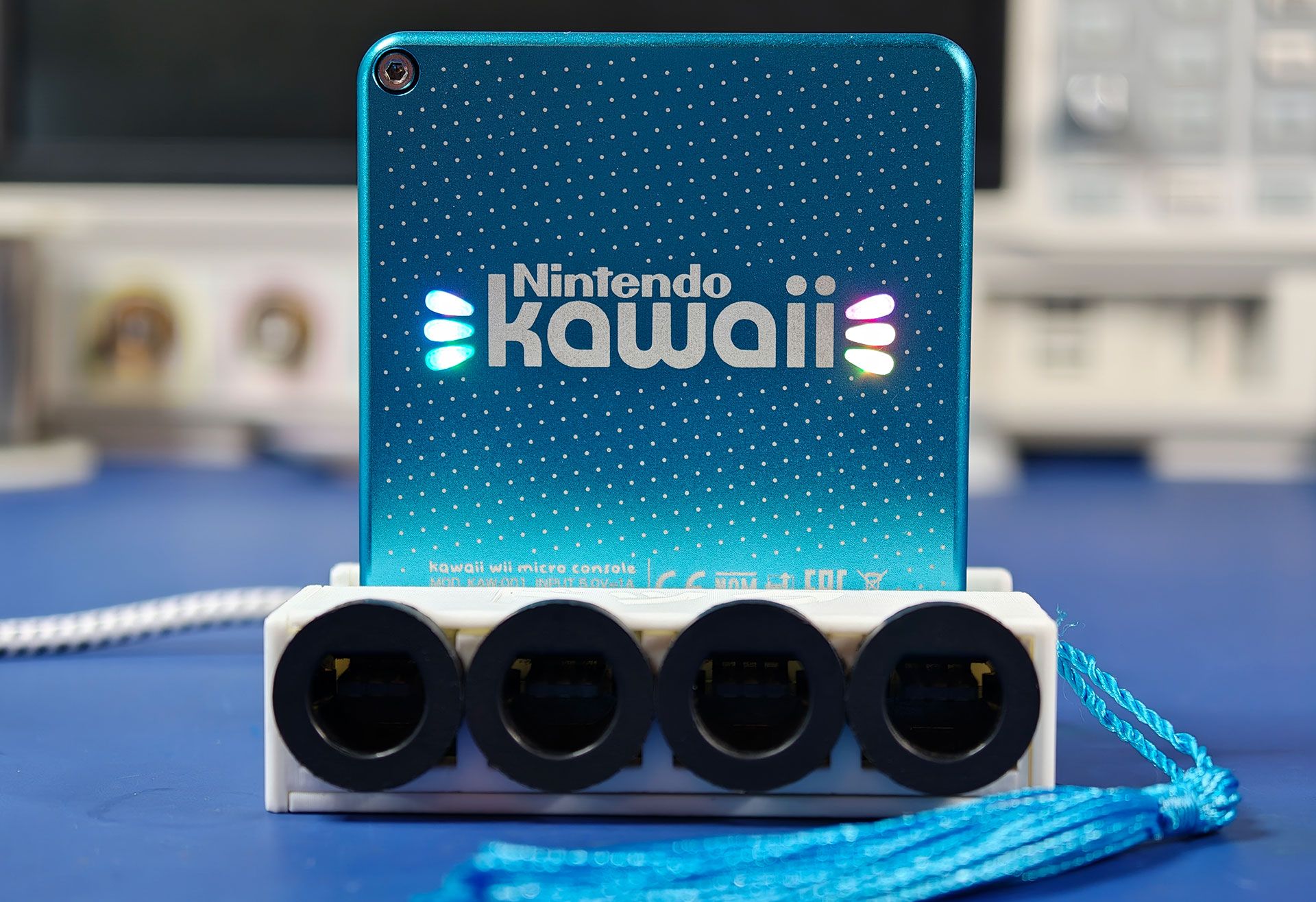
But you will need the dock which is bigger than the ‘console,’ a controller, a power supply, and a TV, of course.
When you purchase through links on our site, we may earn an affiliate commission. Here’s how it works .
Watch On In the above video, Tito from retro gaming channel Macho Nacho Productions goes hands-on with an original Nintendo Kawaii as created and fabricated by YveltalGriffin, Wesk and Ding . At the heart of this project is not the Raspberry Pi Zero , or similar, you might typically expect. Instead, the Kawaii relies on original Nintendo-used processors and ICs.
Vintage Nintendo console lovers will be aware that the firm’s Wii retained backward compatibility with the GameCube. Because of the former’s renowned extreme trimmability among the modding community a trimmed Wii motherboard is used in this project. Specifically, the Kawaii packs in the Omega Trim Wii. The GitHub source doesn’t compare the original and Omega motherboards, but the video shows the original GameCube next to the Kawaii.
You may like Nintendo's Game & Watch hacked and turned into retro emulation beast This must-have miniature Macintosh retro dock gives your M4 Mac Mini a 1980s makeover DIY NES-SY2.0 synthesizer plays chip tunes and NES cartridges, too Other tech tweaks to make this a successful project include the NAND Flex mods, to stack certain motherboard features / ICs. Then, the Thundervolt mod is used to undervolt the CPU so it doesn’t boil in the confined case. Thankfully the Wii processors can still handle GameCube titles with aplomb, even when power constrained.
A nice touch in this build is the CNC aluminum shell which elevates the finished look above similar projects, and on one side we’d like to think the organically ribbed metal fins might help a little with the passive cooling. It is still gratifying here to have original silicon to run your GameCube (and some Wii games that work with GC controllers) titles. Users are expected to load games onto a microSD card . One drawback of this neat design is the flash card becomes captive with the case assembled.
(Image credit: Kawaii project on GitHub) (Image credit: Kawaii project on GitHub) Clearly, the Kawaii isn’t a self-contained console. It has an elegant docking method, though, with discrete pogo pins. The dock actually looks larger than the keychain, and then you’ll need the hefty GameCube controller, a USB power brick, two sets of dongles, and a TV to plug it into.
Though the GitHub page is complete with MCAD, ECAD, and BOM files, the team hasn't gotten around to putting together instructions. Those wishing to replicate this meisterwerk are directed to a thread on BitBuilt that follows the assembly of two Kawaiis.
Get Tom's Hardware's best news and in-depth reviews, straight to your inbox.
Key considerations
- Investor positioning can change fast
- Volatility remains possible near catalysts
- Macro rates and liquidity can dominate flows
Reference reading
- https://www.tomshardware.com/video-games/nintendo/SPONSORED_LINK_URL
- https://www.tomshardware.com/video-games/nintendo/keychain-size-gamecube-uses-genuine-nintendo-silicon-system-also-includes-a-dock-design-shared-to-github#main
- https://www.tomshardware.com
- No Need for Space Gear — Capcom’s ‘PRAGMATA’ Joins GeForce NOW on Launch Day
- OpenAI’s New GPT-5.5 Powers Codex on NVIDIA Infrastructure — and NVIDIA Is Already Putting It to Work
- Strength and Destiny Collide: ‘Samson: A Tyndalston Story’ Arrives in the Cloud
- Retailer selling broken RTX 5090 GPUs for as low as $1,760 — GPUs were damaged during transport, but include all components on the PCB
- The Pentagon announces AI deals with OpenAI, Google, Microsoft, Amazon, Nvidia, and more — LLMs to be deployed on classified Department of War networks ‘for law
Informational only. No financial advice. Do your own research.