
When you purchase through links on our site, we may earn an affiliate commission. Here’s how it works .
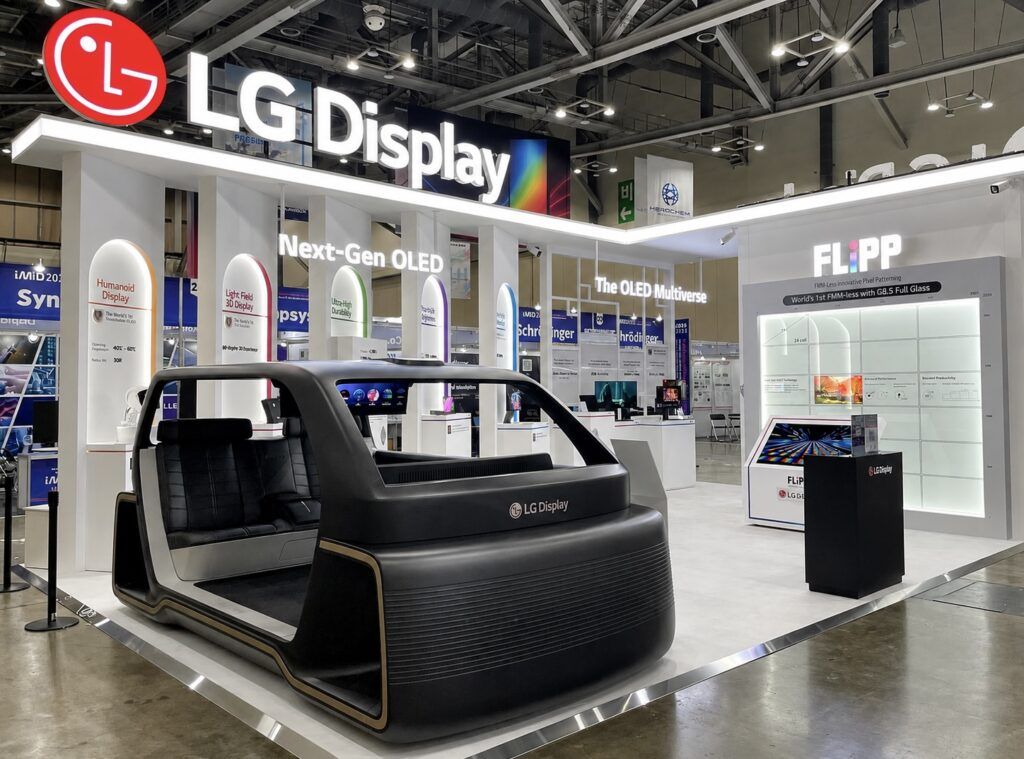
The main benefit of FLiPP is how it increases the subpixel surface area in an OLED stack. Instead of the metal mask taking up space, the subpixels are spread out much closer to each other, which improves their "aperture ratio" by up to 55%. In reality, that translates to 1.6x brighter panels with 2.4x longer lifespans . Since the panel doesn't have to work as hard to drive the pixels, its power consumption drops by 13% as well.
A metal mask is also heavy and can thus sag in the middle, leading to panel uniformity or color blending issues. It's expensive to make, too, because it features tiny holes that scale up in precision depending on resolution and size. FLiPP eliminates those constraints entirely, as it can, in theory, produce panels ranging from 1-100 inches for a broad range of devices and applications with any resolution in mind.
For instance, whenever new panel tech emerges , a new metal mask needs to be created to specifically accommodate its subpixel layout. A majority of the OLED materials are wasted during the stencil process; only about 30% make it through the stencil on the motherglass. Moreover, the motherglass needs to be cut in half for larger displays because of the mask's unstable structure just so be joined back together after deposition.
FLiPP uses a process akin to semiconductor manufacturing where UV light reacts with a photoresist layer through a micron-sharp photomask. A bed of organic material, such as the red subpixels, is first deposited, and a photoresist layer is applied on top. The UV changes the chemical bonds of the areas that should have red subpixels, hardening and locking them into place. The glass then goes through a chemical bath to dissolve away everything else.
LG's large OLED panels get world's first Intertek certification for "perfect" color and brightness
LG enters chip packaging arena with Laser Direct Imaging machine, as TSMC's CoWoS remains constrained
MSI's new flagship QD-OLED monitor can switch between 4K 360Hz, 1440p 520Hz and 1080p 680Hz
The process is repeated for the green and blue subpixels until the desired layout is achieved. LG says this method utilizes 64% more of the motherglass when producing laptop-sized panels, leading to less wastage, which will make displays cheaper. The company has already internally produced an OLED panel that used an entire 8.5-Gen motherglass through FLiPP, which measures at 2,200mm x 2,500mm.
LG is currently looking to apply FLiPP to its RGB OLED technology, which means self-emissive red, green, and blue subpixels will be deposited directly onto a motherglass. Otherwise, in Samsung's QD-OLED and LG's WOLED, white (or blue) LEDs pass through color filters to produce red, green, and blue, instead. Therefore, the combination of RGB OLED and FLiPP could lead to panels with exceptional color volume and gamut coverage — traditionally weaknesses of OLED.
Get Tom's Hardware's best news and in-depth reviews, straight to your inbox.
Key considerations
- Investor positioning can change fast
- Volatility remains possible near catalysts
- Macro rates and liquidity can dominate flows
Reference reading
- https://www.tomshardware.com/monitors/SPONSORED_LINK_URL
- https://www.tomshardware.com/monitors/lg-display-introduces-new-oled-deposition-technique-that-uses-lithography-instead-of-metal-masks-flipp-photolithography-delivers-1-6x-brightness-and-2-4x-longer-lifespan#main
- https://www.tomshardware.com/membership
- You can now buy a delidded Ryzen 9 9950X3D2 Dual Edition for $1,403 — stripped dual-cache offering is $500 more expensive than regular version
- Why Scaling AI Compute Performance Requires a New Power Architecture
- Samsung raises advanced foundry prices by up to 15% as AI demand fills its 4nm lines, report claims — Chinese customers accepting the largest hikes
- The supercomputer race no longer means what it used to, as rankings lose relevance in the AI era — as privately held compute clusters are built, running HPL bec
- Synopsys validates a PCIe 6.0 PHY inside a face-to-face 3D stack at 64 GT/s — says it got there by pulling apart an existing 2D test chip
Informational only. No financial advice. Do your own research.