
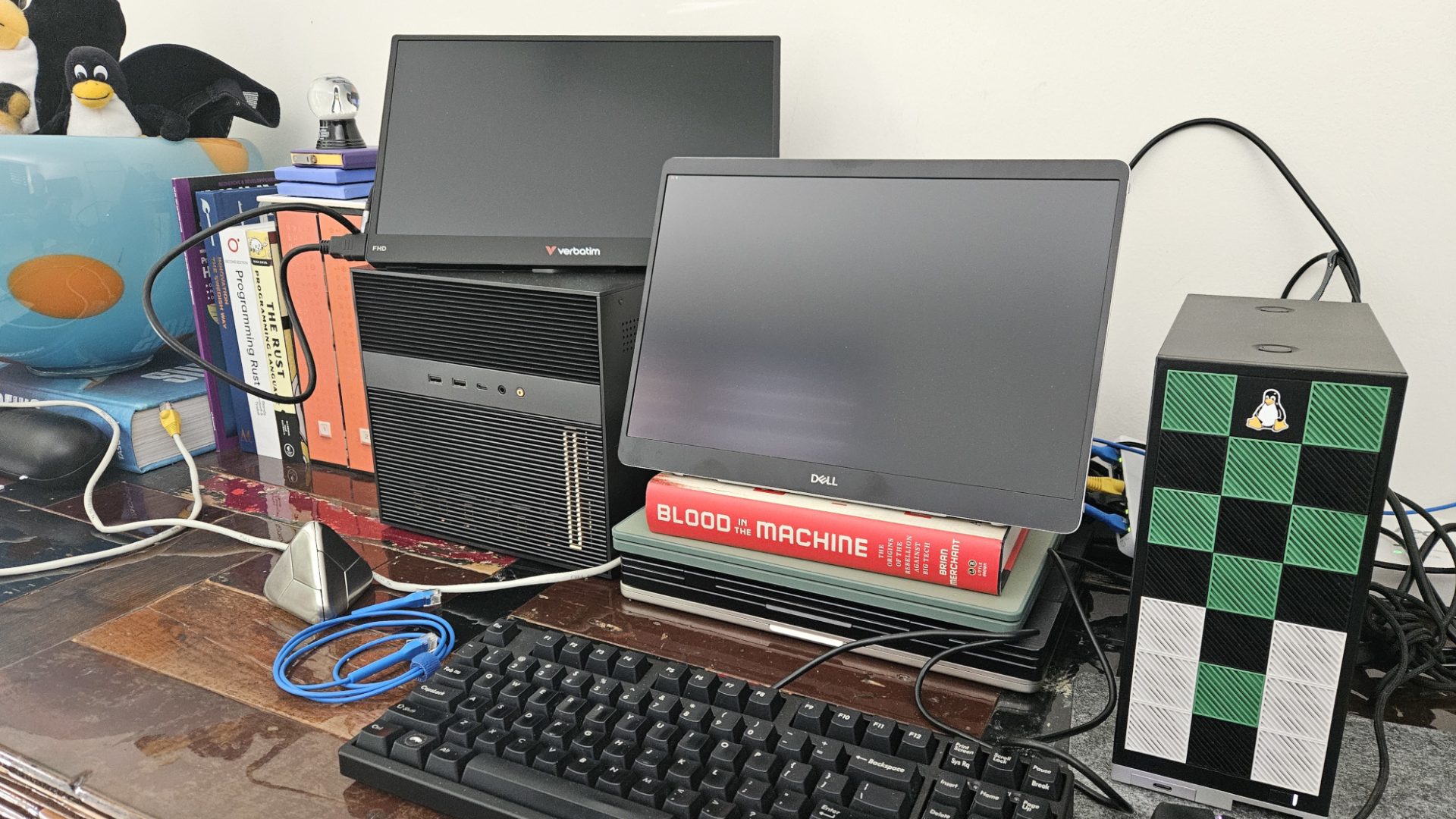
Greg Kroah-Hartman's "Clanker T1000" runs entirely on AMD Ryzen AI Max+ hardware.
When you purchase through links on our site, we may earn an affiliate commission. Here’s how it works .
Greg Kroah-Hartman, the Linux kernel's stable branch maintainer, who is widely regarded as second only to Linus Torvalds in the project's hierarchy, posted a photo to Mastodon on Friday showing the hardware behind his AI-assisted bug-finding tool, dubbed a "clanker."
The setup, which Kroah-Hartman has dubbed "gkh_clanker_t1000," is a Framework Desktop powered by AMD's Ryzen AI Max+ "Strix Halo" processor, running a local large language model to hunt down kernel bugs without relying on any cloud infrastructure, as first reported by Phoronix .
Since April 7, close to two dozen patches assisted by the Clanker T1000 have been merged into the mainline Linux kernel, addressing bugs across a range of subsystems, including ALSA, HID, SMB, Nouveau, and IO_uring. Kroah-Hartman first began testing the tool against the kernel's ksmbd and SMB code earlier this month, choosing that subsystem because it was straightforward to set up and test locally using virtual machines.
You may like Linux lays down the law on AI-generated code, says yes to Copilot, no to AI slop, and humans take the fall for mistakes AMD VP uses AI to create Radeon Linux userland driver in Python Anthropic's latest AI model identifies 'thousands of zero-day vulnerabilities' in 'every major operating system and every major web browser' The patches carry a Git tag reading "Assisted-by: gregkh_clanker_t1000," and Kroah-Hartman has been up-front about the need for human verification, writing in the patch submission that the patches "pass my very limited testing here," adding "please don't trust them at all and verify that I'm not just making this all up before accepting them."
The tool doesn’t write kernel code but instead acts as a fuzzer, bombarding code with unexpected inputs to expose crashes, memory errors, and other latent bugs. Kroah-Hartman then reviews what it finds, writes fixes, and takes full responsibility for the submitted patches.
The Framework Desktop is a 4.5-liter Mini-ITX system built around AMD's Ryzen AI Max+ 395, which pairs 16 Zen 5 CPU cores with 40 RDNA 3.5 compute units and up to 128 GB of unified LPDDR5x memory accessible to both the CPU and GPU. That large shared memory pool makes it capable of running sizable language models locally, a task that would typically require either a high-end discrete GPU with substantial VRAM or a cloud API.
Kroah-Hartman has not disclosed any details about the software stack powering the Clanker T1000, and the emergence of the tool follows the Linux project’s formal adoption of an AI code policy earlier this month, which permits AI-assisted contributions provided developers use an "Assisted-by" disclosure tag and accept full personal liability for any code they submit.
Get Tom's Hardware's best news and in-depth reviews, straight to your inbox.
Key considerations
- Investor positioning can change fast
- Volatility remains possible near catalysts
- Macro rates and liquidity can dominate flows
Reference reading
- https://www.tomshardware.com/software/linux/SPONSORED_LINK_URL
- https://www.tomshardware.com/software/linux/linux-kernels-second-in-command-uses-framework-desktop-to-hunt-bugs-with-local-ai#main
- https://www.tomshardware.com/subscription
- Turtle Beach's new mouse has a 2.25-inch touchscreen and hotswap batteries that last 15 hours apiece — 'MC7' costs $160, part of company's new Command Series pe
- SoftBank subsidiary working with Intel to develop radical new ZAM memory is now receiving Japanese gov't subsidies — new memory designed as a lower-power HBM fo
- US Navy tests laser weapon that shoots down drones on the USS George H.W. Bush supercarrier — ‘system tracked, engaged, and neutralized multiple target drones,’
- Intel stock jumps 28%, setting a record, after it posts strong Q1 with rising forecasts — Intel says yields are improving faster than expected with new nodes
- NVIDIA and Partners Showcase the Future of AI-Driven Manufacturing at Hannover Messe 2026
Informational only. No financial advice. Do your own research.