
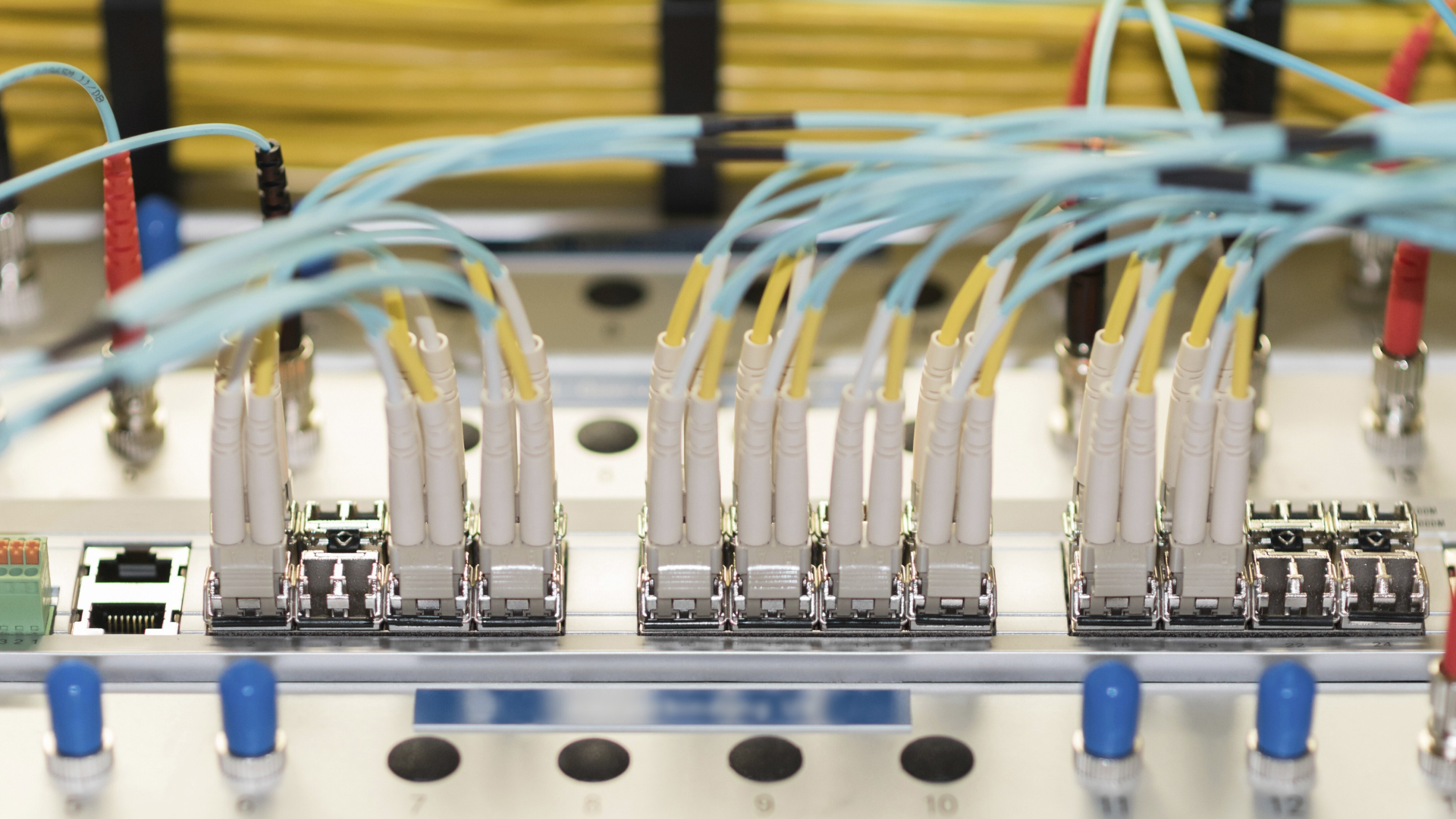
“It really threatens to arguably grind (the data center rollout) to a halt,” ITI Executive Vice President of Policy and General Counsel John Miller said. He also added, “Those chips, without optical transceivers, literally could just sit there waiting around unutilized until you actually have the transceivers to essentially connect them together,” referring to the AI chips that data centers use.
Optical transceivers are tiny modules plugged into hardware that convert their electrical signals into light signals, allowing data to be transmitted as light pulses across fiber optics. Data centers increasingly use optical transceivers and fiber optics to transmit data between AI GPUs and server racks, as they’re faster, offer lower latency, require less power, and generate less heat compared to traditional copper connections. However, Chinese companies currently supply 66% of the global market, meaning banning them from supplying data centers in the U.S. would more than halve the available supply, thereby exacerbating the various shortages that have been pummeling the industry .
However, there are concerns that some of these transceivers could be compromised by Beijing and be used to steal data, install malware, or remotely disrupt American data centers, which is why the FCC is considering the restriction, just like how it banned Huawei from the U.S. telecommunications network. But unlike Huawei, which had many established competitors in the telecommunications hardware industry, only two U.S.-based companies produce optical transceivers that data centers need — Coherent and Lumentum. While these firms could produce optical transceivers to compete with Chinese offerings, they simply do not have the scale to make up for the shortfall if the FCC bans Chinese imports today.
One compromise floated by the Trump administration is that it would only ban Chinese optical transceivers capable of hitting 3.2 terabits per second. While this technology already exists, its production isn’t expected to expand until 2028, with installation not beginning until 2029. This should give American producers time to ramp up their own output, although the suggestion is still under consideration.
Amazon warns $68 billion in blocked data centers threatens US AI lead
Key considerations
- Investor positioning can change fast
- Volatility remains possible near catalysts
- Macro rates and liquidity can dominate flows
Reference reading
- https://www.tomshardware.com/tech-industry/policy/SPONSORED_LINK_URL
- https://www.tomshardware.com/tech-industry/policy/microsoft-lobbies-against-potential-ban-on-chinese-optical-networking-gear-for-ai-data-centers-as-fcc-mulls-restricting-imports-industry-group-says-move-could-grind-data-center-rollout-to-a-halt#main
- https://futureplc.com/privacy-policy/
- 3,500 laser-armed AI submarine drones patrol Norwegian salmon farms, killing sea lice and protecting 112 million fish
- Nvidia RTX PRO 6000 user’s cables almost melted, even when limited to 500W
- Into the Omniverse: How Developers Turn Ideas Into Simulations With Frontier AI Agents
- Linus Torvalds says that AI fixes drove most of the progress in latest Linux kernel
- NVIDIA Expands Open Source Commitment With OpenShell Donation and New AI Infrastructure
Informational only. No financial advice. Do your own research.