
When you purchase through links on our site, we may earn an affiliate commission. Here’s how it works .
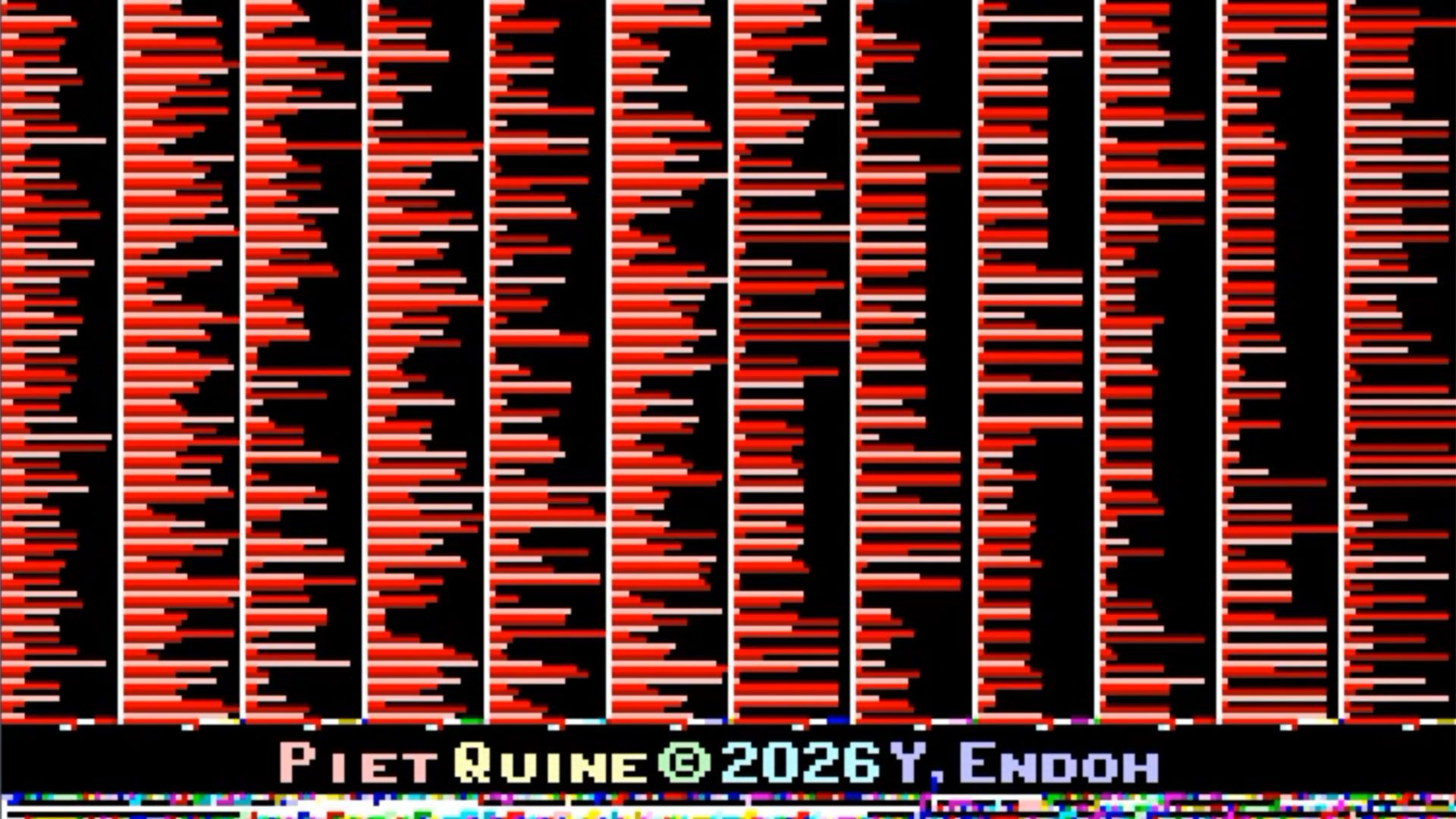
If you haven’t quite grasped the enormity of this feat from the title, it is worth breaking down the respective definitions of both Piet and Quine in a computer programming context. Piet is an esoteric programming language in which programs look like complex, colorful, tiled artwork. Inventor David Morgan-Mar named it after Piet Mondrian, the famous founder of the neoplasticism artistic movement. Such artwork is immediately recognizable with its bold squares and rectangles bordered by heavy black lines. Smaller Piet GIFs look a bit more Mondrian-y to me, but also look more like colorful QR codes than paintings.
Watch On Endoh has created a Quine, graphically. In computer coding, a Quine is a program that produces a copy of its own source code without any external input. This can be quite a tricky feat, even when confined to the world of ASCII text. A requirement of this coding art is that the output is a character-for-character identical representation of the input. It must not simply read its own file to do the duplication task.
When merging the two ideas above, together, things get a whole lot more complicated. However, the top-linked blog and the embedded video shine a light on the task at hand and how Endoh succeeded. Specifically, the video shows Piet Quine running. The Piet interpreter scans the source GIF image in a ‘load data’ phase, followed by a read of the GIF file header and palette info. The challenge here, raising the task above text Quines, is that the GIF folds in binary data, compression, and an awkward flow – they must all be handled deliberately to end up with the desired result.
A key thing to understand about the source image is that it includes a separately interpreted data part, compressed with an adaptive run-length encoding, and a code part. Endoh says that they managed to actually first achieve this way back in 2009, but the GIF was very tall, so not ideal for visual appreciation. The developer decided to ask Claude Code to analyze and reconstruct the original script and build a ‘landscape’ Piet Quine. Even with AI's help, it wasn’t easy to refine the design to the compact finished GIF seen in this article and video. Only after much work on shrinking the visuals and coaching Claude was the GIF shoehorned into the finished 4:3 landscape image (252 x 189 pixels).
Pong game recompiles its own source code every frame
Key considerations
- Investor positioning can change fast
- Volatility remains possible near catalysts
- Macro rates and liquidity can dominate flows
Reference reading
- https://www.tomshardware.com/software/programming/SPONSORED_LINK_URL
- https://www.tomshardware.com/software/programming/mind-bending-self-replicating-gif-code-prints-an-exact-copy-of-itself-is-both-a-program-and-its-own-visual-output-champion-coder-shows-off-piet-quine-technique#main
- https://www.tomshardware.com/membership
- At AI Summit, South Korea Outlines Its AI Future With NVIDIA and Partners
- Built in Fort Worth: Wistron Opens Advanced Manufacturing Plant to Produce NVIDIA AI Systems
- Apple is taking OpenAI to court over alleged theft of trade secrets — ChatGPT maker suggests it doesn't want Cupertino's knowledge anyway
- Amazon’s new 7.65GW Texas AI data center power plant could become the largest source of CO₂ pollution in the US — custom 35-turbine gas plant authorized to emit
- NASA modded space station's laptops so everyone could use the same charger — standardizing ISS chargers eliminated useless weight and reduced failure points
Informational only. No financial advice. Do your own research.