
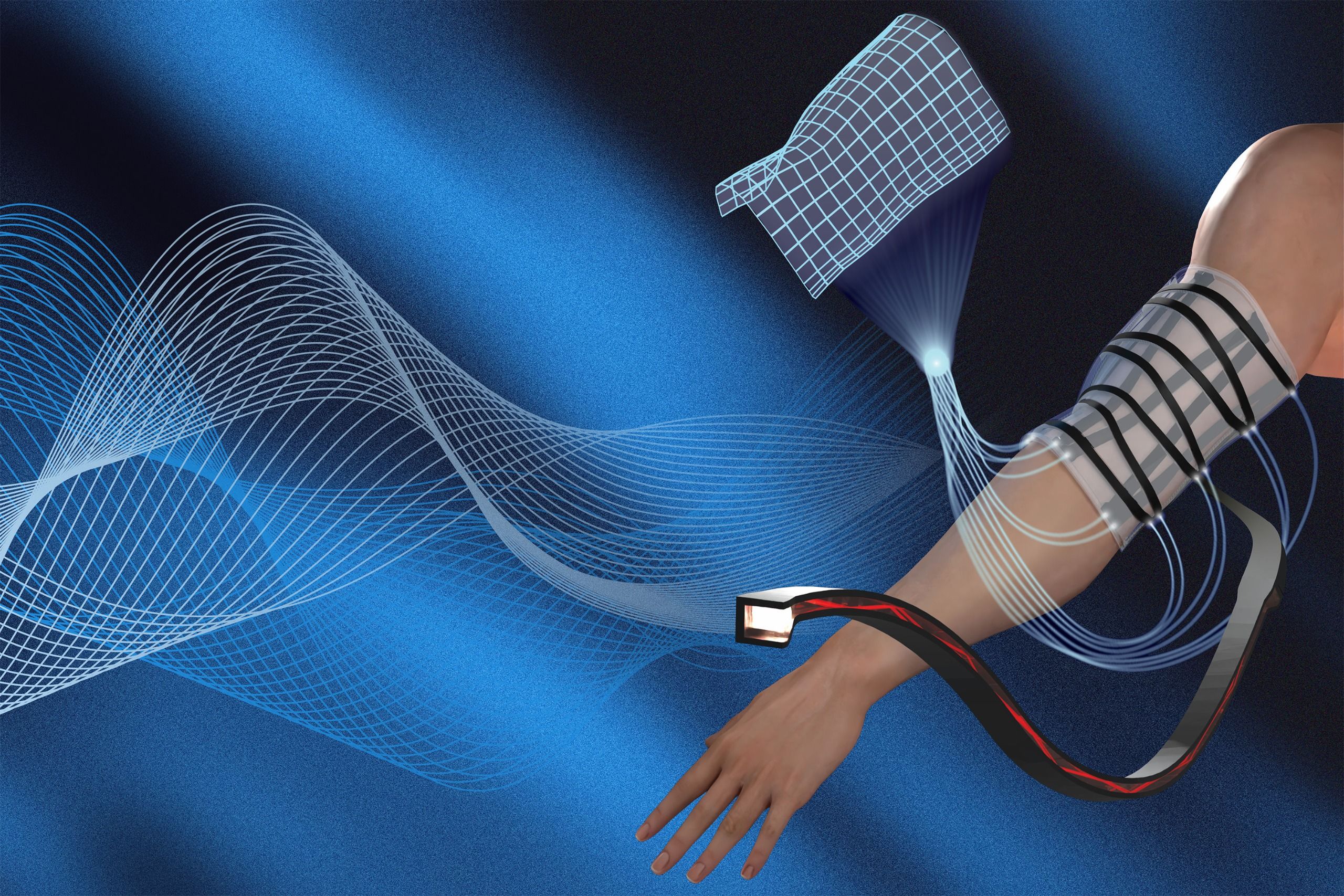
Although it still works with a few fibers cut, a garment would need many more, much thinner ones.
When you purchase through links on our site, we may earn an affiliate commission. Here’s how it works .
The news follows a paper, “Toward fully soft and multifunctional shape sensing via optical waveguide arrays,” recently published in Advanced Intelligent Systems . It details that the waveguides respond to bending in both directions, “bi-directional,” with the array laid out to discern shapes. Combined fiber responses mean fewer sensing elements are needed, and that can also improve damage resilience. The fibers respond to pressure, so they can sense external force, such as a press on the forearm in a physical therapy demo.
Normally, a plain fiber, a transparent core inside a light-trapping cladding, will have less light reach the far end when bent; measuring the light output helps measure the bend. MIT’s changes here include using a flexible rubber core instead of glass, with black-dyed cladding. One side is roughened intentionally so that bending the fiber toward that side, or toward the opposite side, causes different amounts of light to be lost. This enables directional sensing.
Many such fibers are embedded in a silicone sheet, with an LED at one end of each fiber and a light sensor at the other. The sensing surface is fully soft, but the sheet doesn’t stretch as a whole. An external circuit board handles the data collection with an algorithm translating it into a full sheet and 3D shape. The 14 waveguides are each 160 mm long in two layers of seven, zig-zagged within a 16 x 16 x 0.5 cm silicone sheet. The electronics remain at the edge, including analog-to-digital converters that feed microcontrollers over I2C. The reconstruction runs in MATLAB about three times a second, a rate that includes sensor sampling, data logging, and plotting.
To pick the layout, the team first simulated sheets with different waveguide arrangements: it generated the light output each fiber would give for a known shape, ran those readings through the reconstruction algorithm to estimate a 3D shape, and compared the estimate with the known one. One zig-zag spacing pattern had the closest fit. In simulations, between 3 and 20 waveguides per layer were used at angles of 0 to 35 degrees on six target shapes, with 10% added noise, over 30 trials each. The researchers discovered that angling the waveguides improved accuracy more than adding additional ones.
Meta Quest user vibe-codes 3D object throwing to 3D printer
Key considerations
- Investor positioning can change fast
- Volatility remains possible near catalysts
- Macro rates and liquidity can dominate flows
Reference reading
- https://www.tomshardware.com/virtual-reality/SPONSORED_LINK_URL
- https://www.tomshardware.com/virtual-reality/mit-engineers-build-soft-3d-shape-sensing-skin-for-gaming-and-vr-tracks-3d-movement-and-touch-with-sub-half-centimeter-error#main
- https://www.tomshardware.com/membership
- Why Telecom Operators Are Building Their AI Strategy on Open Models
- How NVIDIA GPUs Help Accelerate OpenAI’s GPT-6 Astra Ultrafast
- From Scan to Treatment Plan, AI Helps Close Breast Cancer’s Deadliest Gaps
- DJI’s first battery-swapping dock gets drones recharged and back in the air in under 45 seconds
- Dial Up the Cloud: NVIDIA DLSS 4.5 Controls Arrive on GeForce NOW
Informational only. No financial advice. Do your own research.