
When you purchase through links on our site, we may earn an affiliate commission. Here’s how it works .
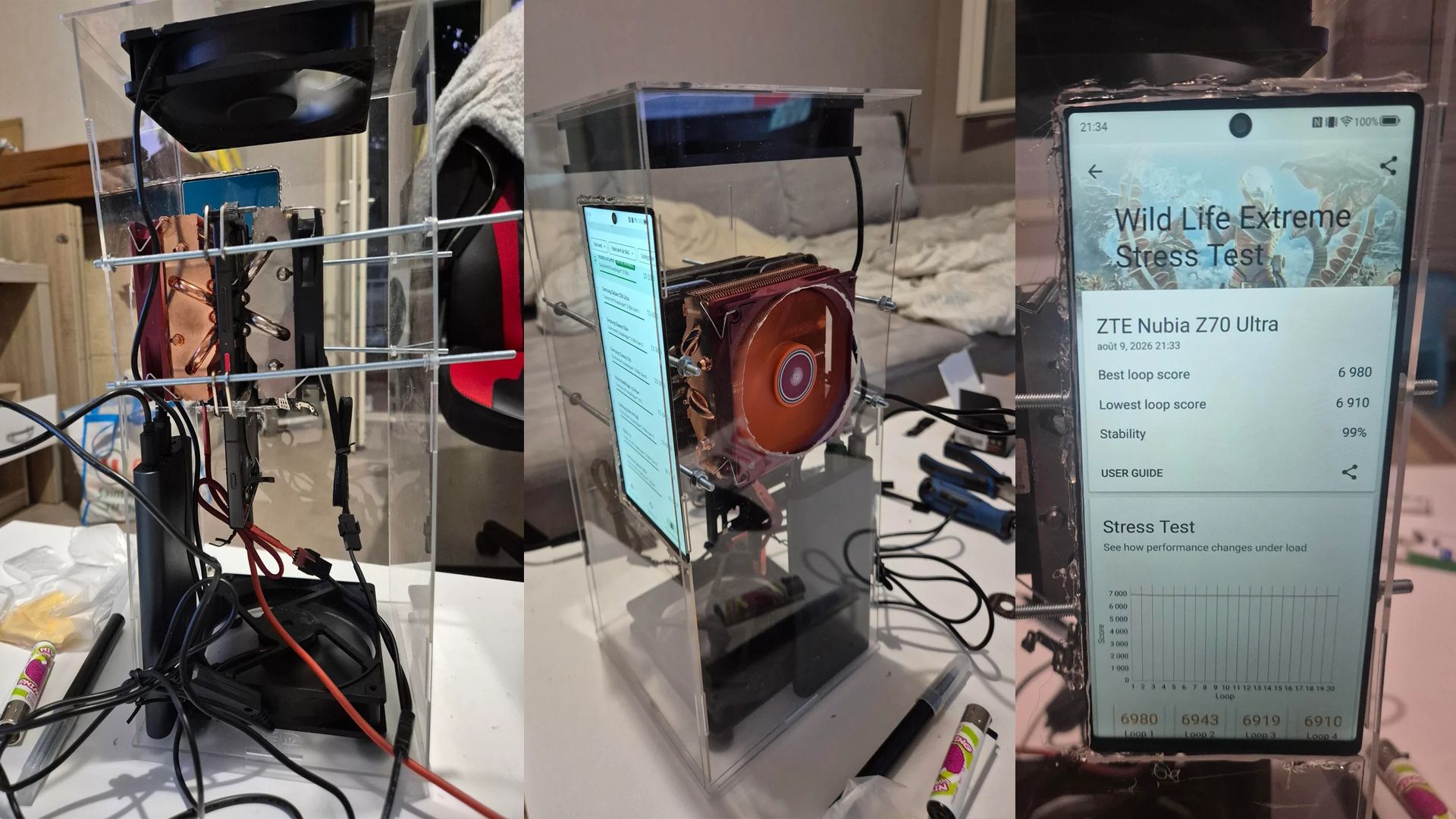
The smartphone chosen for this project is the ZTE Nubia Z70 Ultra, which is powered by Qualcomm's Snapdragon 8 Elite SoC paired with 24GB of LPDDR5X RAM and 1TB of UFS 4.0 storage. It is worth noting that this particular chipset made its debut in 2024, with its prime CPU cores rated to reach up to 4.32 GHz. The latest Snapdragon 8 Elite Gen 5 is a more powerful chip and can go as high as 4.6 GHz. Rather than using a newer, higher-clocked chip, the project is essentially testing how much sustained performance can be extracted from an older Snapdragon flagship.
“It actually started from a pretty simple idea," the creator told Tom's Hardware. "I wanted to see how far I could push the concept of using a single smartphone as my main machine, instead of having a phone, a gaming console and a separate PC.”
To carry out the project, the smartphone was completely stripped down to its core by removing the camera hardware, mobile network hardware, as well as the display, which is cleverly mounted within the custom acrylic enclosure for the system. The creator then mounted two full-size desktop CPU heatsinks on each side of the phone hardware. The contact plates on the heatsinks, being large enough, could fully cover the main components, thus allowing improved heat dissipation compared to the original phone chassis.
The results are particularly impressive when it comes to sustained workloads. In the 3DMark Wild Life Extreme stress test, the setup achieved a 99% stability score over 20 loops. Its best loop produced a score of 6,980, while the lowest-scoring loop came in at 6,910, which is a mere 70-point difference. A screenshot also shows a 3DMark score of 10,533 in the ranking, putting the modified Z70 Ultra slightly ahead of the Samsung Galaxy S25+ powered by the same Snapdragon 8 Elite chipset.
Crazed modder turns NAS into a gaming PC with RTX 5060 hanging from the side, boosts frame rate by 828%
Ingenious modder converts countertop ice machine into an RTX 3060 GPU cooler with a beer fridge thermostat
Custom-built passive water-cooled PC relies on convection chimney effect powered by triple-stacked radiators
The sustained performance is arguably more interesting compared to the peak benchmark numbers. Smartphones are designed around a difficult compromise where their processors can briefly operate at high performance levels. But due to the limited physical space for heat dissipation means sustained workloads eventually force the system to reduce clocks and power consumption.
“The long-term goal is basically one device that can cover Android, desktop Linux, Windows applications and PC gaming,” added the creator. Essentially, they wanted to keep Android at the core while having a desktop environment when connecting the setup to an external monitor, keyboard, and mouse. To achieve that, a custom Linux XFCE4 desktop environment was created using Termux, running directly on top of Android. The setup also supports hardware-accelerated Vulkan via Turnip on the Adreno GPU. Since the creator wanted to run Windows games locally on the Snapdragon hardware, they tinkered with Wine, Box64, and Hangover builds adapted and recompiled for the Linux environment, alongside GameNative.
Get Tom's Hardware's best news and in-depth reviews, straight to your inbox.
Key considerations
- Investor positioning can change fast
- Volatility remains possible near catalysts
- Macro rates and liquidity can dominate flows
Reference reading
- https://www.tomshardware.com/pc-components/cooling/SPONSORED_LINK_URL
- https://www.tomshardware.com/pc-components/cooling/modder-straps-two-desktop-cpu-coolers-to-zte-nubia-z70-ultra-turns-smartphone-into-a-gaming-pc-snapdragon-8-elite-soc-with-24gb-of-ram-runs-the-witcher-3-at-1080p-ultra#main
- https://www.tomshardware.com/membership
- Nvidia Jetson chip found in Russian cruise missile, Ukraine claims — presence in S-71 'Monochrome' weapon may indicate use of AI tech
- Nvidia doubles RTX PRO 6000 Blackwell's MSRP to a staggering $16,000 — 96GB card started pre-orders below $8,000 last year
- AMD borrows $4.75 billion for 'general corporate purposes' — company gives no insight into how it plans to spend cash injection
- PBS broadcaster loses access to 50TB of data comprising 70 years of TV history after contracted cloud storage vendor goes defunct — public TV channel sues Iron
- How optical interconnects and silicon photonics emerged as AI's next hot commodity — looming US-China summit puts photonics into the crosshairs
Informational only. No financial advice. Do your own research.