
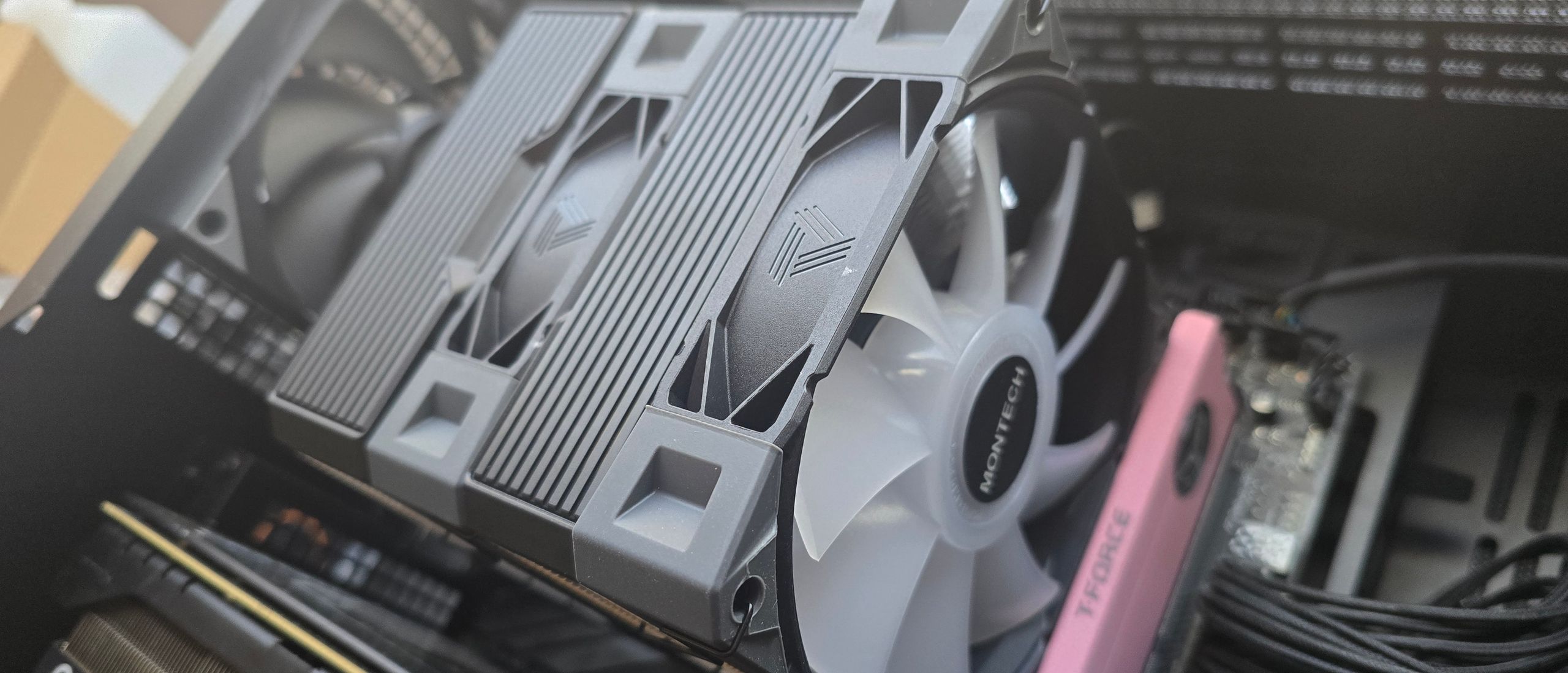
The color scheme of the NX600 model included in this review is black, grey, and silver, which might appeal to users who prefer old-school designs. There’s also a white option, shown below. ARGB and non-ARGB fan options are available with both heatsink designs, for about $5 more.
The top covers of the heatsink are mainly decorative, and can be removed if you so desire – as shown in the picture below.
Standard-height DDR5 sticks 40mm tall fit well under the NX600 with the E28 fans installed, but taller sticks won’t fit perfectly underneath. Our current CPU cooler test bench incorporates TeamGroup’s Sakura Rose T-Force Xtreem DDR5-7200 sticks, 48.8mm (1.92 inches) tall.
(Image credit: Tom's Hardware) (Image credit: Tom's Hardware) If you also use taller RAM DIMMs, you’ll have to raise the intake fan’s placement by a few millimeters for things to fit properly. This might result in slightly lower cooling performance in certain scenarios, particularly those where the fans’ speeds are limited to ensure lower noise levels.
The heatsink towers are protected by soft coverings and foam inserts, with the fans and accessories packaged in cardboard. Included in the package are the dual-tower heatsink, two high-performance E28 fans, mounting hardware for Intel and AMD platforms, fan clips, and a small tube of thermal paste.
You’ll need to first remove the default AM4/5 retention mechanism and then place the mounting studs around the exposed screw holes.
The next step is to place the mounting bars on top of the studs, securing them with the included screws.
Then, apply Montech’s thermal paste. If you’re not sure how to do that, we have a hadny thermal paste application guide that covers the different methods you can use. Afterwards, place the heatsink tower against the CPU and mounting bars, and use a screwdriver to secure it.
Once the heatsink is secured, attach the high-performance E28 fans to the cooling tower with the included clips. Lastly, connect the PWM and (optional) ARGB cables of the fans to the corresponding headers of your motherboard.
We’ve tested coolers with both the Ryzen 9950X3D and its non-V-Cache sibling, the 9950X. There are some differences in how the 9950X and 9950X3D CPUs are impacted by thermal events. While the heat output of the CCDs of AMD’s 9950X3D is relatively balanced, the 9950X I used has one CCD that runs much hotter than the other, with a difference of over 10 degrees Celsius in some scenarios, shown below.
We’ve since returned to using a 9950X3D for cooler testing, as it has a more balanced heat profile, and is almost certainly a more widely adopted CPU.
The benchmark results shared in these reviews may differ from others because I emphasize results that are comparable to real-world use. This means I generally test CPU coolers inside of a closed desktop case, which increases cooling difficulty compared to other testing methods.
Many reviewers test coolers on an open test benches, which have a combination of lesser airflow needs and lowered ambient temperatures. This results in making weak coolers appear stronger than they really are. Some publications have also used generic thermal plates to test cooling solutions. I reject both of these methods because they don’t accurately reflect real-world cooler conditions.
TeamGroup Diamond Rose T-Force Xtreem DDR5-7200
Key considerations
- Investor positioning can change fast
- Volatility remains possible near catalysts
- Macro rates and liquidity can dominate flows
Reference reading
- https://www.tomshardware.com/pc-components/air-cooling/SPONSORED_LINK_URL
- https://www.tomshardware.com/pc-components/air-cooling/montech-nx600-review#main
- https://www.tomshardware.com
- Memory price surge begins to cool as consumers hit affordability limit — AI demand still keeps DRAM and NAND prices climbing through Q3 2026
- Startup activates nuclear microreactor live on stage to power an Nvidia RTX Spark desktop PC — firm working with Nvidia to build a 30MW closed loop AI factory t
- HP has slashed $1,075 off this RTX 5070 gaming PC in its July 4 sale — Omen 35L with 32GB of RAM now just $1,724
- Intel expands production of photomasks in California: EUV and High-NA EUV in the focal point
- Joyride Through July With 12 Games Coming to GeForce NOW
Informational only. No financial advice. Do your own research.