
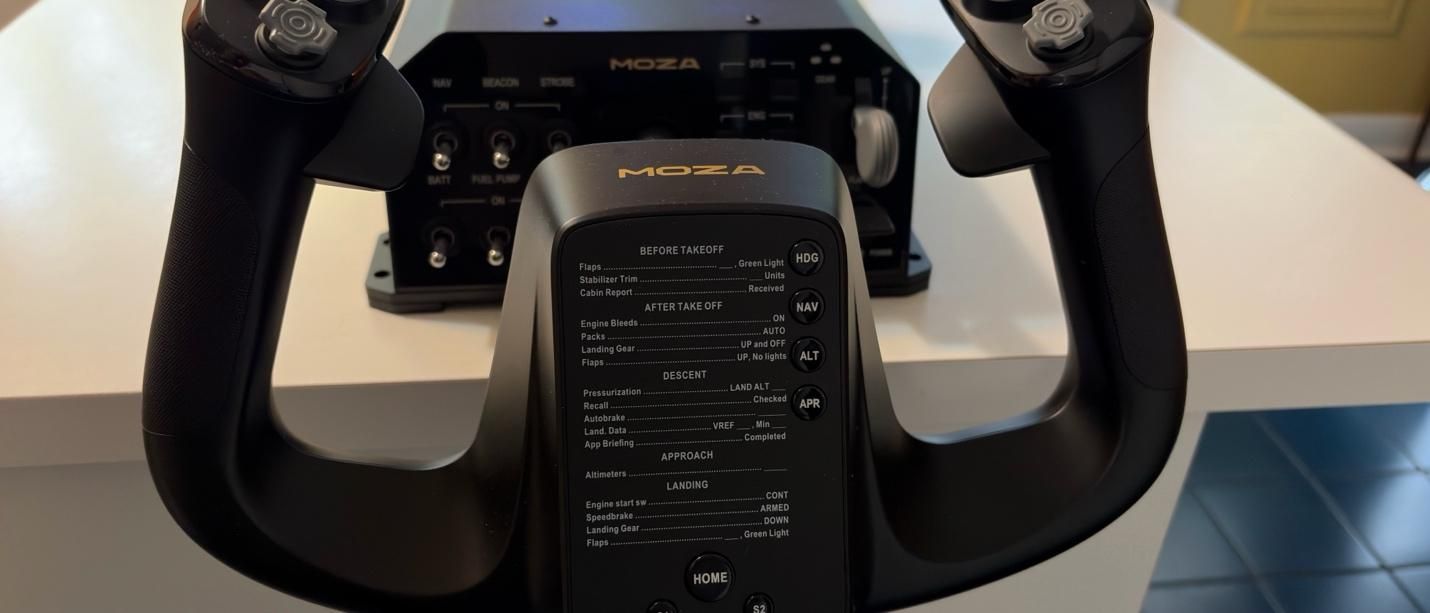
Basic maneuvering . Flying at 5,000 feet, we performed gentle turns and pitch changes to evaluate the precision of the base during small, accurate control inputs.
Turbulent approach . We performed an approach into Las Vegas under hot, windy conditions with strong updrafts and downdrafts. This scenario required larger, more frequent control inputs to assess how the base handles turbulence and rapid corrections.
Curved approach . Finally, we flew the RNAV Visual approach to Runway 1R at San Francisco International Airport. This approach is available in MSFS 2024 if you use the Navigraph database, but it is missing the RF leg between the waypoints KLAUS and SQIRL, so we added it to the navigation database of the PMDG 737 and 777 ourselves. The procedure features a sweeping right-hand arc that continues until roughly one mile from the runway threshold, requiring the aircraft to remain in a turn at very low altitude. The approach demands precise tracking of the flight path while also requiring a smooth, accurate transition to the runway centerline after the final waypoint. This scenario tested both the precision and responsiveness of the AY210 Base.
Basic maneuvering feels precise and smooth with the right settings. That last part is important, however, because the AY210 does not necessarily deliver this experience out of the box. Based on our previous experience with a 737 simulator, even with significant pitch input, the control column should maintain a smooth and consistent feel throughout its movement. With the AY210, we found that the motion could feel less natural and “sticky” unless Pitch Friction Correction was enabled in the MOZA Cockpit Software. Fortunately, this setting significantly improves the feel, giving the control column a response that is much closer to what we experienced in a 737 simulator.The 280 MHz processor and 15-bit high-resolution magnetic encoder also contribute to the AY210’s precise and responsive inputs. We were able to make accurate turns and precisely set our desired descent rate, with even small control inputs translating smoothly and predictably into the simulator.
Here, we perform our usual turbulent approach, landing in Las Vegas during the summer. The combination of extreme heat, strong winds, and thermals along the approach path can create significant turbulence, making for a much less stable approach. Microsoft Flight Simulator 2024 is able to replicate these conditions through its Live Weather system, providing a challenging environment for testing the AY210.
The level of immersion provided by the AY210 is simply incredible. Through the force feedback system, you can feel the effects of wind and turbulence directly through the yoke, rather than relying solely on visual cues or the aircraft’s instruments. This provides useful feedback that helps you anticipate and make the necessary control corrections. The AY210 handled these conditions exceptionally well, accurately conveying the changing forces throughout the approach and giving us a much better sense of how the aircraft was responding.
The RNAV Visual approach to Runway 1R at San Francisco International Airport contains an RF leg between the final two waypoints – KLAUS and SQIRL – which is a sweeping right-hand arc. The AY210 was responsive and precise throughout, allowing us to follow the arc all the way to SQIRL, at which point we were able to accurately align with runway 1R and perform a smooth landing.
By comparison, the Thrustmaster TCA Boeing Yoke felt noticeably jerkier throughout the approach. The two products are also in completely different price tiers, so this is not necessarily a direct or entirely fair comparison. However, the TCA Boeing Yoke is a popular choice among simmers flying Boeing aircraft in Microsoft Flight Simulator, making it a useful reference point. The difference was immediately noticeable, and the AY210’s ability to provide smoother, more natural control while conveying the effects of turbulence is a clear example of what you gain from its more premium design and force feedback system.
The MOZA AY210 Force Feedback Yoke Base delivers one of the most immersive experiences available in desktop flight simulation. It comes at a premium price, but after spending time with the AY210, it is genuinely difficult to go back to a yoke without force feedback. The combination of realistic feedback, precise control, and the level of detail conveyed through the yoke adds an entirely new dimension to the flying experience.
It is not without its flaws. Some of the force feedback effects could be stronger, while the control column can feel slightly unnatural and “sticky” out of the box. Fortunately, both issues can be addressed to some extent through the extensive customization options in MOZA Cockpit Software.
Dan Mateescu Social Links Navigation Contributor Dan Mateescu is a PC enthusiast with many years of experience benchmarking PC hardware. In 2021, he started his own YouTube channel called 'Compusemble' where he benchmarks hardware in video games and the latest tech demos.
Key considerations
- Investor positioning can change fast
- Volatility remains possible near catalysts
- Macro rates and liquidity can dominate flows
Reference reading
- https://www.tomshardware.com/peripherals/controllers-gamepads/SPONSORED_LINK_URL
- https://www.tomshardware.com/peripherals/controllers-gamepads/moza-ay210-force-feedback-base-and-mfy-yoke-review#main
- https://futureplc.com/privacy-policy/
- Linus Torvalds posts his first AI-assisted patch to the Linux kernel, synthetic test clocks 23x performance leap
- Elon Musk calls out memory makers over 'extortionate' chip pricing, says Micron is playing smart for long-term loyalty
- Sipeed reveals Chinese-made DGX Spark and Ryzen AI Halo rival, expected to cost $3,999
- Leap seconds being retired next year to avoid wreaking havoc on computer systems
- Nvidia reportedly insists the RTX 5090 isn't dead despite severe shortages and removed listings at multiple retailers
Informational only. No financial advice. Do your own research.