
The earliest signs that Anthropic was struggling to keep up with the computing demands of its growing user base were the increasingly aggressive usage limits placed across Claude’s services. Free users frequently complained about rapidly exhausting tokens — the units Claude assigns for processing tasks. However, the restrictions extended beyond the free tier. Paid Pro, Max, Team, and Enterprise users also regularly encountered message caps, peak-hour throttling, API rate limits, and strict time-based usage ceilings on Claude Code sessions, particularly during periods of heavy demand.
It was clear that Anthropic was running out of inference capacity. While training an AI model is an expensive, one-time computational undertaking, serving that model to millions of users simultaneously creates a continuous, round-the-clock demand for compute that scales directly with every new user and every new query. The apparent solution is to build more data centers, which Anthropic is apparently pursuing via massive gigawatt deals with Amazon , Google , Microsoft , and Nvidia.
However, modern hyperscale AI data centers can cost tens of billions of dollars and take years to build. Utilities are increasingly struggling to supply sufficient electricity for AI projects, while land, transformers, cooling infrastructure, and high-end GPUs themselves remain constrained. There is also growing sentiment against AI infrastructure from local communities. We recently reported that a U.S. senator got physical with a reporter after a confrontation on a data center issue.
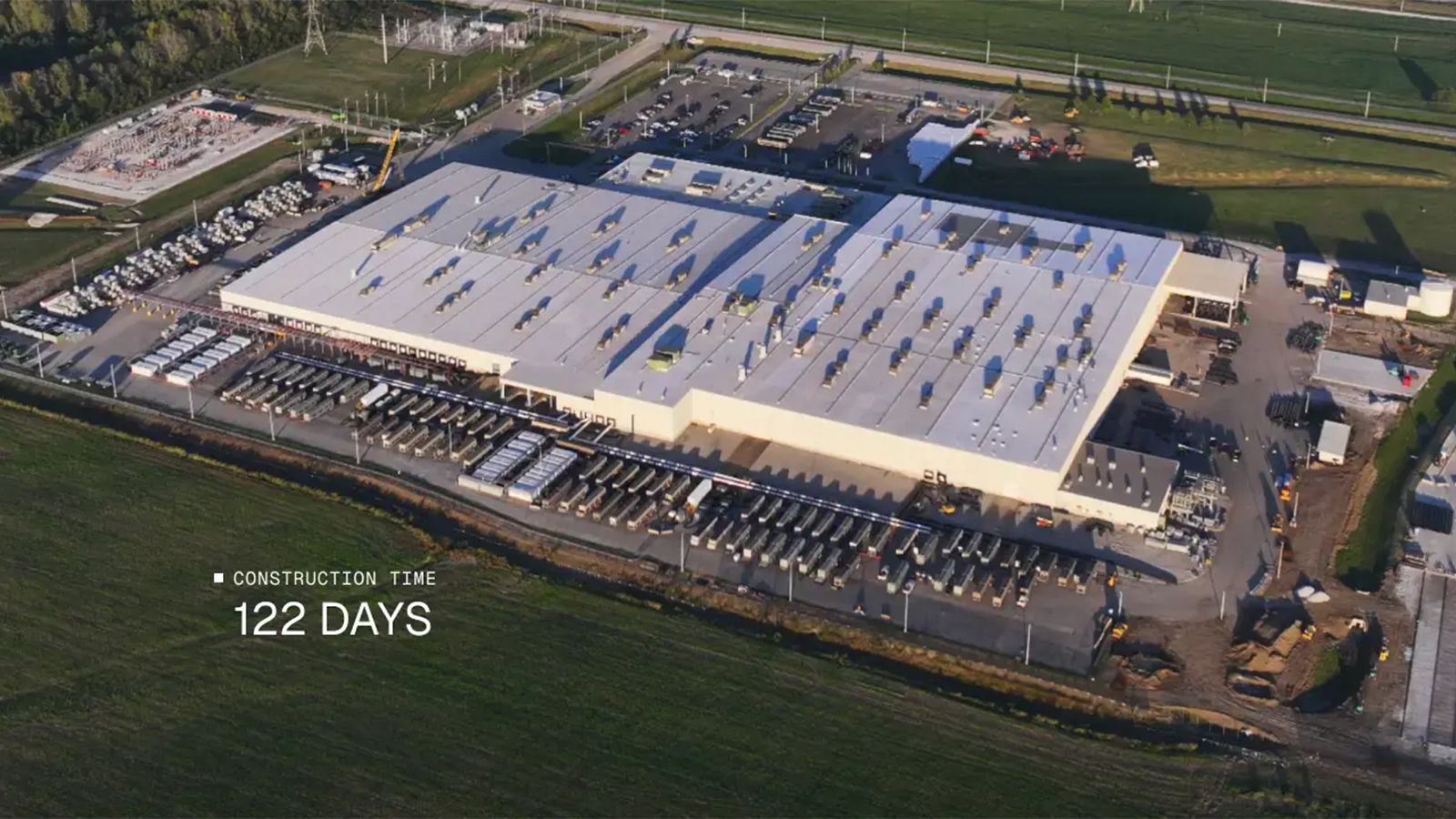
Anthropic's compute capacity problem was immediate and urgent, but the solution was significantly long-term. If only there were a massive AI supercluster with hundreds of megawatts of compute power just sitting there. Turns out there was: SpaceXAI’s Colossus 1. Following the deal, Colossus 1’s entire computing power now belongs to Anthropic — for now.
When Musk unveiled Colossus, it was framed as one of the clearest signs that xAI intended to compete seriously with OpenAI, Anthropic, and Google at the AI frontier. The Memphis-based cluster became famous for how quickly it was assembled. Tens of thousands of Nvidia GPUs were reportedly brought online in record time, eventually scaling to over 220,000 accelerators. Musk repeatedly boasted about xAI’s future compute ambitions, including plans to expand toward million-GPU-class systems through Colossus 2 .
So why does he seem to have wrapped the whole thing in a neat little bow and handed it over to Anthropic, xAI's rival? One possible answer is utilization. Reports suggest that Colossus 1 may have had more available capacity than Grok’s current user base required. However, according to a detailed report by Mirae Asset Securities — a major South Korean investment bank — the bigger utilization issue was architectural. Colossus 1 is a heterogeneous cluster, mixing roughly 150,000 H100s, 50,000 H200s, and 20,000 GB200s — three different generations of Nvidia silicon running under one roof. This was largely a byproduct of how fast xAI assembled the cluster, with different GPU generations coming online as supply allowed, rather than a deliberate design choice.
For AI training, the heterogeneous configuration creates a significant efficiency problem. Distributed training requires every GPU in the cluster to complete each computational step simultaneously before the system can advance. When the faster GB200 chips complete their work first, the entire cluster waits for the slower H100s to catch up — a well-known bottleneck known as the straggler effect. At 220,000 chips, this effect is exponential.
Anthropic's Claude Mythos might be the best overall AI model for cybersecurity but cheaper models can attain similar results, research shows
OpenAI has effectively abandoned first-party Stargate data centers in favor of more flexible deals
Oracle and OpenAI's Abilene expansion saga detailed: 600MW expansion gets scrapped, as larger 4.5GW agreement remains on track
As a result of these issues, xAI's real-world GPU utilization reportedly sat at just 11% — meaning 89% of the cluster's theoretical computing power was going to waste. For context, Meta and Google typically operate at 40% or above.
AI GPUs are not static assets that quietly sit on shelves, gaining value over time. They depreciate rapidly, consume enormous amounts of electricity, and require expensive maintenance and cooling infrastructure. Unused GPUs are effectively burning money.
From that perspective, Anthropic may have arrived at exactly the right moment. The company had exploding demand and an urgent need for ready-made compute, while SpaceX/xAI had a gigantic, not-so-great first-generation AI cluster. For Anthropic, however, the same cluster looked quite different. The company needed compute power for Inference — running queries through an already-trained model, which does not require the tight synchronization that training workloads demand. So, what was a structural inefficiency for xAI's training workloads is a workable infrastructure for Anthropic's inference needs.
Multiple reports suggest xAI is now heavily focused on Colossus 2, a far larger next-generation cluster reportedly aimed at gigawatt-scale AI infrastructure. Unlike Colossus 1's chaotic mix of chip generations, Colossus 2 is built entirely on Nvidia's Blackwell architecture — a homogeneous cluster where every GPU is identical. In a uniform cluster, every chip completes each training step at roughly the same time, allowing GPU utilization to theoretically surpass the range in which Meta and Google currently operate. xAI can also properly optimize its software stack for a single hardware generation rather than trying to serve three simultaneously.
According to the Mirae Asset report, xAI has already moved its core training workloads entirely onto Colossus 2, effectively treating Colossus 1 as a retired first-generation asset. In other words, Colossus 1 may have transitioned from "cutting-edge frontier training weapon" into a monetizable first-generation compute asset, while Musk continues to build towards xAI’s “takeover” with Colossus 2.
Musk has long treated his companies less like isolated entities and more like interconnected pieces of a broader ecosystem. Tesla technologies appear across SpaceX projects. SpaceX infrastructure supports xAI ambitions. xAI products increasingly feed into Musk’s wider platform strategy.
The deal also hints at another possibility: Musk could be positioning SpaceX/xAI as more of an AI cloud infrastructure provider. That would not be entirely surprising. xAI has already launched Grok Business and enterprise-focused offerings featuring APIs, security controls, audit logging, and corporate integrations. This also aligns with Musk’s reported plans for broader structural changes at SpaceX and xAI ahead of the company's upcoming IPO.
Earlier this year, Musk publicly attacked Anthropic and Claude, calling the company “misanthropic and evil.” Yet this week, he claimed he approved the deal after speaking with Anthropic executives and determining that “ no one set off my evil detector .”
Mirae Asset’s analysts attempted to estimate the value of the Anthropic deal, using estimated hourly lease rates for different Nvidia GPU types. The analysts projected that Colossus 1 could theoretically generate roughly $5–6 billion in annual revenue. That nearly perfectly offsets xAI's annualized net loss of approximately $6 billion as of Q1 2026, effectively pulling the company to breakeven in a single contract.
For Anthropic, the analysts applied CEO Dario Amodei's own publicly stated estimate that roughly half of all AI industry compute spending goes toward inference, and that inference compute converts to revenue at a 3x multiplier. On that basis, the $5 billion being directed toward inference capacity could generate approximately $15 billion in incremental ARR — a significant addition to Anthropic's already rapidly growing revenue base.
Another critical aspect of the announcement involved “orbital AI compute capacity” — basically, data centers in space . Granted, it does sound like science fiction marketing language. But it directly ties into a core problem both companies, alongside several other AI giants, are increasingly facing: AI infrastructure is beginning to outgrow terrestrial constraints. So when a joint announcement comes from the world's largest AI company and the company that built the world’s largest reusable rocket system and operates thousands of active satellites in orbit, you best believe we may soon have data centers floating around in space.
Despite Mirae Asset’s analysis, the factual financial details of the Colossus deal are not publicly available. However, Anthropic recently raised $30 billion in a Series G funding round, valuing the company at $380 billion . It would not be too wild a guess to say some of that cash may have gone into funding the Colossus agreement. Then again, the company said last month that its annualized revenue run rate had already surpassed $30 billion , highlighting the staggering scale at which Claude’s business is now operating.
xAI built Colossus 1 fast — too fast, it turned out. The resulting mixed GPU architecture created structural training inefficiencies that made the cluster hard to justify as a long-term platform. With Colossus 2 now operational and built properly on uniform Blackwell hardware, Colossus 1 became a first-generation asset in search of a better use.
Anthropic, with explosive demand and not enough compute, provided exactly that. The deal converts what was effectively a depreciating liability into roughly $6 billion in annual revenue — enough to bring xAI close to breakeven. For Anthropic, the same compute could unlock an estimated $15 billion in additional ARR. Both companies got what they needed, and Musk gets a compelling infrastructure story heading into a potential IPO.
Etiido Uko is a news contributor for Tom's Hardware covering the latest updates in big tech and the PC industry. He is a mechanical engineer and senior technical writer with over nine years of experience in documentation and reporting. He is deeply passionate about all things engineering and technology, and is an expert in gadgets, manufacturing, robotics, automotive, and aerospace. ","collapsible":{"enabled":true,"maxHeight":250,"readMoreText":"Read more","readLessText":"Read less"}}), "https://slice.vanilla.futurecdn.net/13-4-23/js/authorBio.js"); } else { console.error('%c FTE ','background: #9306F9; color: #ffffff','no lazy slice hydration function available'); } Etiido Uko Social Links Navigation News Contributor Etiido Uko is a news contributor for Tom's Hardware covering the latest updates in big tech and the PC industry. He is a mechanical engineer and senior technical writer with over nine years of experience in documentation and reporting. He is deeply passionate about all things engineering and technology, and is an expert in gadgets, manufacturing, robotics, automotive, and aerospace.
Key considerations
- Investor positioning can change fast
- Volatility remains possible near catalysts
- Macro rates and liquidity can dominate flows
Reference reading
- https://www.tomshardware.com/tech-industry/artificial-intelligence/SPONSORED_LINK_URL
- https://www.tomshardware.com/tech-industry/artificial-intelligence/musks-colossus-1-ai-supercomputers-inefficient-mixed-architecture-design-couldnt-be-used-to-train-grok-so-anthropics-using-it-for-inference-instead-musk-readies-unified-blackwell-only-colossus-2-for-frontier-training-and-potential-ipo#main
- https://www.tomshardware.com
- NVIDIA Spectrum-X — the Open, AI-Native Ethernet Fabric — Sets the Standard for Gigascale AI, Now With MRC
- Microsoft launches Cloud‑Initiated Driver Recovery for remote rollback of faulty updates — no user action or OEM intervention will be needed to handle broken dr
- Acer's monster 18-inch Predator Helios Neo 18 AI gaming laptop drops to $1799 — save $400 on this 5070 Ti desktop replacement
- ‘Your Career Starts at the Beginning of the AI Revolution,’ NVIDIA CEO Tells Graduates
- Intel Core Ultra 7 270K Plus drops below MSRP for the first time — grab the 24-core Arrow Lake Refresh chip for just $279 for a limited time
Informational only. No financial advice. Do your own research.