
When you purchase through links on our site, we may earn an affiliate commission. Here’s how it works .
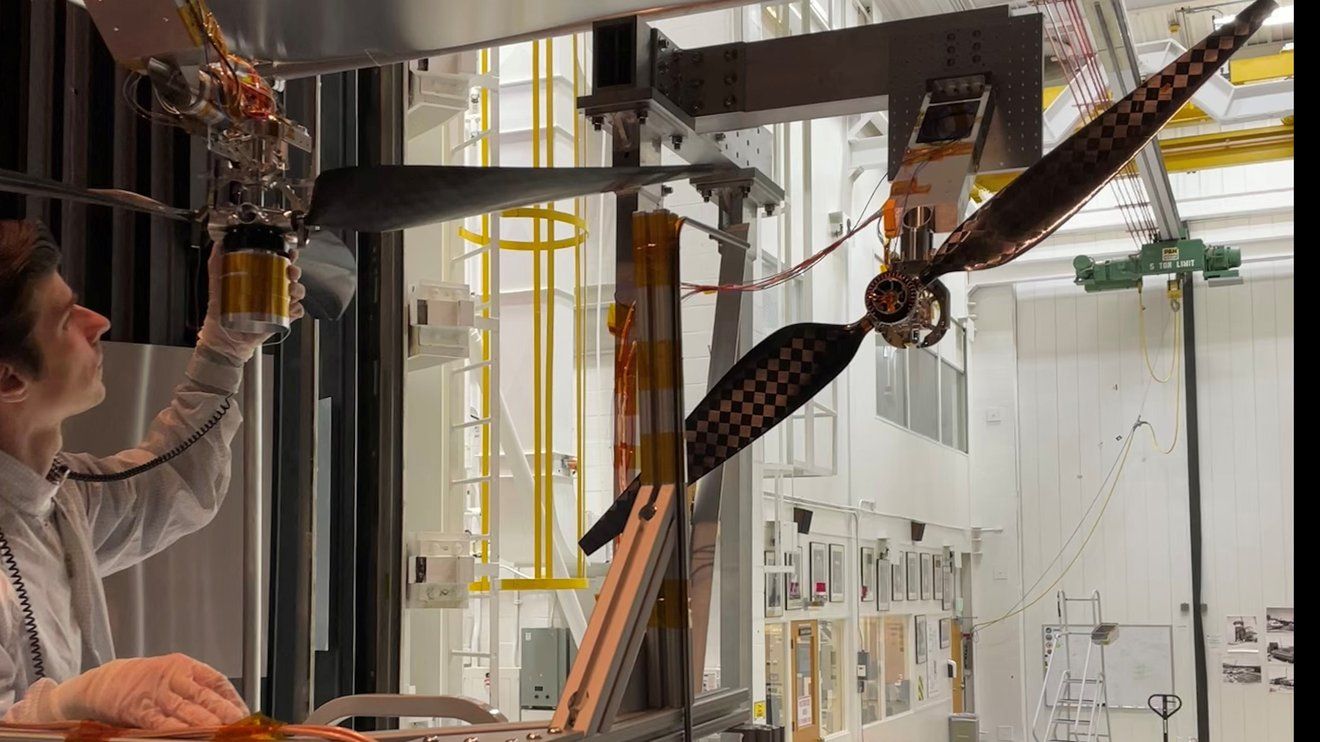
These extreme speeds are necessary to generate enough lift in Mars’ ultra-thin atmosphere, which is only about 1% as dense as Earth’s. The rotors were jointly developed by NASA and AeroVironment as part of Project SkyFall, a proposed mission to deploy multiple airborne exploratory rotorcraft across Mars. The mission, currently targeted for December 2028, would transport three next-generation Mars helicopters aboard a spacecraft to the Red Planet. Once the spacecraft lands on Mars, the helicopters would deploy to different regions of the planet for independent exploration missions, using the landed spacecraft as a communications and operational base.
Watch On SkyFall would mark only the second time NASA has conducted Mars exploration using an airborne craft. The pioneering 2021 Ingenuity Mars Helicopter mission deployed the small rotorcraft — equipped with carbon-fiber blades — to access parts of Mars that ground-based rovers such as the famous Perseverance Rover could not easily reach. NASA reports that while Ingenuity was initially planned for just five flights, it ultimately completed 72 flights, with its longest covering approximately 2,300 feet (704 meters). These achievements confirmed the viability of powered-rotor flight on Mars and laid the foundation for developing new ultra-fast rotor systems.
NASA engineers reprogrammed Mars helicopter's Snapdragon chip to run the rover instead, reconfiguring system from 140 million miles away
3D-printed rocket fuel successfully tested, could enable lighter missiles and faster production rates
15 tiny 3D-printed fans fit inside a domed Noctua NF-A12x25 frame to form the "Fanhattan Project"
“NASA had a great run with the Ingenuity Mars Helicopter, but we are asking these next-generation aircraft to do even more at the Red Planet,” said Al Chen, Mars Exploration Program manager at JPL. “That’s not an easy ask. While everything about Mars is hard, flying there is just about the hardest thing you can do. That’s because its atmosphere is so incredibly thin that it is hard to generate lift, and yet Mars has significant gravity.”
The biggest obstacle to airborne exploration on Mars has always been the planet’s ultra-thin atmosphere, which requires extremely high rotor speeds to generate sufficient lift. Ingenuity achieved this with rotor tip speeds of around Mach 0.7 as a safety precaution. However, despite its success, the entire craft was only about the size of a tissue box, weighed 1.8 kg (4 lbs), and did not carry a payload, so it did not carry any scientific or communication equipment. The obvious solution was larger aircraft, but bigger craft create more drag and require significantly more thrust to remain airborne. That thrust could theoretically be achieved at near-supersonic rotor speeds, but rotor blades would normally be at risk of structural failure under such extreme conditions, until now.
“The successful testing of these rotors was a major step toward proving the feasibility of flight in more demanding environments, which is key for next-gen vehicles,” said Shannah Withrow-Maser, a NASA aerodynamicist and member of the test team. “We thought we’d be lucky to hit Mach 1.05, and we reached Mach 1.08 on our last runs. We’re still digging into the data, and there may be even more thrust on the table. These next-gen helicopters are going to be amazing.”
NASA’s new supersonic rotor technology could enable significantly larger exploratory aircraft capable of carrying bigger batteries for longer missions, more advanced scientific instruments, and improved communication systems. NASA says Project SkyFall’s helicopters will perform low-altitude aerial exploration and scouting missions, gathering scientific data while helping pave the way for future robotic and potentially human missions to Mars.
Get Tom's Hardware's best news and in-depth reviews, straight to your inbox.
Key considerations
- Investor positioning can change fast
- Volatility remains possible near catalysts
- Macro rates and liquidity can dominate flows
Reference reading
- https://www.tomshardware.com/tech-industry/SPONSORED_LINK_URL
- https://www.tomshardware.com/tech-industry/nasa-pushes-mars-helicopter-rotors-past-the-speed-of-sound-for-the-first-time-ever-next-gen-skyfall-aircrafts-rotors-hit-3-750-rpm-ten-times-faster-than-normal-helicopters#main
- https://www.tomshardware.com/subscription
- Microsoft CTO confesses that 30-year-old code from the mid-90s still forms the bedrock of Windows 11 — ancient Win32 API still the backbone, but CTO says it's '
- Testing Nvidia's RTX Mega Geometry tech — VRAM-reducing tech a leap forward for path-traced rendering
- Testing the top Thunderbolt 5 docks with up to 140W Power Delivery, 10 GbE, and even internal M.2 SSD slots — Razer, CalDigit, Hyper, Ivanky, and WAVLINK go hea
- Ukraine’s new AI-guided laser destroys Shahed suicide drones in seconds from 3.1 miles away — also useful for demining operations, trailer-mounted Tryzub system
- Devastating 'Dirty Frag' exploit leaks out, gives immediate root access on most Linux machines since 2017, no patches available, no warning given — Copy Fail-li
Informational only. No financial advice. Do your own research.