
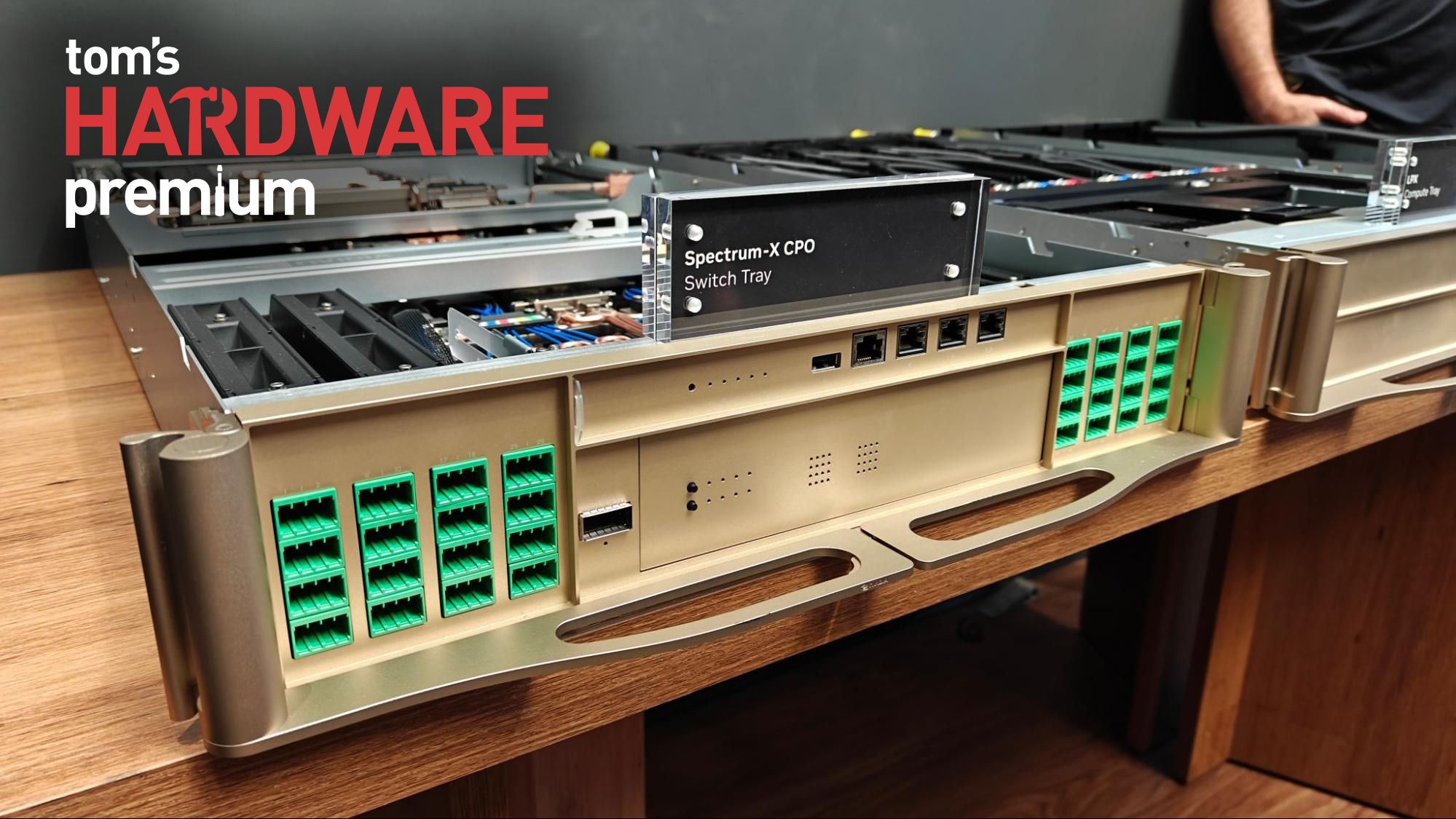
SemiAnalysis calls NPO the interim step between pluggable transceivers and true CPO.
When you purchase through links on our site, we may earn an affiliate commission. Here’s how it works .
Just two months ago, SemiAnalysis published a research note pushing its CPO volume expectations out to 2027 for scale-out networks and 2028 or 2029 for full-scale production, subsequently knocking 17% off Applied Optoelectronics stock and roughly 8% off Lumentum in a single session and drawing a public rebuttal from rival analysts.
NPO is the architecture that stands to gain if that pessimism proves right, with Broadcom having shown a 3.2T VCSEL-based NPO product line at OFC 2026 in March, and six connector and optics firms forming a standards group the same week to define a common socket for this class of device.
NPO presents an interim solution under the transition from pluggable to true CPO. NPO has certain benefits over CPO that bypass current production and reliability challenge of CPO, while maintaining most of the benefits CPO provide.Pros:🟠 Better serviceability (field… pic.twitter.com/R4JQX2xeQA August 10, 2026
A front-panel pluggable transceiver sits 15cm to 30 cm of copper trace away from the switch ASIC, and the DSP that cleans up the signal after that journey draws 6W to 8W of a typical 800G module's 14 to 17W budget. CPO reduces that distance to millimeters by mounting the optical engine on the same package substrate as the ASIC, thereby eliminating the DSP. Per Broadcom, this enabled a 70% reduction in optics power for its co-packaged Tomahawk switches, and Nvidia's figures for a 1.6T link show per-link power falling from around 30W to 9W.
NPO splits the difference by moving the optical engine off the faceplate to sit beside the ASIC, close enough to shorten the electrical path and drop the DSP, but on its own engine substrate instead of the ASIC's package. The module mates to the board through a socket, so the engine can be pulled and replaced in the field in the same way that a pluggable can; an engine reflowed onto a CPO substrate can't. SemiAnalysis's January CPO deep dive defines NPO as an optical engine co-packaged onto a separate substrate that "remains socketable."
Co-Packaged Optics (CPO) foundry roadmaps — breaking down TSMC, Intel, Samsung, and GlobalFoundries' approach to next-generation scale-up connectivity
How optical interconnects and silicon photonics emerged as AI's next hot commodity
Lumentum CEO warns of impending bottleneck on critical material used for silicon photonics
Linear pluggable optics (LPO), the other interim architecture in circulation, takes the opposite route by removing the DSP but leaving the optics in a standard front-panel module, cutting power to roughly seven to 8.5W per 800G port at the cost of reach and interoperability headaches, while leaving the optical engine on the faceplate rather than moving it next to the ASIC.
A soldered CPO substrate has no rework path because removing a reflowed, underfilled engine means applying solder-melt temperatures of 220°C to 260°C millimeters from the ASIC and every other engine on the package, and the sub-micron fiber alignment inside the engine itself doesn't survive a second thermal excursion. One dead optical engine therefore condemns the switch ASIC, the substrate, and every other engine attached to it.
SemiAnalysis's June note ran the numbers for a hypothetical 32-engine package. At a 95% attach yield per engine, compound yield lands near 19%, or roughly one good assembly in five. GlobalSemiResearch published a point-by-point rebuttal arguing the calculation freezes yield at a single pessimistic snapshot and ignores screening, binning, and the spare engines Nvidia designed into Spectrum-X for redundancy.
Meta presented reliability results at OFC 2026 indicating co-packaged optics can beat pluggables on failure rates, and Broadcom said its CPO systems logged more than 1 million cumulative 400G-equivalent port-hours in Meta testing without a single link flap.
Lasers, historically the highest-failure optical component, sit outside the package in both architectures: the OIF's ELSFP standard, published in August 2023, defines a hot-swappable external laser module that CPO and NPO designs both draw on. Modulators, photodetectors, and fiber attach stay inside the engine, so a failure in any of those means either swapping a socketed module or scrapping a soldered one.
FCC proposes import ban on Chinese optical transceivers
Key considerations
- Investor positioning can change fast
- Volatility remains possible near catalysts
- Macro rates and liquidity can dominate flows
Reference reading
- https://www.tomshardware.com/tech-industry/SPONSORED_LINK_URL
- https://www.tomshardware.com/tech-industry/near-packaged-optics-gains-ground-aso-the-industry-hedges-against-co-packaged-optics-growing-pains#main
- https://www.tomshardware.com/my-account
- Save $106 on this 4TB Team Group SSD with Gen 4 speeds, now 10.2 cents per GB — Newegg coupon deal makes this T-Force G50 one of the cheapest PCIe 4.0 drives on
- Prusa Research XL, Core One, and Core One L all to receive second-generation upgrades — all new orders get updated model for 'free'
- SK hynix to expand production capacity in China as it mulls Solidigm IPO, report claims — second phase of fab could boost local production by 50%
- NVIDIA AI Factory Compute Is Becoming an Investable Asset Class
- Razer Naga V3 Pro Review: My new 23-button mouse
Informational only. No financial advice. Do your own research.