
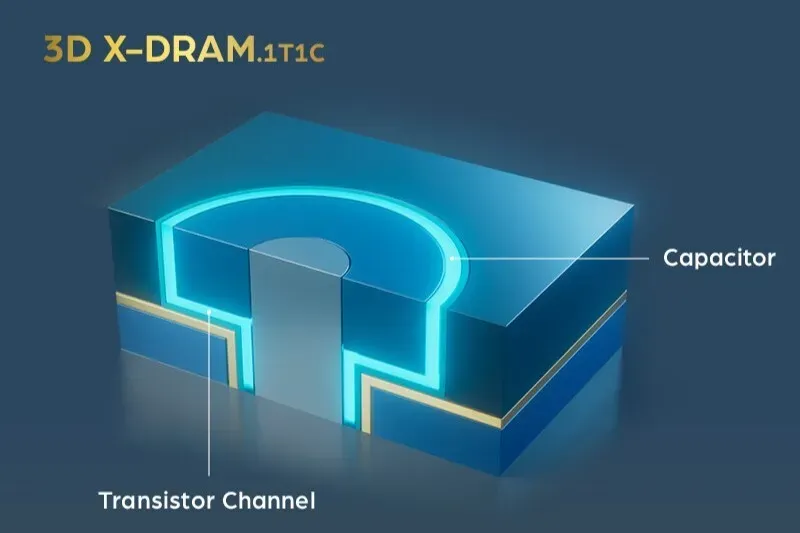
Next-gen memory designed as a lower-cost, lower-power HBM alternative for AI workloads
When you purchase through links on our site, we may earn an affiliate commission. Here’s how it works .
NEO Semiconductor announced on April 23rd that its 3D X-DRAM technology has successfully passed proof-of-concept (POC) validation, demonstrating that a new class of high-density DRAM can be manufactured using existing 3D NAND infrastructure. The company simultaneously announced a new strategic investment led by Stan Shih, founder and former Chairman and CEO of Acer, and a board director of TSMC for over two decades.
At the center of the announcement is the company’s 3D X-DRAM technology , a new class of DRAM that aims to break past conventional memory scaling limits by adopting a vertically stacked architecture designed for higher density, lower power consumption, and improved suitability for AI-driven workloads.
You may like SoftBank subsidiary working with Intel to develop radical new ZAM memory is now receiving Japanese gov't subsidies Intel is co-developing new Z-Angle Memory to compete with HBM used in AI data centers Memory makers are set to earn $551 billion from the AI boom, twice as much as contract chip manufacturers The proof-of-concept chips, fabricated and tested at Taiwan's National Institutes of Applied Research – Taiwan Semiconductor Research Institute (NIAR-TSRI) in collaboration with National Yang Ming Chiao Tung University, delivered the following results: Read/write latency : under 10 nanoseconds Data retention : over 1 second at 85°C/185°F (claimed 15× improvement over JEDEC standard) Bit-line disturbance : over 1 second at 85°C (185°F) Word-line disturbance : over 1 second at 85°C Endurance : greater than 10¹⁴ cycles
"These results validate a new scaling path for DRAM," said Andy Hsu, Founder & CEO of NEO Semiconductor. "We believe this technology can enable significantly higher density, lower cost, and improved energy efficiency for the AI era. By leveraging established 3D NAND manufacturing processes and ecosystem, we aim to bring 3D DRAM to reality sooner. NEO is actively engaging with leading global memory and semiconductor companies on potential co-development opportunities, and we believe our technology is well suited for a scalable licensing and partnership model to bring next-generation AI memory solutions to market."
Industry commentary included in the announcement was quite positive — although this does not imply confirmation of viability at scale. TechInsights’ Jeongdong Choe described the results as a “significant milestone” in the shift toward 3D memory architectures, noting that conventional DRAM scaling is approaching physical limits and that the industry is increasingly exploring vertical alternatives.
The broader context behind this development is the growing strain AI workloads are placing on memory systems. While GPU compute performance has scaled aggressively over the past decade, memory bandwidth — the rate at which data can be fed to those processors — has become a limiting factor in large-scale AI training and inference systems. This has already driven widespread adoption of high-bandwidth memory (HBM), a vertically stacked DRAM architecture integrated close to GPUs. However, HBM presents complex 3D stacking and bonding requirements and high manufacturing costs.
Get Tom's Hardware's best news and in-depth reviews, straight to your inbox.
Key considerations
- Investor positioning can change fast
- Volatility remains possible near catalysts
- Macro rates and liquidity can dominate flows
Reference reading
- https://www.tomshardware.com/tech-industry/artificial-intelligence/SPONSORED_LINK_URL
- https://www.tomshardware.com/tech-industry/artificial-intelligence/neo-semiconductors-revolutionary-3d-x-dram-for-ai-processors-has-passed-proof-of-concept-validation-company-secures-funding-to-develop-next-gen-memory-hbm-alternative#main
- https://www.tomshardware.com/subscription
- Just $479 nets you the AMD Ryzen 5 9600X CPU, B850 Max motherboard, and 16GB of DDR5-6000 RAM — perfect start to a low-cost gaming PC build
- Congress moves to strip the DoC of chip-export discretion with the MATCH Act — DUV lithography machines among those targeted in chipmaking tool crackdown
- Bolt Graphics tapes out its first Zeus GPU test chip on TSMC 12nm — firm touts 17x lower cost of compute
- CPU requirements for AI workloads are multiplying, driving intensifying shortages and price hikes — Intel already shifting production from consumer chips to Xeo
- Where to buy AMD's Ryzen 9 9950X3D2 — more L3 cache and dual 3D V-cache-stacked CCDs
Informational only. No financial advice. Do your own research.