
When you purchase through links on our site, we may earn an affiliate commission. Here’s how it works .
Researchers at Princeton University have created a three-dimensional neural network device that combines living brain cells and advanced embedded electronics. According to a recent press release, this 3D bioelectronic computer was programmed to differentiate patterns using computational techniques.
Basically, we are looking at living brain cells performing computational tasks outside the brain, using embedded electronics. This is not the first time scientists have used brain cells to perform computation. In previous attempts, scientists cultivated 2D cultures in petri dishes or 3D clusters, probing and monitoring activity from the outside.
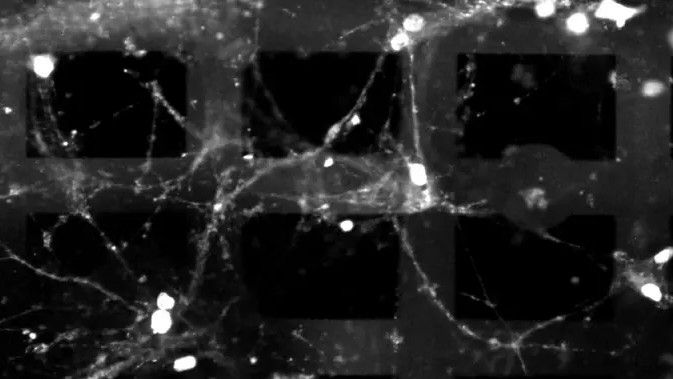
The Princeton research took a different approach. To build the device, the team created a 3D mesh of microscopic wires and electrodes supported by a thin layer of epoxy. They then cultured tens of thousands of neurons into a vast 3D network that can perform computation, using the mesh as a scaffold.
You may like Human brain cells set to power two new data centers, thanks to 'body-in-the-box' CL1 Researchers train living rat neurons to perform real-time AI computations Living neurons integrated into modern AI processing, claims SF startup According to the researchers, this new approach “enabled them to record and stimulate the neurons' electrical activity at a much finer scale than past approaches”. Over the course of six months, they observed how the network developed, tested techniques to reinforce or weaken links between key neurons, and eventually trained an algorithm to identify recurring pulse patterns.
To test the system, the researchers presented two distinct patterns in separate experiments, and it successfully differentiated the patterns in both cases. The team aims to progressively scale the device to perform increasingly complex tasks.
According to the paper's first author, Kumar Mritunjay, a postdoctoral researcher in electrical and computer engineering, the technology could "not only help uncover the computing secrets of the brain but can also assist in understanding and possibly treating neurological diseases.”
The original aim of the research was to investigate fundamental problems in neuroscience by studying the activities of living brain cells. That aim remains. However, the researchers realized that it could also play a role in solving one of AI’s key bottlenecks: power consumption.
Get Tom's Hardware's best news and in-depth reviews, straight to your inbox.
Key considerations
- Investor positioning can change fast
- Volatility remains possible near catalysts
- Macro rates and liquidity can dominate flows
Reference reading
- https://www.tomshardware.com/tech-industry/big-tech/SPONSORED_LINK_URL
- https://www.tomshardware.com/tech-industry/big-tech/new-3d-device-computes-using-living-brain-cells-bioelectronic-device-uses-3d-electronic-mesh-design-paired-with-living-tissue#main
- https://www.tomshardware.com/subscription
- Intel reportedly says it boosted yields by selling what would normally be 'scrap' or 'low-expectation' CPUs — customers more willing to accept lesser chips due
- Score an RTX 5070 prebuilt with a Ryzen 7 7700X & 16 GB of DDR5 for $650 off — Stack these promo codes to save on Skytech Gaming's high-end systems
- Intel has reportedly cancelled discrete gaming GPUs for the upcoming Xe3P Arc "Celestial" family — gaming GPU remains uncertain even for the next-gen Xe4 "Druid
- KTC H27P3 27-inch 5K dual-mode gaming monitor review: Incredible pixel density and flexibility
- Turtle Beach's new mouse has a 2.25-inch touchscreen and hotswap batteries that last 15 hours apiece — 'MC7' costs $160, part of company's new Command Series pe
Informational only. No financial advice. Do your own research.