
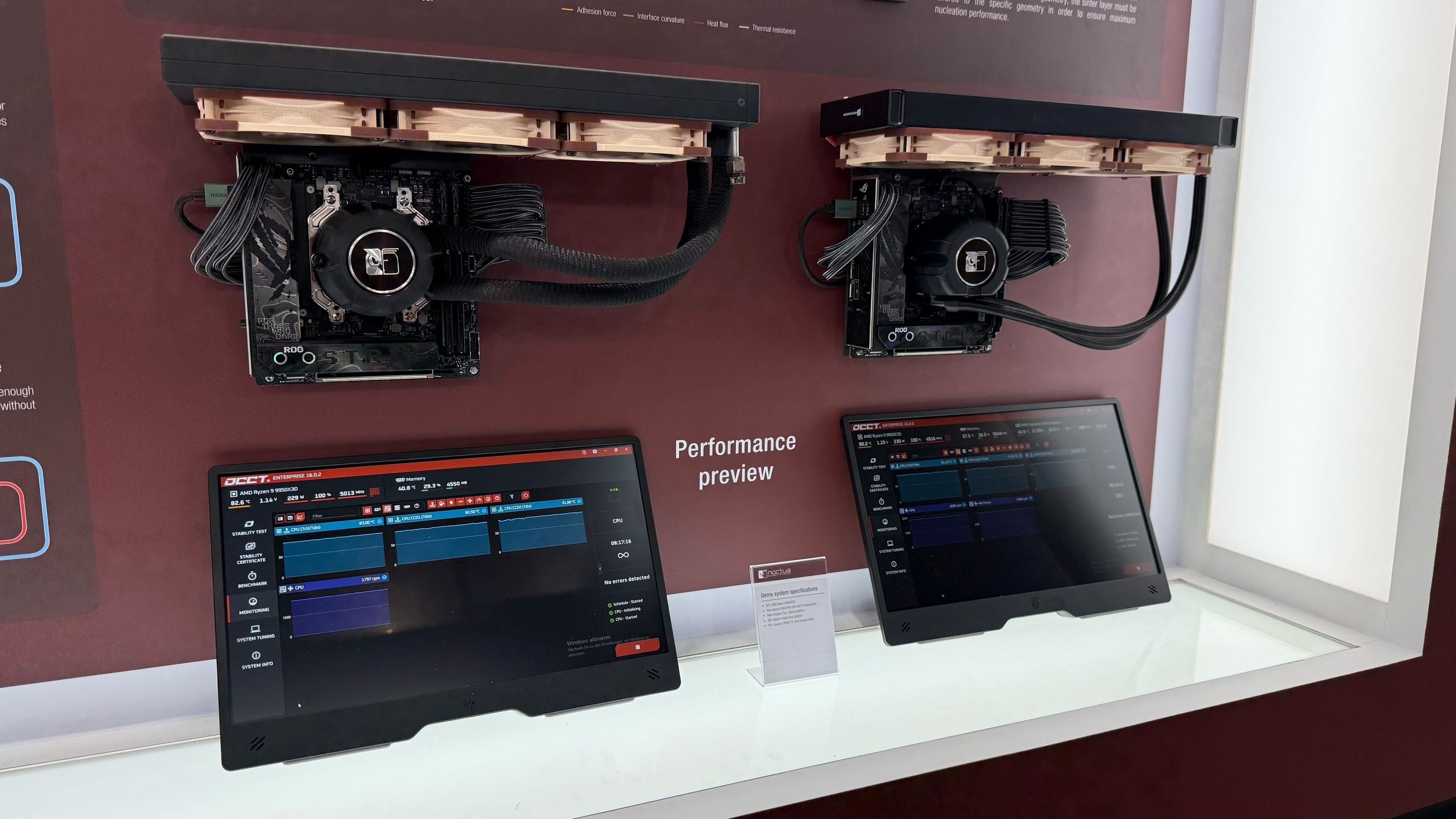
Beyond the sintered evaporator coating, the inlet and outlet hoses of the cooler now sit on the same side of the evaporator, much like those of an active AIO pump, for better motherboard clearance and compatibility. The tubes on this prototype also feature a new material that reduces permeation, seals better at the connectors, and achieves full regulatory compliance.
Overall, the unit now looks much like a typical AIO and much closer to a retail-ready product versus the somewhat rough-and-ready prototypes of years past.
Between the internal and external refinements evident in this latest version of the thermosiphon, Noctua is confident enough in the performance and manufacturability of the product that it has set a potential launch window for the unit, and it tentatively expects a retail version to arrive sometime in Q3 2027. While that's still a ways away, it's typical of the company's dogged pursuit of near-perfection, and it seems safe to say that we should expect an even further refined version of this product at next year's Computex.
Follow Tom's Hardware on Google News , or add us as a preferred source , to get our latest news, analysis, & reviews in your feeds.
As the Senior Analyst, Graphics at Tom's Hardware, Jeff Kampman covers everything that has to do with graphics cards, gaming performance, and more. From integrated graphics processors to discrete graphics cards to the hyperscale installations powering our AI future, if it's got a GPU in it, Jeff is on it.\u00a0 ","collapsible":{"enabled":true,"maxHeight":250,"readMoreText":"Read more","readLessText":"Read less"}}), "https://slice.vanilla.futurecdn.net/13-4-24/js/authorBio.js"); } else { console.error('%c FTE ','background: #9306F9; color: #ffffff','no lazy slice hydration function available'); } Jeffrey Kampman Senior Analyst, Graphics As the Senior Analyst, Graphics at Tom's Hardware, Jeff Kampman covers everything that has to do with graphics cards, gaming performance, and more. From integrated graphics processors to discrete graphics cards to the hyperscale installations powering our AI future, if it's got a GPU in it, Jeff is on it.
thestryker So Q3 2029 then. I kid, I kid, I really hope they're able to do something with this design. I'm always hoping for some innovation in cooling for desktop PCs. It seems like AIOs are getting about as good as they're going to be so if they're able to productize this and it does well maybe we'll see some improvements in future iterations. In the GN video they cited they're aiming for at least 10 year life span (permeation is a very big problem for this design). Reply
alan.campbell99 I think this is an interesting development, it's one of these things I've wondered about. It's not new, I do recall someone a few year ago testing a passive liquid cooling system, probably using fluorinert or similar. Don't recall the specifics other than it might have been used with an i5 or i7 with reasonable success. Reply
bill001g If anyone is going to figure this out it will be noctua. Not real sure who they are marketing it to. If it also had no fans then maybe someone who wanted a silent pc. I guess with no pump it can't fail but most AIO already outlast the useful life of the machine they are cooling in many cases. Maybe now that people are being forced to keep machines longer because of memory pricing but noctua is not going to be cheap either. Reply
master737373 Interesting, I knew Noctua was working on a thermosiphon but I didn't know they were also working on an AIO. (Wall of text coming, sorry 😀 ) While I'm glad they showed the performance on a 9950x3D, which has the same power requirements as 7950x, I wish they would've tested the performance using an Intel CPU since Intel CPUs' cooling performance (thermal displacement) isn't bottled by the actual CPU like it is with AMD. The size of the core complex dies AMD uses is 10mm^(2) per die. So if you have one one die (6-8 cores), all of the heat is produced on a surface area that's 10mm^(2), while if you have two dies (6-16 cores*), all of the heat is produced on a surface area that's 20mm^(2). That's about the surface area of an adult fingernail, when using two dies. Now imagine trying to displace 170W of heat from a surface area that size to a cooler. You physically can't match that rate of heat production, which is why the majority of heat management on AMD Ryzens come from the SoC on the I/O Die throttling cores so the CPU doesn't go above their thermal limit. But in doing so, AMD had to design their CPUs to being able to run at their thermal limits indefinitely. This is also why there's very little difference in cooling performance between the smallest, weakest coolers like a Wraith and the largest, strongest air coolers like D15 G2 and AIO like 360-420mm Arctic Liquid Freezer III. The biggest difference is when there's only moderate load on the CPU, where it's not reaching the thermal limit because the SoC doesn't need to push more power even with thermal headroom, thus sitting between 75-85C. Meanwhile, Intel CPUs, have die sizes around 260mm^(2). Compare their power requirement of 253W over 260mm^(2) vs 230W over 20mm^(2). The cooler isn't what's providing the majority of the thermal maintenance, it's the SoC. Showing the performance of coolers while using an AMD Ryzen doesn't show the actual cooling performance of the cooler because they'll never be saturated enough to the point where the cooler can't take on more heat. All of the heat of AMD CPUs is produced in one small spot, which is why Noctua has offset mounting for AMD CPUs to ensure the center of the cooler is over the core complex dies (CCX, and also so the CCX isn't dumping its heat on only one or two heat pipes. Basically, without showing cooling performance on an Intel CPU, where the cooling performance is actually bottlenecked by the cooler and not the CPU, the numbers provided on the coolers performance mean next to nothing. AMD's thermal density is extremely high and in one small spot, while Intel's thermal density is lower and spread out over the entire CPU. For instance, my 7950x is delidded and I'm direct-die cooling, yet I get the exact same temps under full load as before removing the IHS. But the idle and low- to moderate load temps are about 5C-ish lower than before. There's a reason why GPUs like RTX 3090 and RTX 4090, which pulls 350W and 450W, respectively, can sit at a comfortable 70C while under 100% load while having simpler, weaker, and smaller coolers. The die size is 630mm^(2), so all of that heat is spread out over more surface area, allowing the cooler to displace it much quicker, because each square mm of the cooler's coldplate has to displace much less heat. Ryzen 9950x thermal density over the die is 170W / 20mm^(2) = 8.5W/mm^(2). 14900ks thermal density over the die is 253W / 260mm^(2) = 0.973W/mm^(2). RTX 3090 and 4090 thermal density over the die is 350W / 630mm^(2) = 0.555W/mm^(2) and 450W / 630mm^(2) = 0.714W/mm^(2) So we can see how the cooler would hardly even be able to do it's job with an AMD Ryzen. Until AMD changes away from the chiplet design, cooling performance of coolers should be best shown cooling an Intel CPU. *Ssometimes AMD will bin a x900x(3D) or a x950x(3D) and disable the second CCD at the factory to use as a x600(x), x700(x), or x800(x) Reply
Key considerations
- Investor positioning can change fast
- Volatility remains possible near catalysts
- Macro rates and liquidity can dominate flows
Reference reading
- https://www.tomshardware.com/pc-components/heatsinks/SPONSORED_LINK_URL
- https://www.tomshardware.com/pc-components/heatsinks/noctua-shows-off-improved-thermosiphon-prototype-passively-circulated-liquid-cooler-gets-q3-2027-projected-launch-date#main
- https://www.tomshardware.com
- Industry coalition urges Trump administration to take urgent action as AI data centers' extreme memory consumption threatens other industries — AI-driven memory
- Meta putting up tents across the US to house AI servers, like ‘a scene out of the movie Mad Max’ — structures take three months to build and use jet engines for
- Why Financial Institutions Are Converging on Transaction Foundation Models to Build Their Own Intelligence
- NVIDIA Research Advances Robotics From Simulation to the Real World
- NVIDIA Vera CPU Is ‘Packing a Heavy-Hitting Punch’ Against Competition
Informational only. No financial advice. Do your own research.