
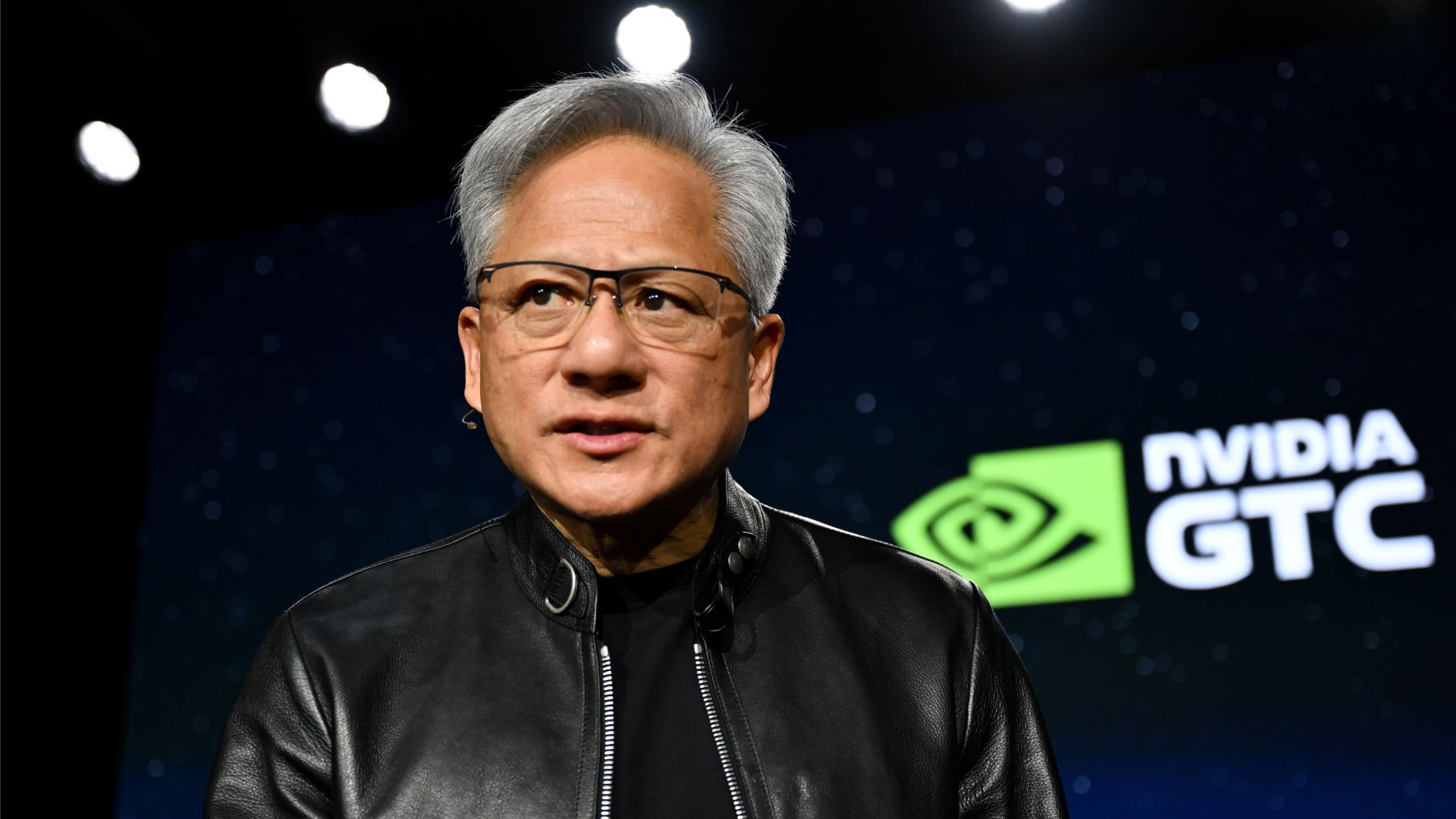
The Nvidia boss says that keeping Chinese AI researchers using the American tech stack is a good thing for the U.S.
When you purchase through links on our site, we may earn an affiliate commission. Here’s how it works .
Nvidia CEO Jensen Huang got into a heated debate during a recent podcast, during which he talked with Dwarkesh Patel about whether the U.S. should be selling chips to China. During part of the conversation, which you can see below by expanding the tweet, Patel said he doesn’t know whether it’s actually good to give Chinese access to AI chips. Still, since he likes to play devil’s advocate during his interviews, where he takes an opposing stance to his guest, he asked the leader-clad chief of the world's largest AI chipmaker if doing so is a threat to American companies and national security .
Patel gave Anthropic’s Claude Mythos as an example for his argument, which apparently revealed “thousands of zero-day vulnerabilities” in “every major operating system and every major web browser.” He said that if China had access to the massive amounts of compute that Nvidia delivers, it could probably have used it to develop cyber-offensive capabilities that threaten the United States' security. Huang had a fairly nuanced response to this, but he also first pointed out that Mythos was trained on “fairly mundane capacity, and a fairly mundane amount of it."
"You’re not talking to someone who woke up a loser” – Jensen HuangJensen nearly lost his composure during a heated debate about selling chips to China, despite showing tremendous patience in response to the pushback. pic.twitter.com/A6F7RAXAgh April 16, 2026
You can expand the tweet above to see the exchange. Jensen says China already has access to a lot of compute power. Although Nvidia still makes the most advanced, most efficient chips, he argues that China can still achieve advanced models through sheer brute force, like Huawei’s AI CloudMatrix cluster . So, keeping the chipmaker out of the country would not stop its development of frontier AI models and would only result in Chinese AI being trained outside of the American tech stack.
You may like Nvidia CEO Jensen Huang says China hasn't approved H200 imports yet Nvidia says Chinese military dependence on American technology would be 'nonsensical' Nvidia CEO Jensen Huang to visit China as company prepares to start H200 shipments to the country “We want to make sure that all the AI developers in the world are developing on the American tech stack, and making the contributions, the advancements of AI — especially when it’s open source — available to the American ecosystem,” Huang said. “It would be extremely foolish to create two ecosystem: the open-source ecosystem, and it only runs on a foreign tech stack, and a closed ecosystem that runs on the American tech stack. I think that would be a horrible outcome for the United States.”
Another argument against selling advanced AI chips to China is that it will do the same thing the country did with iPhones and Tesla. While these two products are still leaders in their markets, many Chinese companies are now building products that can compete with them on price, features, and quality. This could also happen in the AI chip industry. If and when Chinese-made AI chips get the same capabilities as Nvidia’s latest offerings, couldn’t Chinese AI companies just easily switch over to a Chinese AI chip in the future, should it become available, or if Beijing forces them to?
“We have to keep innovating and, as you probably know, our share is growing, not decreasing. The premise that even if we competed in China, that we’re going to lose that market anyways… You’re not talking to somebody who woke up a loser,” Huang said. “That loser attitude, that loser premise makes no sense to me.”
He then went on to say that AI chips aren’t as simple as vehicles, where users can easily swap one brand for another daily. “Computing is not like that. There’s a reason why the x86 deal exists. There’s a reason why ARM is so sticky. These ecosystems are hard to replace; it costs an enormous amount of time and energy, and most people don’t want to do it. So, it’s our job to continue to nurture that ecosystem, to keep advancing the technology so that we can compete in the marketplace,” the Nvidia chief added.
Get Tom's Hardware's best news and in-depth reviews, straight to your inbox.
Key considerations
- Investor positioning can change fast
- Volatility remains possible near catalysts
- Macro rates and liquidity can dominate flows
Reference reading
- https://www.tomshardware.com/tech-industry/SPONSORED_LINK_URL
- https://www.tomshardware.com/tech-industry/nvidia-ceo-jensen-huang-nearly-lost-his-composure-when-pressed-on-selling-chips-to-china-youre-not-talking-to-someone-who-woke-up-a-loser#main
- https://www.tomshardware.com
- Blowing Off Steam: How Power-Flexible AI Factories Can Stabilize the Global Energy Grid
- Advancing Open Source AI, NVIDIA Donates Dynamic Resource Allocation Driver for GPUs to Kubernetes Community
- Google and Pentagon in talks to run custom AI chips inside classified environments — Google pushes for tight controls for TPUs surrounding use for mass surveill
- Elon Musk pushing forward with Terafab at 'light speed' — staff reaching out to various suppliers and are reportedly willing to pay a premium to gain priority
- Anonymous perps behind 86 million files scraped from Spotify hit with $322 million court judgement — Anna's Archive case presents intriguing precedent for AI tr
Informational only. No financial advice. Do your own research.