
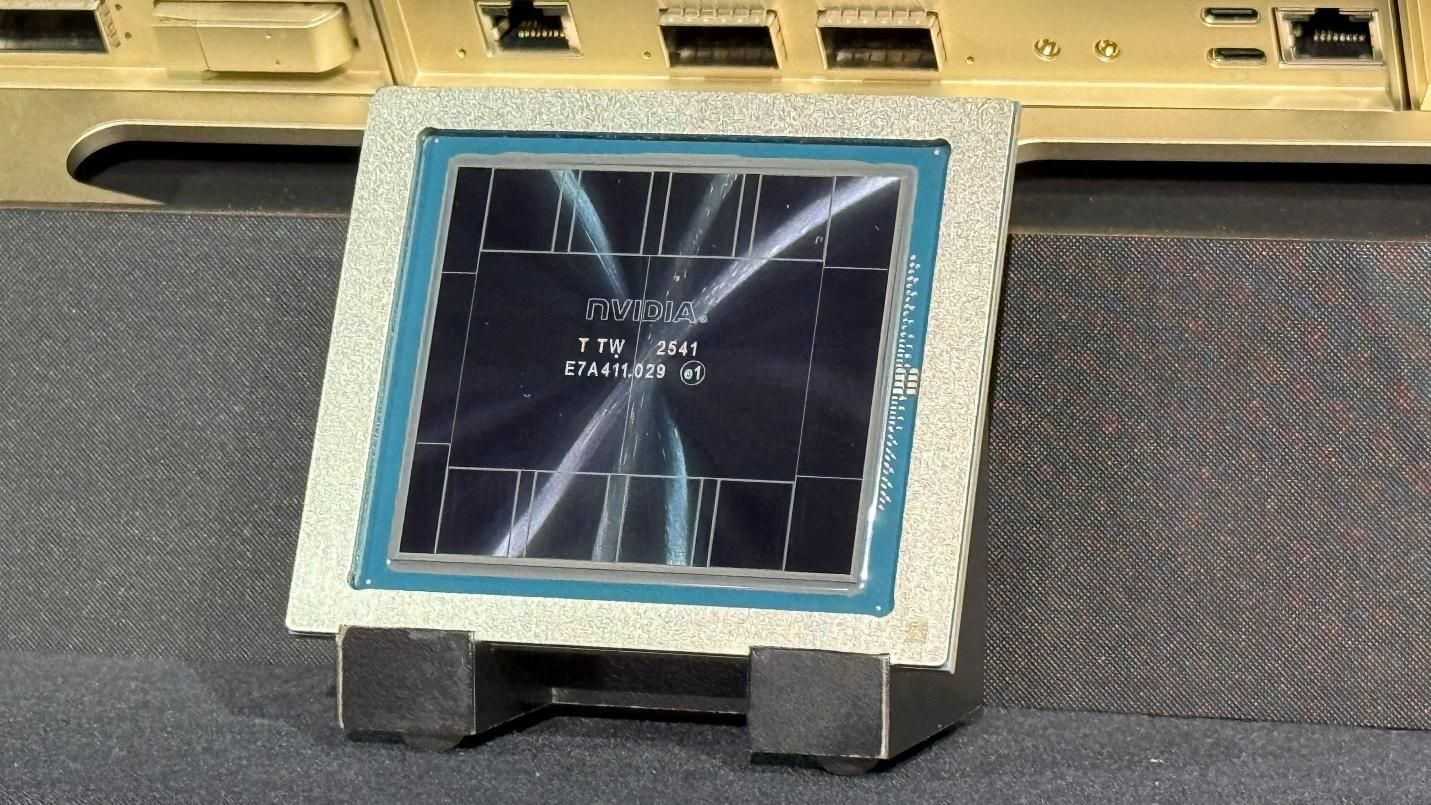
Rubin also improves the fundamental performance of matrix operations in the Tensor Core by doubling the amount of work those cores can perform on the K dimension, or the shared inner dimension of a pair of matrices to be multiplied. Without going too deep into the math, the size of the K dimension is directly related to the number of times the Tensor Core has to loop over the elements of the two matrices being multiplied.
In Nvidia's example, then, the calculation of a result matrix that would require four loop iterations on Blackwell can be completed in only two on Rubin. Nvidia says this improvement has wide-ranging benefits for throughput-, memory-, and latency-bound kernels, and it’s helpful for both context processing and decode phases of inference.
Rubin also focuses on improving the performance of the attention mechanism that’s foundational to transformer-based LLMs More advanced models now support context lengths of up to a million tokens, and quickly performing attention calculations on such long input sequences quickly is a key driver for improved inference performance.
Softmax is an essential operation in attention calculations, and in order to keep up with the improved Tensor Core throughput in Rubin, Nvidia has once again boosted softmax throughput in the GPU SM’s Special Function Unit (SFU).
Since it relies on the transcendental math capabilities of the SFU, softmax throughput can become a bottleneck for subsequent inference work, and it's a limitation that Nvidia already sought to address with enhancements to the Blackwell Ultra SFU. Blackwell Ultra doubled FP32 and BF16/FP16 exponential throughput compared to the first-gen Blackwell GB200.
Rubin maintains Blackwell Ultra's 2X speedup over Blackwell in FP32 exponential math, and it doubles BF16/FP16 exponential calculations again compared to Blackwell Ultra, leading to a 4X improvement in throughput compared to Blackwell for those lower-precision data types.
Rubin also increases Tensor Core occupancy by providing finer-grained opportunities for coordination between dependent kernels than on Blackwell. One case that Nvidia cites where these dependencies arise is the generation of activations for an LLM, where one kernel produces and stores data that is then used by a subsequent kernel as a prompt proceeds through a neural network.
On Blackwell GPUs, a long-running producer kernel on one thread block (perhaps within a CUDA structure like a cluster) might delay the execution of a subsequent consumer kernel on those thread blocks, even as other thread blocks of the producer kernel have finished their work.
Rubin offers finer-grained dependency resolution between kernels, such that a consumer kernel can begin executing on individual thread blocks as soon as the producer kernel’s output from each thread block becomes available, instead of waiting for the entire batch of producer kernel data to become available. This finer-grained management results in better GPU utilization, lower kernel-to-kernel latency, and ultimately increases tokens per second per user.
All of the improvements we've discussed so far relate to how work happens on one GPU, but the Vera Rubin NVL72 rack-scale accelerator comprises many GPUs connected over an NVLink fabric within the rack. Model weights, key-value cache data, and inter-GPU synchronization messages all move over this fabric, so keeping overhead and latency low is key to realizing maximum performance.
GPUs running CUDA kernels can directly initiate communication with other GPUs in the rack using Nvidia Collective Communications Library (NCCL) API, lowering overhead. Nvidia notes that because the GPU performs those operations directly as part of the compute kernel, the efficient execution of those communications becomes critical to performance.
On a Blackwell system, an NVLink transfer between GPUs might require data store operations followed by a memory barrier and an atomic flag. The Rubin architecture introduces a feature called counted writes that reduces the amount of coordination and synchronization traffic necessary to share data between GPUs across the fabric.
On Rubin, the memory barrier and atomic operations are replaced by a single write counter update on the receiving GPU, reducing network traffic and latency and improving compute utilization by reducing the time spent waiting for coordination overhead.
All told, in tandem with the high single-threaded performance of the Vera CPU for agent harnesses, tool calling, code compilation, and more, the improvements in the Rubin GPU for performance on critical inference operations, as well as improved efficiency for data movement on-chip and across the rack, promise to help create a rack-scale and data-center-scale system that will both increase inference performance and lower per-token inference costs in the increasingly agentic future that Nvidia envisions. We’re excited to see more of what this GPU can do as deliveries of Vera Rubin systems are set to begin this fall.
Follow Tom's Hardware on Google News , or add us as a preferred source , to get our latest news, analysis, & reviews in your feeds.
As the Senior Analyst, Graphics at Tom's Hardware, Jeff Kampman covers everything that has to do with graphics cards, gaming performance, and more. From integrated graphics processors to discrete graphics cards to the hyperscale installations powering our AI future, if it's got a GPU in it, Jeff is on it.\u00a0 ","collapsible":{"enabled":true,"maxHeight":250,"readMoreText":"Read more","readLessText":"Read less"}}), "https://slice.vanilla.futurecdn.net/13-4-25/js/authorBio.js"); } else { console.error('%c FTE ','background: #9306F9; color: #ffffff','no lazy slice hydration function available'); } Jeffrey Kampman Senior Analyst, Graphics As the Senior Analyst, Graphics at Tom's Hardware, Jeff Kampman covers everything that has to do with graphics cards, gaming performance, and more. From integrated graphics processors to discrete graphics cards to the hyperscale installations powering our AI future, if it's got a GPU in it, Jeff is on it.
Key considerations
- Investor positioning can change fast
- Volatility remains possible near catalysts
- Macro rates and liquidity can dominate flows
Reference reading
- https://www.tomshardware.com/pc-components/gpus/SPONSORED_LINK_URL
- https://www.tomshardware.com/pc-components/gpus/nvidia-details-rubin-architectural-optimizations-for-inference-improvements-target-better-performance-and-efficiency-from-the-gpu-to-the-rack#main
- https://www.tomshardware.com/membership
- Intel to co-develop and manufacture Fortinet's next-gen firewall ASIC on Intel 4 — node gets its first named external customer
- Taiwan indicts ex-TSMC manager for allegedly stealing chip secrets for China — first case of its kind links managers to Chinese semiconductor materials analysis
- Intel to co-develop and manufacture Fortinet's next-gen firewall ASIC on Intel 4 — node gets its first named external customer
- Zilog Z80 turns 50 as an open-source replacement heads to drop-in DIP40 silicon — iconic 8-bit CPU launched in July 1976 and was discontinued in 2024
- Creality K2 SE 3D printer price slashed by 17%, now under $250 — grab a competitive entry-level high-speed multicolor device at a bargain price
Informational only. No financial advice. Do your own research.