
At CVPR, NVIDIA is unveiling new physical AI agent skills that help researchers and developers speed the development of autonomous vehicles , robots and vision AI systems .
The core challenge in physical AI research isn’t simply developing stronger models. It’s building a full workflow around them — reconstructing real-world scenes, generating edge-case scenarios, training policies, evaluating behavior and rapidly iterating. Today, these steps are fragmented across separate tools, slowing the pace of experimentation as researchers struggle to piece them together.
Earlier this week, NVIDIA announced NVIDIA Cosmos 3 , the open frontier model for physical AI and the world’s first full omnimodel unifying vision reasoning, world and action generation. Leading across the open model public leaderboards central to physical AI, the world foundation model provides core capabilities for physical AI development. NVIDIA physical AI skills pair with Cosmos, NVIDIA libraries and simulation frameworks to help researchers move from model capabilities to scalable end-to-end workflows faster than ever.
For AV researchers, the problem is the “long tail” of driving — rare interactions, unusual road geometry, lighting changes and edge-case behaviors that are difficult to repeatedly collect, but critical for training and validation.
Neural Reconstruction skill demo in OpenClaw, showing a video re-rendered from an elevated virtual sensor viewpoint.
With NVIDIA autonomous vehicle skills, researchers and developers can task AI agents to automate workflows for scene reconstruction from fleet data and generate synthetic scenarios. Neural Reconstruction skills help AI agents turn fleet-captured data into editable 3D scenes for simulation and synthetic data generation, while technologies including NVIDIA Omniverse NuRec , InstantNuRec , Harmonizer and HiGS accelerated renderer help accelerate reconstruction, improve scene realism and generate new views.
InstantNuRec enables fast 3D Gaussian road-scene reconstruction from images without per-scene optimization.
For AV researchers, repeatable simulation helps vary conditions, compare system responses and uncover failure modes across scenarios beyond what can be captured in real-world data.
NVIDIA AlpaGym , an open source closed-loop reinforcement learning framework, extends that approach by connecting policy rollouts and high-fidelity simulation with agent skills, scaling across thousands of GPUs, to help researchers move through setup, rollout and evaluation. NVIDIA OmniDreams , an action-conditioned generative world model, adds photorealistic rendering to the simulation loop, generating camera frames that respond directly to policy actions in real time.
NVIDIA is also advancing AV research with its most powerful open driving foundation model to date: NVIDIA Alpamayo 2 Super , an open 32-billion-parameter reasoning vision language action (VLA) model that reasons, plans and acts across the full driving stack for safer, scalable level 4 development and deployment.
For vision AI research, the bottleneck is creating enough controlled examples to study how models behave when visual conditions, object states or temporal events change. Work in zero-shot anomaly detection, synthetic anomaly generation and few-shot defect recognition all run into the same data wall.
New skills for visual inspection generates multiple rare defects on different surfaces.
New NVIDIA Metropolis skills are helping researchers and developers use AI agents to generate synthetic visual scenarios, including anomalies, augment data and support pseudo-labeling. These skills benefit from Cosmos 3’s mixture-of-transformers architecture, which uses a reasoning transformer to analyze observations and feed instructions to a generation tower, helping scale physically grounded virtual worlds.
Researchers building high-accuracy visual inspection models can use the Defect Image Generation skill to create examples of different defects across different surfaces using real images. The workflow combines NVIDIA Isaac Sim for simulation, Cosmos 3 and NVIDIA OSMO for orchestration and vision language reasoning — letting researchers create rare visual cases and assess whether models respond correctly.
New NVIDIA Metropolis VSS Blueprint skills extract insights from massive volumes of video data.
For video AI agents, the NVIDIA Metropolis Blueprint for video search and summarization (VSS) , NVIDIA TAO and Video Augmentation skills help extract insights from massive volumes of video data, fine-tune models and automate the build-and-evaluate loop. This gives researchers a more repeatable way to develop reasoning vision AI agents that can detect events, reason over complex scenes, summarize activity and send alerts.
Teaching robots skills like navigating or manipulating comes down to iteration. For researchers, the bottleneck is building enough controlled environments and policy rollouts to understand how robot behavior changes across tasks, settings and embodiments — work that typically means stitching together simulation environments, task variations, policy training and evaluation by hand.
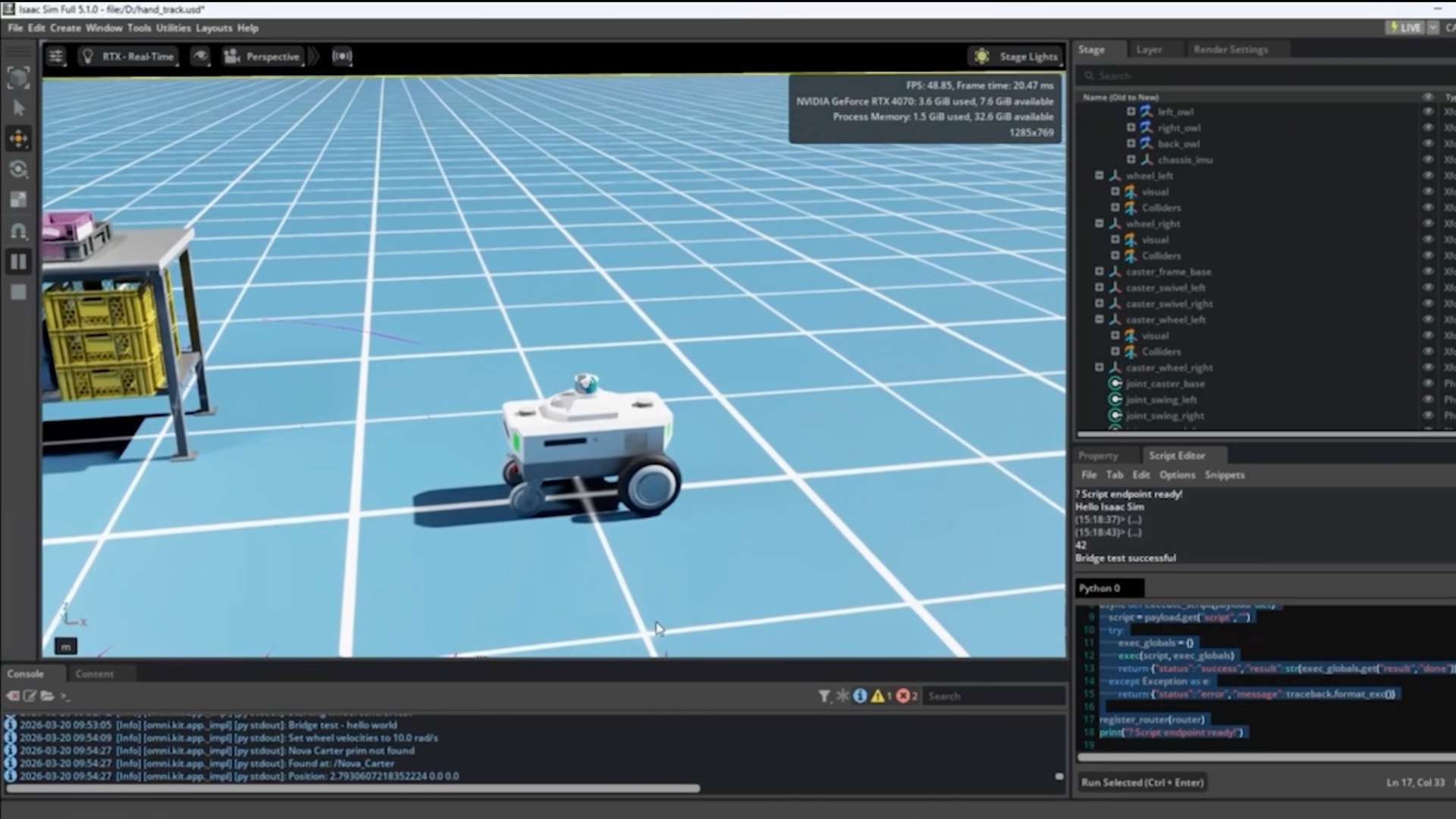
NVIDIA Isaac Sim 6.0 includes agent-friendly skills and connectors to help automate workflows.
With NVIDIA robotics skills, researchers can task AI agents to automate most common development steps across scene preparation, simulation and robot learning with NVIDIA Omniverse libraries , Isaac Sim and Isaac Lab frameworks. Agents can help launch simulation sessions, author scenes, control simulation, capture data and validate environments in Isaac Sim, while Isaac Lab skills support reinforcement learning setup, training, evaluation and custom environment development.
New NVIDIA Isaac mobility skills automate navigation workflows.
Key considerations
- Investor positioning can change fast
- Volatility remains possible near catalysts
- Macro rates and liquidity can dominate flows
Reference reading
- https://blogs.nvidia.com/blog/cvpr-physical-ai-research-agent-skills/#primary
- https://blogs.nvidia.com/blog/author/pranjalij/
- https://blogs.nvidia.com/blog/cvpr-physical-ai-research-agent-skills/#disqus_thread
- Gigabyte showcases new Infinity products for its 40th anniversary — X870 Infinity Next halo motherboard boasts metal 3D-printed elements, Aero Wood goes dark, M
- NZXT showcases H6 mid-tower chassis, new Ultra RGB fans, and a white H2 offering — boundless RGB customization options take this case to a whole new level
- Industrial Software Leaders Build Secure, Autonomous AI Engineers With NVIDIA NemoClaw
- Industrial Software Leaders Build Secure, Autonomous AI Engineers With NVIDIA NemoClaw
- NVIDIA Levels Up Local AI Agents Across RTX PCs and DGX Spark
Informational only. No financial advice. Do your own research.