
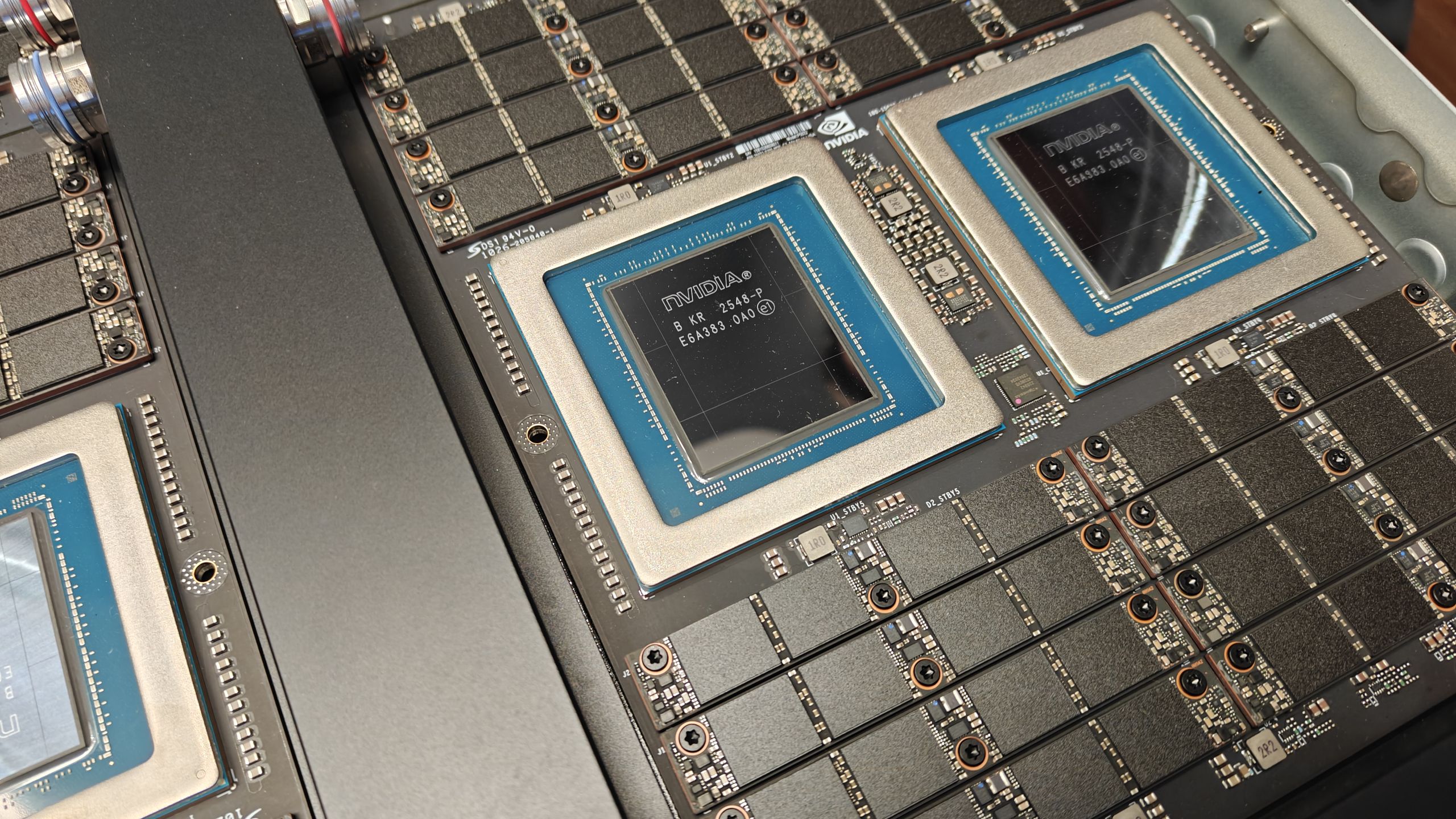
But just as chiplet-based designs made trade-offs in per-thread performance, Vera will likely make trade-offs for its unique architecture. The majority of data center workloads are still “legacy” tasks that hyperscalers have built for, and even with seemingly insatiable demand for AI infrastructure, that is unlikely to change for several years.
Buck recognizes this trade-off, asking: “Can Intel and others build rich fabrics? Do they have the IP and the ecosystem to do it and connect it all the way through to LP memory? They need to tell you when they’re going to do it… but that trade-off will come at the cost of the legacy workload.” Earlier this year, at GTC in March, Buck was even more clear. “The world is not going to be served by one SKU of CPU, and that is not our intention,” the executive said in a news conference at the time.
Still, it’s clear Nvidia has ambitions with data center CPUs beyond what headlines are floating around on the New York Stock Exchange. Nvidia says CPUs represent a $200 billion TAM (Total Addressable Market) opportunity for the company, a rather rosy forecast compared to the rest of the industry, which sees a TAM of around $120 billion by 2030 (though recent estimates have climbed as high as $170 billion). And agentic AI is expanding that market, with Morgan Stanley in April estimating that agents could add as much as $60 billion to the data center CPU market.
Vera is in full production alongside Nvidia’s next-gen AI infrastructure, including Rubin GPUs, ConnectX-9 NICs, SpectrumX Ethernet switches, and the various components that go into building a Vera Rubin NVL72 rack. The company says there are around 1.3 million components that go into a rack, and it has a list of over 300 partners globally to build them. As part of our visit to Nvidia HQ last week, we saw a Vera Rubin NVL72 rack in action, running workloads for OpenAI.
Follow Tom's Hardware on Google News , or add us as a preferred source , to get our latest news, analysis, & reviews in your feeds.
Jake Roach is the Senior CPU Analyst at Tom\u2019s Hardware, writing reviews, news, and features about the latest consumer and workstation processors. ","collapsible":{"enabled":true,"maxHeight":250,"readMoreText":"Read more","readLessText":"Read less"}}), "https://slice.vanilla.futurecdn.net/13-4-25/js/authorBio.js"); } else { console.error('%c FTE ','background: #9306F9; color: #ffffff','no lazy slice hydration function available'); } Jake Roach Social Links Navigation Senior Analyst, CPUs Jake Roach is the Senior CPU Analyst at Tom’s Hardware, writing reviews, news, and features about the latest consumer and workstation processors.
Key considerations
- Investor positioning can change fast
- Volatility remains possible near catalysts
- Macro rates and liquidity can dominate flows
Reference reading
- https://www.tomshardware.com/pc-components/cpus/SPONSORED_LINK_URL
- https://www.tomshardware.com/pc-components/cpus/nvidia-has-shipped-hundreds-of-thousands-of-grace-standalone-servers-gpu-firm-pivots-messaging-as-cpus-take-center-stage-in-agentic-data-centers#main
- https://www.tomshardware.com/membership
- 3D printing enthusiast resurrects cancelled dbrand Steam Machine Companion Cube as DIY project — project shelved due to copyright can now be made and assembled
- Memory chip boss admits RAM prices are 'abnormally high' — SK Group chairman considering building a semiconductor plant in the US to expand supply, calm ‘chipfl
- Trump administration reportedly reviving push to ban Chinese AI models following Kimi K3 launch, citing cybersecurity concerns — downloadable open weights could
- AI Innovators Adopt NVIDIA Vera — Why Max Single-Threaded CPU at Scale Matters
- NVIDIA Vera Rubin Driving Performance Per Watt, Lowest Token Cost for Partners Worldwide
Informational only. No financial advice. Do your own research.