
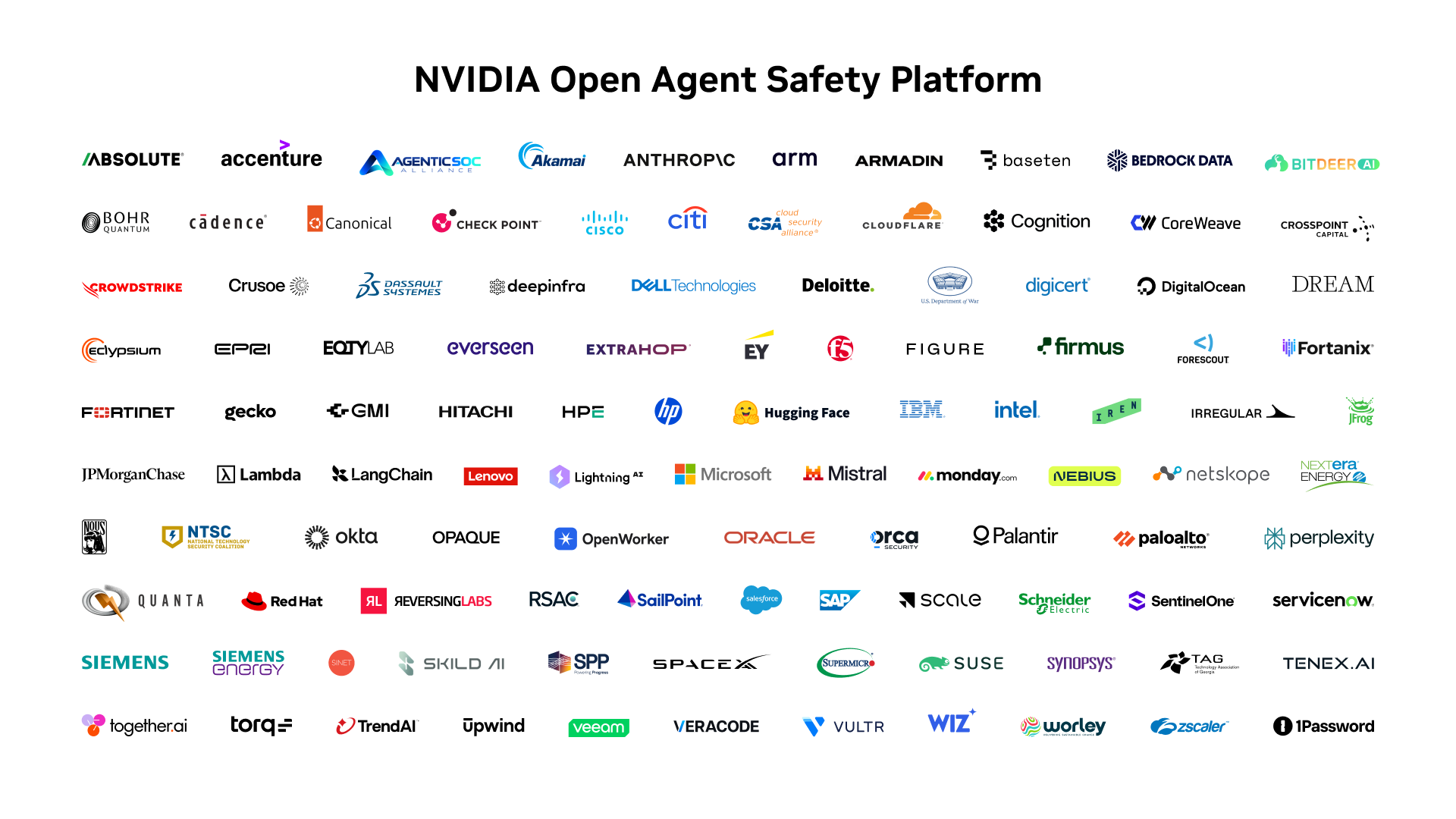
The platform is aimed at developers and enterprises deploying increasingly autonomous agents across data centers, workstations, and even robotic systems, and can work with both open and closed models. While OpenShell is optimized for Nvidia Vera — a purpose-built CPU for agentic AI — it can also be extended to third-party compute platforms from Arm and Intel, as it's open-source.
Nvidia's industry partners in the initiative include AI Labs and frameworks, security and identity providers, enterprise platforms, and hardware and infrastructure companies, with several partners already incorporating the platform into their ecosystems. SpaceXAI is using the platform with Cursor coding agents and Grok models, while Anthropic is integrating OpenShell and BlueField with Claude Managed Agents to add another layer of control.
Scale AI is incorporating the technology into its agentic infrastructure for enterprise and government customers. Similarly, Salesforce and Nvidia have also integrated OpenShell with Slack, allowing users to view agent activity, audit events, and approve or reject requests for additional permissions directly from Slack.
SAP, meanwhile, is embedding OpenShell into its Joule Studio runtime, contributing engineering work to the project, while also working with Nvidia on interoperability standards through the Open Secure AI Alliance . Robotics companies, including Figure, Gecko Robotics, and Skild AI, are also building with OpenShell to add similar controls to autonomous systems operating in the physical world.
It's somewhat surprising that the strongest voices calling for regulation are the leaders of the very labs developing the AI agents. On one hand, having the people at the forefront of development call for restraint adds validity and urgency to the concerns. On the other hand, skeptics say it might all be part of a broader “self-serving” agenda that is part marketing for the models' capabilities, part a ploy to influence whatever regulations end up being made, and part an attempt to slow down China's AI development even further. In fact, Anthropic, OpenAI, SpaceXAI, and Google are now facing an antitrust lawsuit for agreeing to slow AI development , with the plaintiff explicitly calling the move “self-serving.”
U.S. President Donald Trump appears to strongly agree with this view, saying that a “sick conspiracy” was underway to undermine. Trump announced plans for an “AI force” that will “cherish” AI and watch over it. Jensen Huang also finds calls for regulation strange. He says he is not outright against regulations but calls the recent clamoring a “distraction.” Huang argues that you cannot rely on the AI model to regulate itself or pass alignment tests. If an agent encounters a bug, it will naturally try to bypass standard software code to achieve its goal.
Huang's advocacy, however, cannot be viewed as completely altruistic. Broad restrictions on AI or a halt in development will likely reduce sales for Nvidia, whose AI accelerators power most AI models. What's more, the company's CEO has always considered rogue AI as a cybersecurity and networking failure, and is now positioning the Open Agent Safety Platform as the required infrastructure solution for the entire industry.
AI’s extraordinary potential for society will only be realized if we solve AI safety,” said Huang. “As we continue to discover the frontier of AI capabilities, we must accelerate discovery at the frontier of AI safety. Safety and security require full-stack engineering. Nvidia Open Agent Safety Platform brings together industry, researchers, and public-sector organizations to share best practices, align on evaluation methods, and foster international cooperation. Together, we can raise the bar for global AI safety.”
None of these appear to address an arguably more concerning aspect of AI safety: extremely powerful tools falling into the hands of bad actors or being used in applications that blur ethical lines. For example, blockchain-assisted cyberattacks have risen 440% since the launch of Chinese open-source AI tools that do not restrict the generation of malicious code and lower the knowledge barrier to launching cyberattacks. Elsewhere, researchers used AI to create 16 new viruses that never existed in nature. While the specific study was controlled medical research, it shows that highly dangerous applications are possible. Experts worry that such studies are way ahead of necessary guardrails and regulations.
Etiido Uko Social Links Navigation News Contributor Etiido Uko is a news contributor for Tom's Hardware covering the latest updates in big tech and the PC industry. He is a mechanical engineer and senior technical writer with over nine years of experience in documentation and reporting. He is deeply passionate about all things engineering and technology, and is an expert in gadgets, manufacturing, robotics, automotive, and aerospace.
Key considerations
- Investor positioning can change fast
- Volatility remains possible near catalysts
- Macro rates and liquidity can dominate flows
Reference reading
- https://www.tomshardware.com/tech-industry/artificial-intelligence/SPONSORED_LINK_URL
- https://www.tomshardware.com/tech-industry/artificial-intelligence/nvidia-launches-open-agent-safety-platform-to-restrain-rogue-ai-agents-new-hardware-and-software-security-stack-can-quarantine-agents-in-milliseconds#main
- https://www.tomshardware.com/my-account
- Firm rents four Nvidia H200s to test '80x cheaper' DeepSeek claim
- Fall Into 25 New Games on GeForce NOW This October
- Anthropic lists ‘existential risks to humanity’ as one of its risk factors in IPO prospectus
- AI Security Is an Engineering Problem — How to Solve It at Every Layer of the Agent Stack
- The price of AI is crashing faster than the rate of Moore's Law, report suggests
Informational only. No financial advice. Do your own research.