
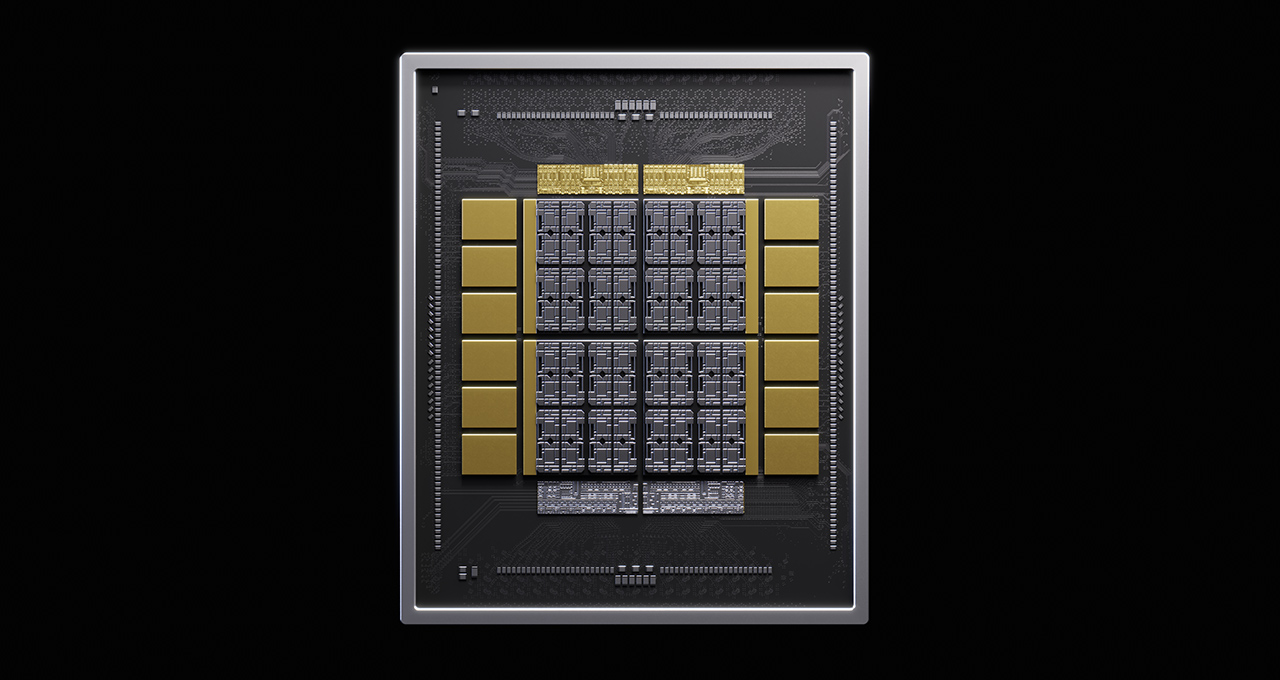
As AI agents and trillion-parameter workloads become mainstream, the performance of AI infrastructure depends not only on compute, but on how compute, memory, storage, networking and software are designed together as a unified system.
To help hyperscalers and AI innovators build the next generation of semi-custom AI infrastructure, NVIDIA today expanded NVIDIA NVLink Fusion with NVIDIA NVHBM , a next-generation high-bandwidth memory technology that brings higher memory performance and efficiency to XPUs. It will be validated and offered by leading memory partners, extending this advanced memory capability to NVLink Fusion customers.
Traditional HBM architectures place the memory controller on the XPU die, consuming valuable silicon area that could otherwise be dedicated to compute. NVHBM, built on the same technology that NVIDIA will use for future GPUs, integrates NVIDIA’s custom memory controller into the HBM base die.
By integrating the memory controller into the 3D HBM stack instead of the XPU, NVHBM delivers up to 30% greater memory bandwidth and 15% lower HBM power consumption, and frees up to 25% more area on XPU compute die compared with standard HBM4E.
NVIDIA is establishing a standard NVHBM implementation, available from multiple memory providers. This reduces the engineering effort required to integrate and qualify memory across multiple suppliers — giving NVLink Fusion customers a faster path for bringing custom AI chips to market.
Amazon’s Annapurna Labs will be the first to work on NVHBM as part of its broader collaboration with NVIDIA around NVLink Fusion.
Amazon’s Annapurna Labs will work with NVIDIA on NVHBM technology and the NVLink scale-up architecture to enhance performance and efficiency for AI workloads.
This builds on AWS’s previously announced support for NVLink Fusion. Annapurna Labs will support NVLink Fusion with its next-generation Trainium chips starting with Trainium4, which would allow Amazon chips and NVIDIA GPUs to work together with common rack-scale architecture.
“NVHBM represents a new architectural approach to advancing high-bandwidth memory performance and efficiency,” said Nafea Bshara, vice president of Annapurna Labs at Amazon . “We look forward to this technology collaboration to benefit future AWS infrastructure designs.”
NVLink Fusion enables partners to connect custom XPUs and CPUs to NVIDIA’s rack-scale platform.
Partners can access NVIDIA NVLink chiplets, NVLink-C2C, NVLink Switches and NVIDIA MGX systems and racks, as well as a broad ecosystem of CPU partners, ASIC designers, system manufacturers and technology providers.
Offered with each generation of NVIDIA’s rack-scale system architecture, NVLink Fusion allows hyperscalers and AI-native companies to focus engineering resources on XPU innovation while using a proven technology stack for scale-up and scale-out networking, rack-scale systems and software — creating a faster, lower-risk path to deploying semi-custom AI infrastructure.
Learn more about NVLink and NVLink Fusion .
Key considerations
- Investor positioning can change fast
- Volatility remains possible near catalysts
- Macro rates and liquidity can dominate flows
Reference reading
- https://blogs.nvidia.com/blog/nvlink-fusion-nvhbm-custom-high-bandwidth-memory/#primary
- https://blogs.nvidia.com/blog/author/jesseclayton/
- https://blogs.nvidia.com/blog/nvlink-fusion-nvhbm-custom-high-bandwidth-memory/#disqus_thread
- GeForce NOW Gives Gamers More Ways to Play at Gamescom 2026
- Cloudflare frees up 100TB of RAM by shrinking 1.1.1.1's DNS cache entries — 250 billion cached DNS entries at any given time means one wasted byte costs 250GB
- X busts 200,000-strong Chinese bot farm, including accounts making claims about AI data centers and electricity — suspect accounts posted claims about pricing a
- EPA faces lawsuit over claims it fast-tracked approval of toxic 'data center chemicals' — exposure to photoacid generators used for semiconductor manufacturing
- Hot Chips 2026: OpenAI's Jalapeño AI ASIC unpacked — accelerator developed using AI achieves efficiency and throughput gains against power-hungry Blackwell
Informational only. No financial advice. Do your own research.