
Kioxia announces new Super High IOPS SSD that helps accelerate AI workloads on Nvidia GPUs
Astera Labs showcases 320-lane PCIe 6.0 switch for vendor-agnostic scaling in data centers
Traditional CPU-centric I/O cannot efficiently handle such workloads and creates bottlenecks because the CPU must issue commands, manage requests, and control data transfers. Even in advanced solutions like GPUDirect Storage , which allows data to be transferred directly from SSDs to GPUs, the CPU still owns the control path and can become a bottleneck.
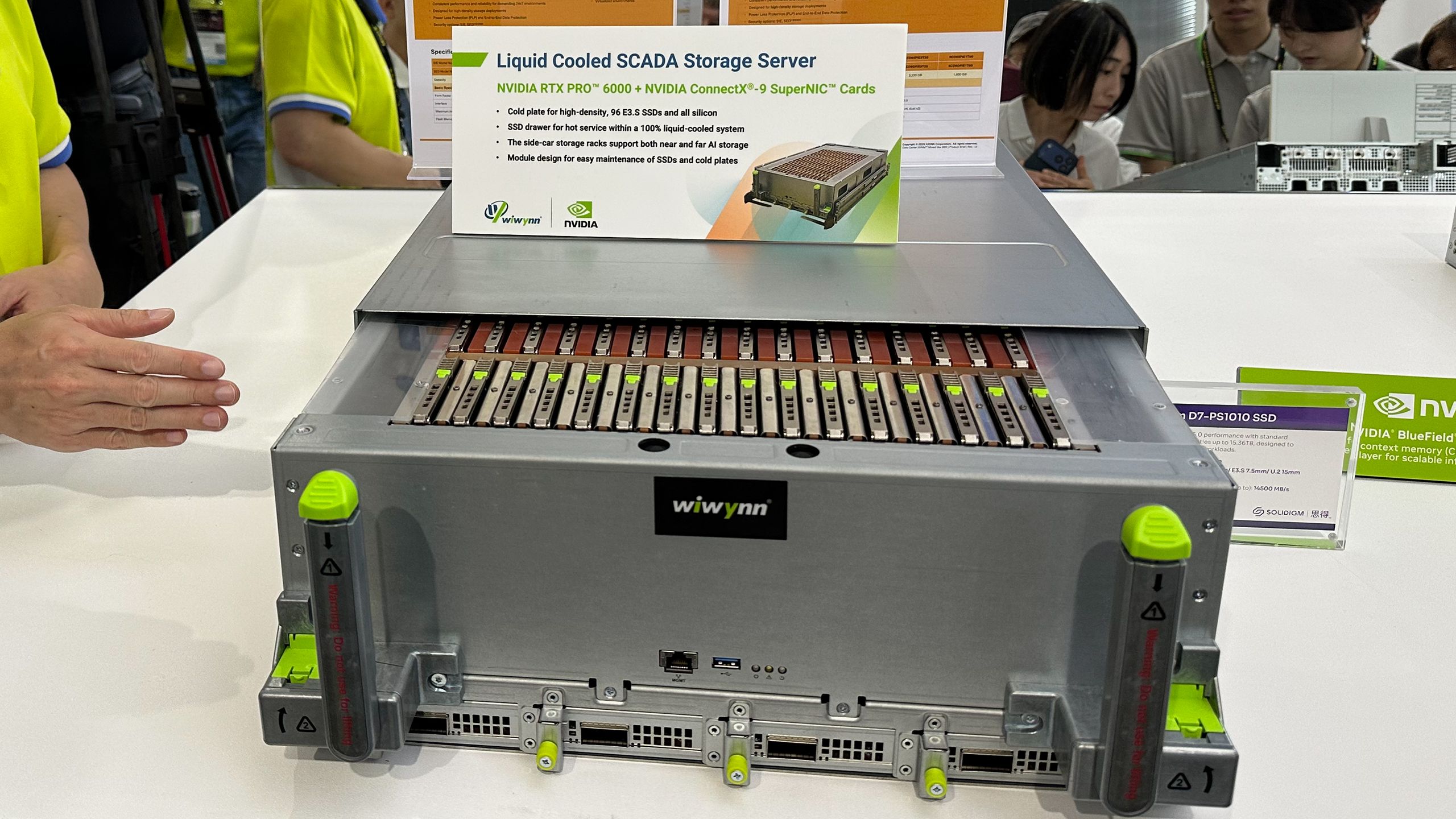
The SCADA platform, previewed in late 2025, is designed to allow GPUs access to very large datasets directly and efficiently without involving a central processor. This is impossible to do on conventional machines, as SCADA lets GPUs themselves initiate and control storage I/O operations and the data path.
SCADA runs on PCIe 6.x hardware from partners like Broadcom and Micron, and customers can now build their own SCADA machines with commercially available components. However, SCADA servers have not yet been popularized. In fact, Wiwynn seems to be among the first server makers to even showcase a SCADA server.
Wiwynn's SCADA server can indeed be a panacea for the problem that is AI storage. It supports up to 96 liquid-cooled E3.S SSDs, meaning that the drives will perform as expected even under high loads. When equipped with 96 30.72 TB Micron 9650 Pro drives with a PCIe 6.0 interface, the server can store 2.949 PB of data.
On the performance side of things, Wiwynn claims an aggregated random read speed of 528 million 4K IOPS, as well as sequential read/write speeds limited by the performance of PCIe switches and/or network cards rather than the drives themselves. As manufacturers expand the capacities and performance of their E3.S SSDs, servers like the one Wiwynn demonstrated at Computex will gain capacity and performance as well.
Phison shows PCIe 6.0 X3 SSD controller with 28 GB/s of bandwidth and 6.8 million IOPS, supports 2 petabytes per drive
Nvidia's memory costs soar 485%, latest AI systems now cost $7.8 million to build
Examining Nvidia's 60 exaflop Vera Rubin POD — how seven chips underpin company's 40 rack AI factory supercomputer
Architecturally, Wiwynn's SCADA server is an Nvidia MGX rack-compliant system in an 6RU form-actor that has a maximum power consumption of 9 kW. All key components of the machine are liquid cooled, the drives are cooled by six separate cold plate modules that are integrated into the system's liquid cooling loop so to inject coolant to all SSDs simultaneously in order to ensure consistent performance of all drives.
Nvidia clearly positions SCADA as tier 3.5 storage servers located behind local SSDs, but ahead of tier 4 remote storage servers that often rely on hard drives .
SCADA machines are meant to feed data to actual compute servers at a very high data transfer rate in small blocks, so its RTX 6000 Pro GPUs act more like very sophisticated storage processors that initiate and handle storage transactions, millions of small storage requests on behalf of AI applications, and pass them to the compute server via the ConnectX-9 cards, while the SSDs and their controllers still perform the actual storage functions.
(Image credit: Tom's Hardware) (Image credit: Tom's Hardware) (Image credit: Tom's Hardware) (Image credit: Tom's Hardware) In general, SCADA is a part of Nvidia's Storage Next vision, which is a collection of technologies aimed to make storage behave more like an extension of GPU memory for AI workloads.
For obvious reasons, Wiwynn does not disclose pricing of its SCADA storage server as it depends on multiple factors, including pricing of 3D NAND, DRAM, and SSDs, not to mention purchase volumes. In any case, an Nvidia Vera-based server equipped with four RTX Pro 6000 Blackwell graphics cards will not be cheap.
Anton Shilov is a contributing writer at Tom\u2019s Hardware. Over the past couple of decades, he has covered everything from CPUs and GPUs to supercomputers and from modern process technologies and latest fab tools to high-tech industry trends. ","collapsible":{"enabled":true,"maxHeight":250,"readMoreText":"Read more","readLessText":"Read less"}}), "https://slice.vanilla.futurecdn.net/13-4-24/js/authorBio.js"); } else { console.error('%c FTE ','background: #9306F9; color: #ffffff','no lazy slice hydration function available'); } Anton Shilov Social Links Navigation Contributing Writer Anton Shilov is a contributing writer at Tom’s Hardware. Over the past couple of decades, he has covered everything from CPUs and GPUs to supercomputers and from modern process technologies and latest fab tools to high-tech industry trends.
Key considerations
- Investor positioning can change fast
- Volatility remains possible near catalysts
- Macro rates and liquidity can dominate flows
Reference reading
- https://www.tomshardware.com/pc-components/ssds/SPONSORED_LINK_URL
- https://www.tomshardware.com/pc-components/ssds/nvidias-high-speed-ai-data-center-storage-servers-break-cover-touting-2-9-petabytes-of-storage-and-extreme-pcie-6-0-performance-wiwynn-shows-off-scada-server-with-gpu-accelerated-storage#main
- https://www.tomshardware.com/my-account
- Elon Musk's first-gen orbital data center craft spans wider than a Boeing 747 and runs an interchangeable chip payload — AI1 satellite compute payload is 120 kW
- Forecast: Fun Ahead — 18 Games Join in June to Stream on GeForce NOW
- Save $300 on Gigabyte's Gaming A16 gaming laptop at Walmart — Budget RTX 5060 -powered 16-inch laptop is now only $1,199
- Razer Blade 18 (2026) review: Coming in fast and hot
- Brad Paisley joins fight as zoo's dispute with AI data center escalates, petition tops 330,000 signatures — Nashville weighs sweeping hyperscale ban
Informational only. No financial advice. Do your own research.