
When you purchase through links on our site, we may earn an affiliate commission. Here’s how it works .
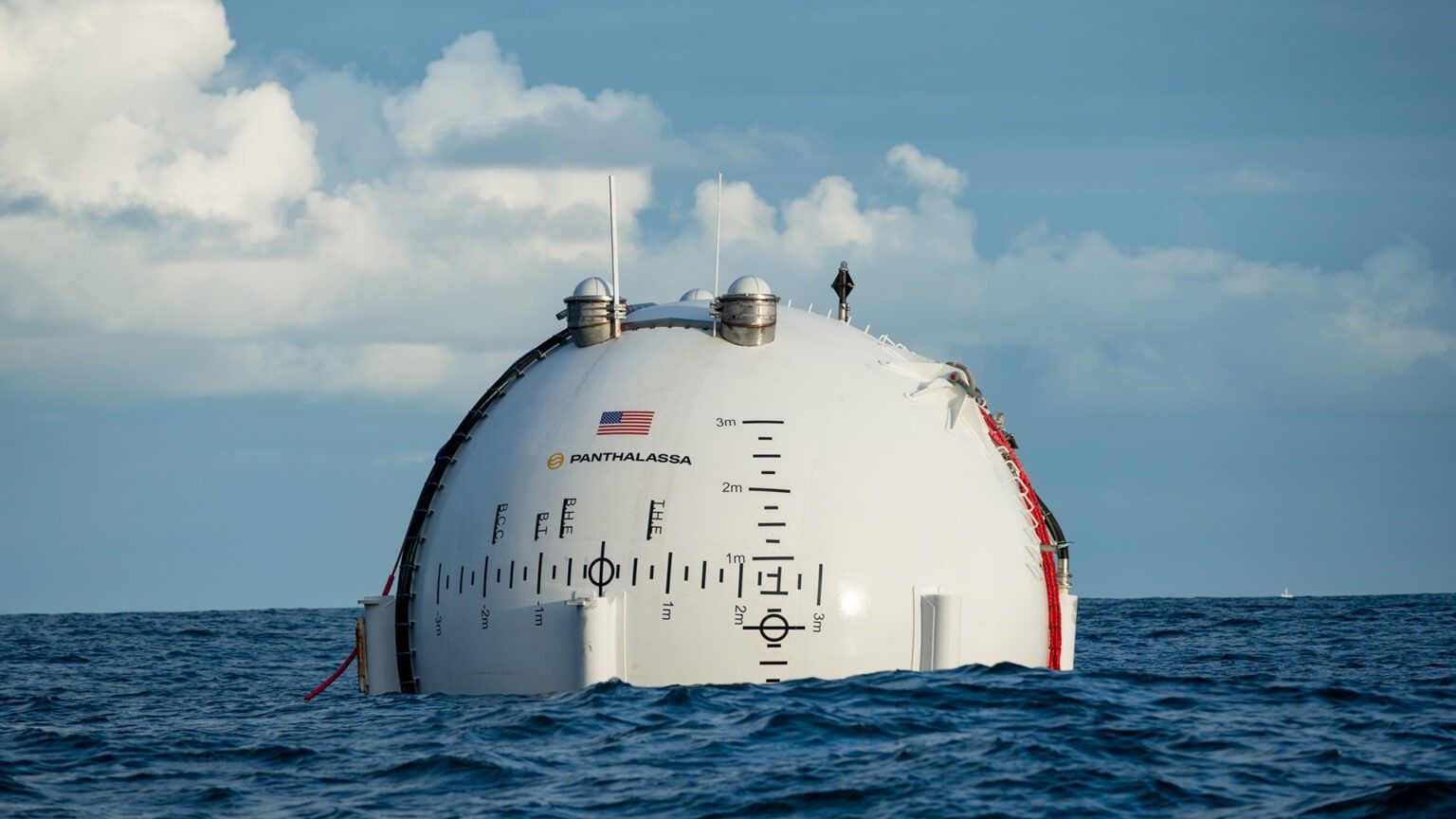
The Portland-based start-up said it would use the funding to complete its pilot manufacturing facility in Oregon for its Ocean-3 series nodes — an autonomous platform that will house and power data centers for AI inference computing at sea, using electricity generated from ocean waves.
“There are three sources of energy on the planet with tens of terawatts of new capacity potential: solar, nuclear, and the open ocean,” said Garth Sheldon-Coulson, Co-Founder and CEO of Panthalassa. “We’ve built a technology platform that operates in the planet’s most energy-dense wave regions, far from shore, and turns that resource into reliable, clean power. We’re now ready to build factories, deploy fleets, and provide a sustainable new source of energy for humanity.”
You may like US startup plans to build data centers inside ocean-based wind turbines, servers water cooled via chilly North Sea Amazon, Microsoft, and Google under investor pressure to disclose data center water and power use New AI data center in Utah will generate and consume more than twice the amount of power the entire state uses Panthalassa’s solution is an autonomous, fully integrated system called a node that houses both AI infrastructure and power-generating hardware in a single offshore unit. Each lollipop-shaped node consists of a buoyant spherical head connected to a long, submerged vertical tube and structural frame.
As ocean waves pass, the node bobs up and down, but, crucially, the surrounding water moves only in small orbital paths. This relative motion between the structure and the water column induces oscillations within the tube, effectively driving seawater up and down through the system.
That oscillating flow is channeled into the spherical chamber through a high-pressure jet, where it is converted into usable mechanical energy. The water then passes through internal turbines, generating electricity before recirculating back into the tube to repeat the cycle. The system is designed as a closed hydraulic loop that continuously extracts energy from wave-induced motion.
As the ocean never stops moving, the system generates power around the clock. That power runs the onboard payloads. For truly autonomous operation, the system transmits data back to shore via satellite, eliminating the need for tethering. Another noteworthy benefit of the system is that the surrounding ocean provides free supercooling, solving one of the biggest engineering challenges in land-based data centers.
Get Tom's Hardware's best news and in-depth reviews, straight to your inbox.
Key considerations
- Investor positioning can change fast
- Volatility remains possible near catalysts
- Macro rates and liquidity can dominate flows
Reference reading
- https://www.tomshardware.com/tech-industry/artificial-intelligence/SPONSORED_LINK_URL
- https://www.tomshardware.com/tech-industry/artificial-intelligence/palantir-co-founder-peter-thiel-backs-usd140m-wave-powered-ai-data-center-startup-panthalassa-aims-to-run-offshore-compute-nodes-using-ocean-energy#main
- https://www.tomshardware.com
- Utah first state to hold websites liable for users who mask their location with VPNs — law goes into effect, designed to prevent bypassing age checks
- CISA flags actively exploited ‘Copy Fail’ Linux kernel flaw enabling root takeover across major distros — unpatched systems may remain vulnerable to attack
- Secretlab launches Mandalorian Titan Evo gaming chair in Star Wars collection for May the 4th — collab builds with a new high-end themed chair
- OpenAI’s New GPT-5.5 Powers Codex on NVIDIA Infrastructure — and NVIDIA Is Already Putting It to Work
- Inland QN450 1TB SSD Review: Maximum efficiency, minimum spend
Informational only. No financial advice. Do your own research.