
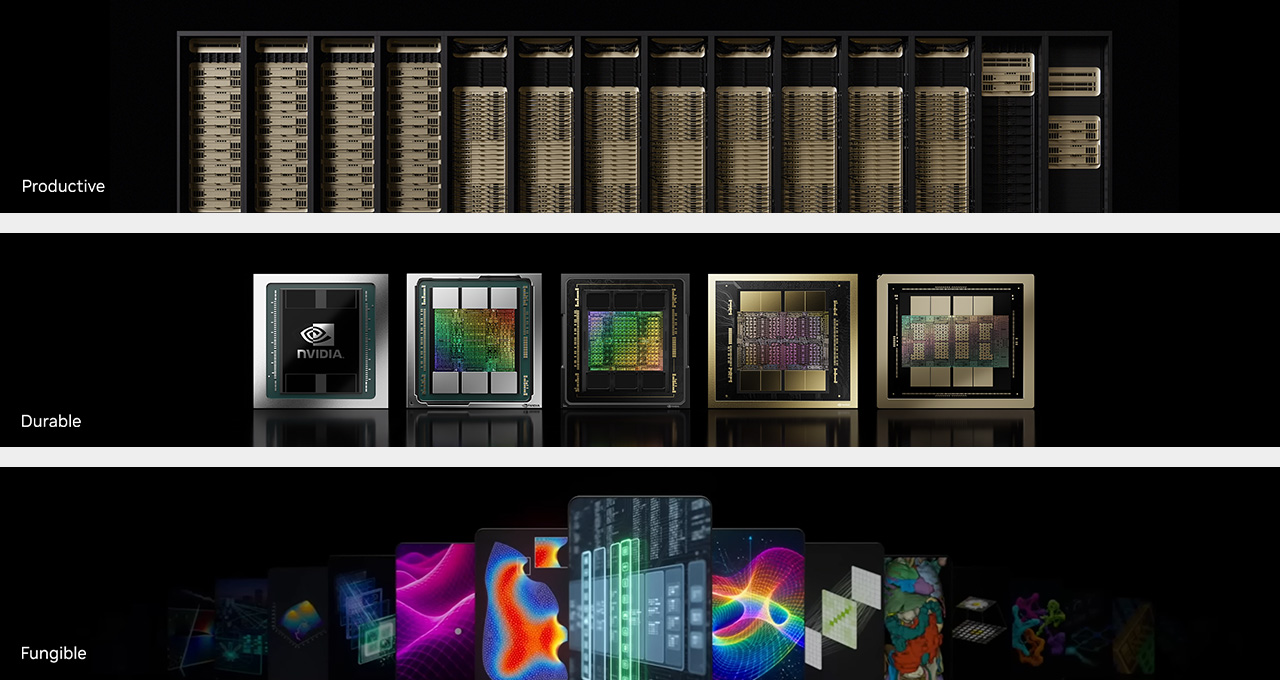
Productive : Delivering the highest throughput per megawatt and the lowest cost per token, which maximizes their earning capacity .
Durable : NVIDIA GPUs and systems keep earning years after they ship, extending useful life .
Fungible : They run every type of AI — in every phase and every place — as well as many workloads that don’t involve AI at all, which deepens and broadens the demand they can serve.
Engineering codesign across the full stack maximizes AI factory throughput, and continuous software optimization keeps installed hardware productive years after it ships. NVIDIA CUDA-X libraries let a factory run any accelerated workload. A standardized architecture then puts all of it within reach of any operator, deployable from a validated reference design.
Power is the binding constraint on an AI factory. This makes tokens per second per megawatt the number that governs earning capacity. More tokens inside a fixed power envelope means more revenue. Lower cost per token means more margin on it.
SemiAnalysis AgentX data shows NVIDIA Vera Rubin NVL72 systems deliver over 30x higher throughput per megawatt than NVIDIA GB300 NVL72, and up to 45x lower cost per million tokens on the DeepSeek V4 Pro model. Gains of that size come from extreme codesign across the full stack: from models and workloads down through software to compute, networking and memory, all optimized together.
Two questions follow. If every generation makes tokens dramatically cheaper, does demand for compute shrink?
Cheaper tokens make more use cases economical, and those use cases consume more tokens than the efficiency saved.
The second question is about durability. If each generation is so much better than the last, what happens to the older generations?
Not every workload needs the newest system. The right fit depends on a workload’s complexity and shape, which is why the last generation keeps earning after the next one arrives.
The NVIDIA A100 GPU shipped in 2020 and is still in commercial service six years later, demonstrating its continued economic value; CoreWeave recently extended bookings for units first introduced in 2020 through 2029. Over the years, every major operator has extended the depreciation schedule on its servers, which is a guess about when hardware stops earning, and one that keeps moving out. A September 2026 Sprout analysis, “ The Productive Life of a Data Center GPU ,” tracks how that schedule has shifted across every major operator.
Barkr puts useful life at five to six years for an eight-GPU H100 system and nine to 10 years for GB300 NVL72, based on what those systems resell for. Silicon Data shows a six-year-old A100 GPU is still worth a quarter of what it cost, where a five-year depreciation schedule had it at zero more than a year ago. Ornn Data finds the market paying 80% as much to rent an A100 GPU on a five-year contract as on a one-month contract.
CUDA , the software platform with which NVIDIA GPUs are programmed, runs across generations, so nothing an operator already owns is stranded when a new architecture arrives. Continuous software and kernel optimization keeps improving what existing hardware can do.
The same platform runs machine learning, deep learning, generative AI, reasoning, agentic AI and physical AI. Each new kind of work arrived on hardware that was already installed.
That’s fungibility. The more kinds of work a system can take, the longer it keeps finding work.
A factory built for one kind of work is a bet that the work stays. A factory that runs everything stays useful and revenue-generating even when the work changes.
NVIDIA AI factories run every type of AI model — open and proprietary — across language, vision, biology, physics and robotics. They run every phase, from data processing through pretraining, post-training and inference. And they run in every place, from hyperscale and AI clouds to sovereign programs, enterprise data centers and the edge.
Not all of it is building and running AI models. The same infrastructure runs data processing, scientific computing, simulation, graphics and more.
All of those workloads, AI and non-AI alike, reduce to the same parallel math, and NVIDIA GPUs are built to run exactly that across thousands of cores at once. CUDA is why one chip can simulate light, fold a protein and predict the next token. More than 1,000 ready-made CUDA-X libraries sit on top, covering everything from deep neural networks, computational lithography and quantum circuit simulation to vector search and climate modeling, with more than 10 million developers building on them.
That’s what makes NVIDIA GPUs general-purpose accelerated computing rather than a custom ASIC built for one workload. Being general purpose does not mean being generic: Tensor Cores and the Transformer Engine put AI-optimized hardware inside a programmable architecture, delivering specialization and flexibility in one chip. One architecture running all of it is what keeps utilization high, and the return with it.
This versatility shows up in production across customers:
Key considerations
- Investor positioning can change fast
- Volatility remains possible near catalysts
- Macro rates and liquidity can dominate flows
Reference reading
- https://blogs.nvidia.com/blog/productive-durable-fungible-ai-factories/#primary
- https://blogs.nvidia.com/blog/author/shrutikoparkar/
- https://blogs.nvidia.com/blog/productive-durable-fungible-ai-factories/#disqus_thread
- University of Manchester Uses NVIDIA Earth-2 to Forecast Air Pollution Across the UK
- The price of AI is crashing faster than the rate of Moore's Law, report suggests
- Sony Japan tries an anti-scalper lottery system for PS5 Pro orders, locks systems behind a 60-hour playtime requirement
- 5 Companies Using NVIDIA AI for Clean Energy
- Sony Japan tries an anti-scalper lottery system for PS5 Pro orders, locks systems behind a 60-hour playtime requirement
Informational only. No financial advice. Do your own research.