
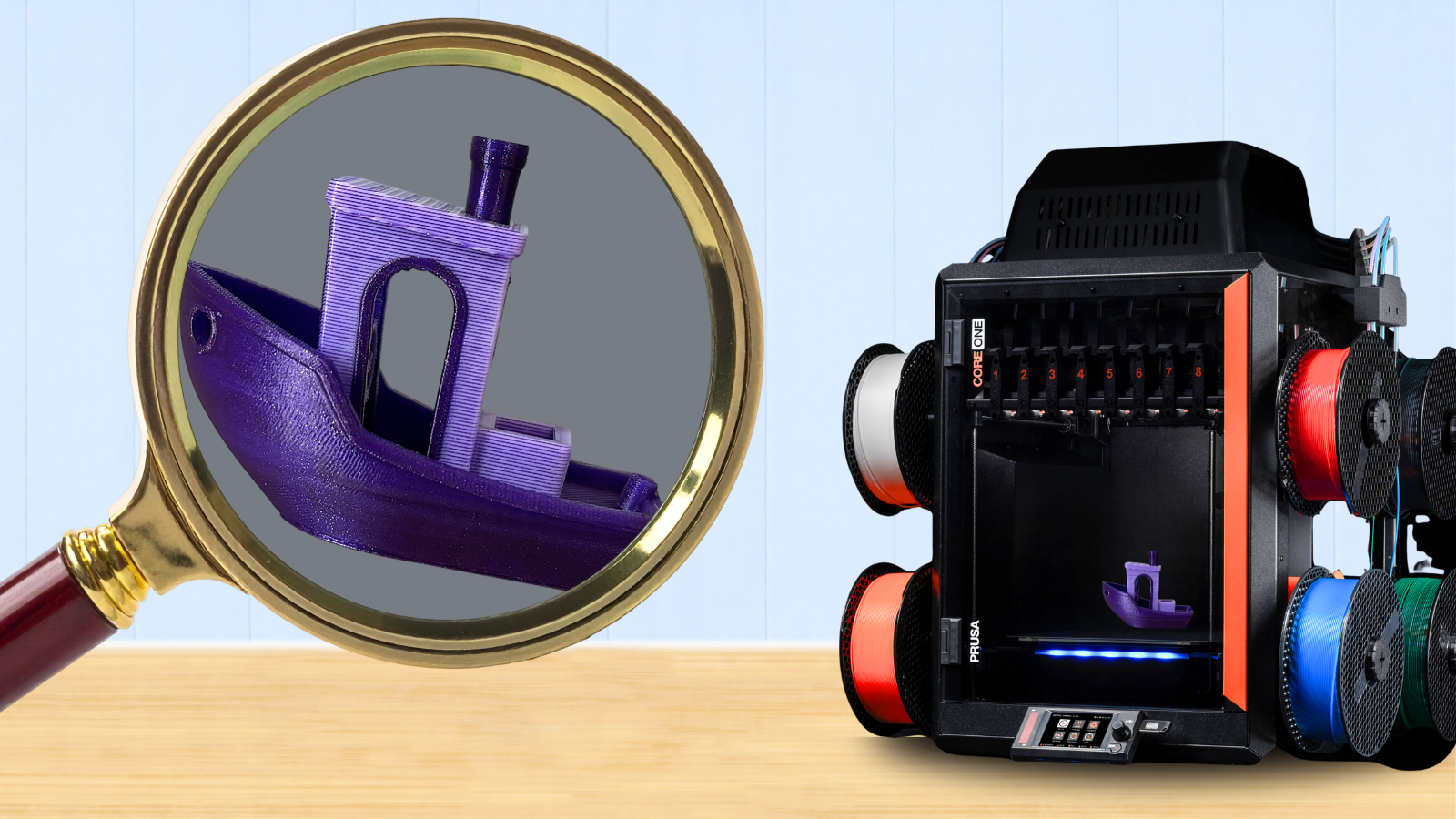
Open-source ColorMix is now available on Prusa Slicer and the EasyPrint mobile app.
When you purchase through links on our site, we may earn an affiliate commission. Here’s how it works .
Full Spectrum is a method of visually blending FDM filaments to create an endless color palette. The technique is gaining popularity with the rise of toolchangers and similar multimaterial 3D printers. The method works best when you print at ultra-thin layer heights, which toolchangers can achieve with relative speed and minimal waste.
We doubt that color mixing will replace having individual spools of precise color anytime soon. Besides the extra time, Full Spectrum colors can exhibit rather obvious banding, especially when using opaque materials. But it can create subtle shades and hues that are otherwise difficult to find. On the Benchy’s below, I used the same 75% white with 25% purple. The boat on the left used a translucent “high speed” white, which blended much better than the standard opaque white on the right.
We tested ColorMix on a 3D Benchy using a Prusa MK4 with an MMU3, and it took over 7 hours to create a 66-gram purge tower. On a Prusa XL toolchanger, the time was reduced to 2 hours and 46 minutes, with only 22 grams of waste. Prusa’s new INDX should be able to increase print speed while reducing waste to nearly nothing.
Originally developed by Radu (aka Ratdoux) using OrcaSlicer and a Snapmaker U1 toolchanger , his technique is very much like HueForge’s color painting . While HueForge images are super thin and meant to be viewed from the top down, Full Spectrum can be applied to ordinary models and is best viewed from the side.
Bambu updates its 3D printers to print unique hues or gradients using two or three filaments
Josef Prusa says Bambu Lab allegedly violates AGPL license with an un-auditable network 'black box'
The challenge to "filament painting” an FDM print is that plastic filaments can’t mix together like paint or ink. Instead, you need to create the illusion of color by tricking the eye. The team at Prusa Research noticed a similarity between Ratdoux’s method and halftoning, which produces color images by spacing small dots. If you've ever looked closely at printed comic books, newspapers, or magazine photos, you’ve seen halftones at work.
Paper printing presses use what’s known as CMYK, with four standard colors of ink: cyan, magenta, yellow, and black. White is provided by the underlying paper. ColorMix uses five filament colors, which the team at Prusa Polymers is currently working to standardize as part of its method. If you want to try ColorMix right now, they suggest using Prusament Azure Blue , Ms. Pink , and Pineapple Yellow . We expect Prusament’s CMYKW to be a bit translucent as well, which will further help blend the color.
Get Tom's Hardware's best news and in-depth reviews, straight to your inbox.
Key considerations
- Investor positioning can change fast
- Volatility remains possible near catalysts
- Macro rates and liquidity can dominate flows
Reference reading
- https://www.tomshardware.com/3d-printing/SPONSORED_LINK_URL
- https://www.tomshardware.com/3d-printing/prusa-research-goes-full-spectrum-in-anticipation-of-indx#main
- https://www.tomshardware.com/subscription
- Finland deploys new system to detect threats to undersea cables — distributed acoustic sensors measure vibrations from the seabed and informs the authorities an
- Gigabyte Z890 Aorus Elite Wifi7 Plus Motherboard Review: Cost-conscious refresh board delivers (almost) all the fixens
- Aoostar mini-PCs bring elite Ryzen power in a tiny footprint for under $400
- Intel will reportedly upgrade its Wildcat Lake refresh to an 8-core config next year, leak claims — top-end silicon tipped to feature 4 P-cores and 4 LP-E cores
- Outlook may have allowed unencrypted connections for decades, report claims — Fedora and Dovecot upgrade reveal protocol downgrade issue present since at least
Informational only. No financial advice. Do your own research.