
SanDisk features two pieces of software for the Optimus GX Pro 8100: the SanDisk Dashboard, based on WD’s Dashboard, and Acronis True Image for SanDisk. Both applications support other products, and SanDisk also has other software that applies to other products, so check the Software Downloads page if you own a different drive. While the OEM Acronis package has obvious applications – it’s for backing up, cloning, and recovering files – the Dashboard may be more involved for the average user. This SSD toolbox helps you stay on top of your drive’s health, it covers optional features, allows you to update the firmware, and more.
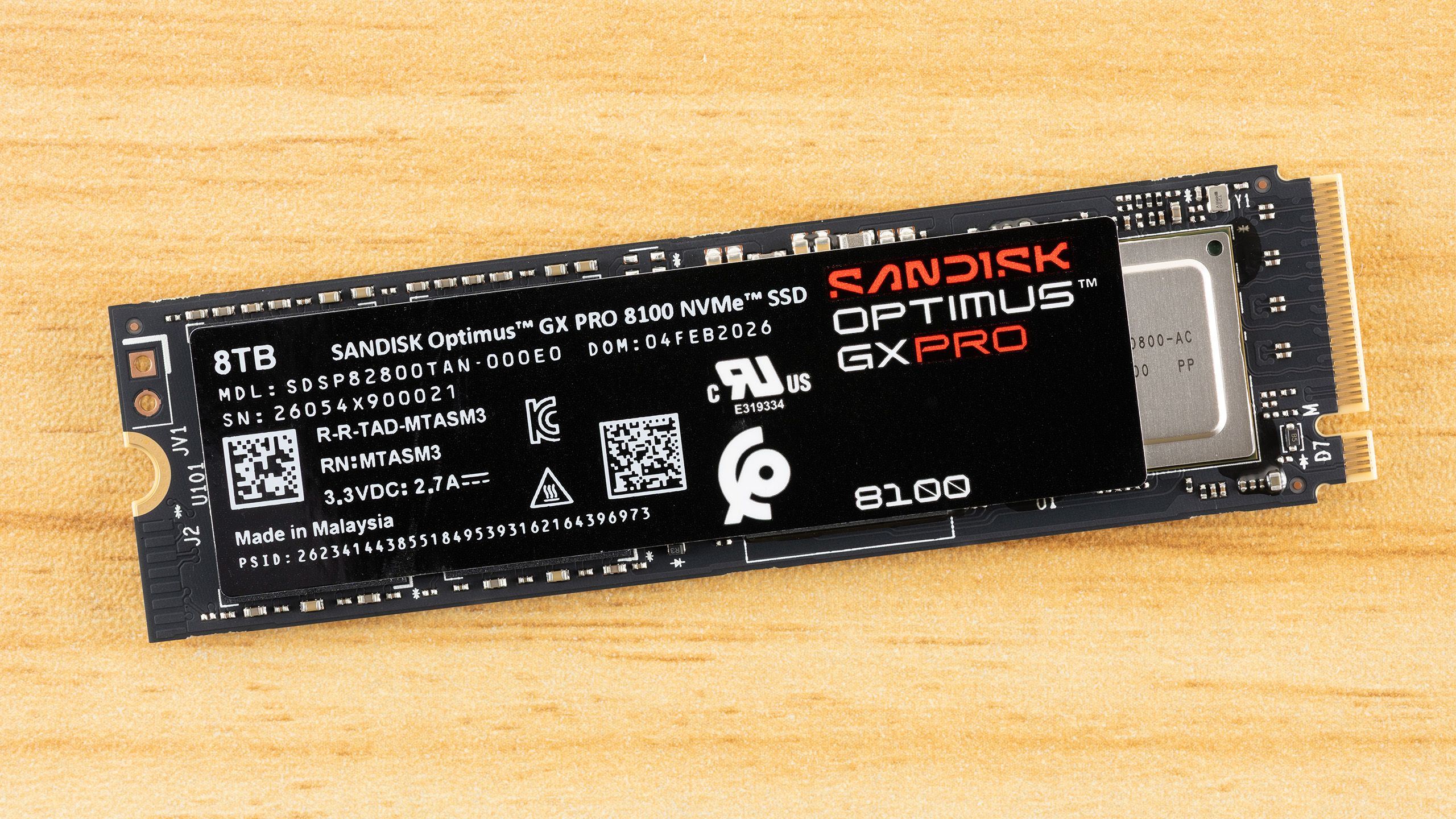
(Image credit: Tom's Hardware) (Image credit: Tom's Hardware) The 8TB Optimus GX Pro 8100 is a double-sided drive. At all other capacities, it is single-sided. If you’re going for the heatsinked version of the drive, this doesn’t matter, though. In rare cases, you might have a system that needs or prefers a single-sided drive, in which case it’s worth being aware of the fact that you will be limited to 4TB.
As to why the drive is double-sided only at 8TB, that has to do with how many NAND flash packages can fit on the PCB. With the controller and DRAM on the top side, there is only room for two flash packages. Each package can usually have a maximum of sixteen dies. Each die is 1Tb, or 128GB. Therefore, each package contains a maximum of 2TB of flash. Since four packages are necessary for 8TB, the 8TB SKU is necessarily double-sided. There will be exceptions to this on drives that can fit four flash packages per side – DRAM-less drives, and especially ones with only four flash channels, as the controllers may be smaller, or drives with denser flash. 2Tb QLC flash is certainly a possibility, although for the time being, such flash would be prioritized for enterprise.
The only other interesting information here is the power rating. 3.3V / 2.7A puts the power ceiling around 9W, which is more than ample for the average power numbers that SanDisk lists on the specifications sheet. We should point out that those numbers are averages, and for reads and writes separately. In fact, the drive via SMART is rated for active power draw of 8.9W – exactly where 3.3V / 2.7A hits – with a potential peak of 9.5W. Active power could include mixed workloads, that is, both reads and writes, and as that’s what we test, we would expect our maximum value to be closer to that active power number.
(Image credit: Tom's Hardware) (Image credit: Tom's Hardware) (Image credit: Tom's Hardware) The drive has an SSD controller, power management circuitry, two DRAM packages, and four NAND flash packages. The controller is branded SanDisk with the “A101” being telltale, but the “2508” in the middle tells us the truth: this is a Silicon Motion SM2508 and not a proprietary solution. This is a high-end PCIe 5.0 controller with eight flash channels and DRAM support. It’s newer than the original PCIe 5.0 controller, the Phison E26, and is made in a smaller process node. As a result, it is significantly more power-efficient, which is a very good thing considering that some E26 drives came with active cooling. WD and SanDisk do tweak the controller firmware and use nCache 4.0 to separate the drive from more generic designs.
The DRAM is labeled D8CKD, and each package is thus 32 GB or 4GB of DDR4 in a 16-bit configuration. This is 8GB total, which maintains the 1GB:1TB DRAM:NAND flash ratio we expect for optimal performance. You could use more efficient DRAM, but the power savings would be relatively small. The flash – labeled in part with 2527 for the 27th week of 2025, exactly matching the controller’s 2527 – is 1Tb BiCS8 TLC. This flash has proven to be power-efficient with exceptionally low random read latency. There’s a reason we find the Black SN8100 hard to beat, and that’s with this combination of characteristics.
Current page: SanDisk Optimus GX Pro 8100 Introduction
Key considerations
- Investor positioning can change fast
- Volatility remains possible near catalysts
- Macro rates and liquidity can dominate flows
Reference reading
- https://www.tomshardware.com/pc-components/ssds/SPONSORED_LINK_URL
- https://www.tomshardware.com/pc-components/ssds/sandisk-optimus-gx-pro-8100-8tb-ssd-review#main
- https://www.tomshardware.com
- Asus ProArt PA27USD 27-inch OLED review: Precision color with high-speed gaming prowess
- Intel’s performance-enhanced 18A-P process enters risk production — drop-in 18A upgrade promises 9% performance improvement at iso-power, cuts thermal resistanc
- Build an elite AMD gaming PC around Gigabyte's X870 motherboard for $70 off — Gigabyte X870 Aorus Elite WiFi7 drops to $249
- 2021 Honda Civic infotainment system can be jailbroken via USB — flaw uses public Android test keys to install unauthorized apps, enables for 'EvilValet' attack
- NVIDIA Confidential Computing to Help Expand Apple’s Private Cloud Compute
Informational only. No financial advice. Do your own research.