
When you purchase through links on our site, we may earn an affiliate commission. Here’s how it works .
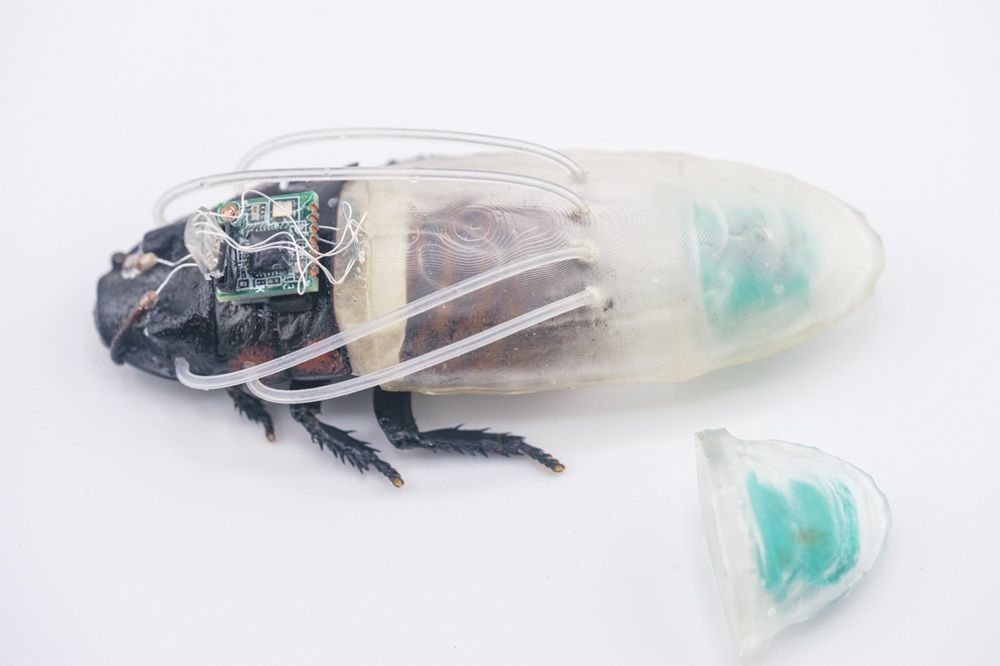
Although that description sounds like the start of a sci-fi or horror movie, the team led by Hirotaka Sato at Nanyang Technological University has been working with the much-hated pest for a good while, outfitting them with infrared cameras in a bid to help rescue operations by steering the roaches in disaster areas to find survivors. To be clear, as the release notes, Cyborg insects are living insects that have been retrofitted with technology. Sato's team had already demonstrated an orchestrated swarm of the little beasties in 2024, but reportedly wasn't happy with the fact that they couldn't send them through water, and went back to the drawing board to fix that.
The result is an upgraded form that went underwater for three hours in stages, at a depth of 20" (50 cm); enough for most puddles and lightly flooded areas. Quite interestingly, the roaches' speed was only lightly affected, going from 3.5" (8.75 cm) per second on land to 3.1" (7.84 cm) a second while submerged in water. Cockroaches don't swim per se , but they can paddle-float, and are fine navigating water bodies in general, and it's possible they can go deeper than in the test.
To achieve this, the animals wear a spiffy-looking bespoke 3D-printed scuba suit, complete with tubes that attach from the tank to their "nostrils," called spiracles. The tank has a sponge with both hydrogen peroxide and manganese dioxide, in a slow, carefully tuned reaction that outputs oxygen at a controlled rate. This choice was made to avoid the tricky task of providing a heavy, pressurized oxygen tank — though imagining a cockroach with a tiny tank backflipping into water from a tiny boat is amusing.
The cockroach is pretty much the ideal platform for this type of endeavor, as their legs are easy to control with electrical impulses, and their locomotion characteristics let them navigate almost every type of terrain, oftentimes better than many miniature robots. Their biological batteries theoretically last for weeks on end, too. One roach needs food only every few weeks, a mission-critical feature given that scientists working with miniaturization of any sort keep butting their heads against energy limitations. The IR cameras and wireless do use an actual mini battery pack, but the insects themselves can find sustenance on their own.
MIT researchers revive 40-year-old triangular zipper concept now made possible by 3D printing, creates shape-shifting robots and deployable structures
DARPA calls for proposals for autonomous underwater drones
Key considerations
- Investor positioning can change fast
- Volatility remains possible near catalysts
- Macro rates and liquidity can dominate flows
Reference reading
- https://www.tomshardware.com/tech-industry/robotics/SPONSORED_LINK_URL
- https://www.tomshardware.com/tech-industry/robotics/scientists-have-created-a-3d-printed-remote-controlled-cyborg-cockroach-equipped-with-ir-cameras-living-insects-fitted-with-flexible-diving-suit-can-survive-and-move-underwater-for-three-hours#main
- https://www.tomshardware.com/subscription
- Palantir CEO Alex Karp claims AI companies are stealing customers' data while charging them for unproductive tokens — says 'livid' businesses 'are paying for to
- Supermicro denies that its offices were raided by Taiwanese authorities in Nvidia GPU smuggling case — company says that it coordinated with the police and prov
- GitHub thumbs nose at Sony's controversial end to physical media with its introduction of Repo CDs — offers limited run of 1,000 CD-ROM copies of public GitHub
- Startup activates nuclear microreactor live on stage to power an Nvidia RTX Spark desktop PC — firm working with Nvidia to build a 30MW closed loop AI factory t
- HP has slashed $1,075 off this RTX 5070 gaming PC in its July 4 sale — Omen 35L with 32GB of RAM now just $1,724
Informational only. No financial advice. Do your own research.