
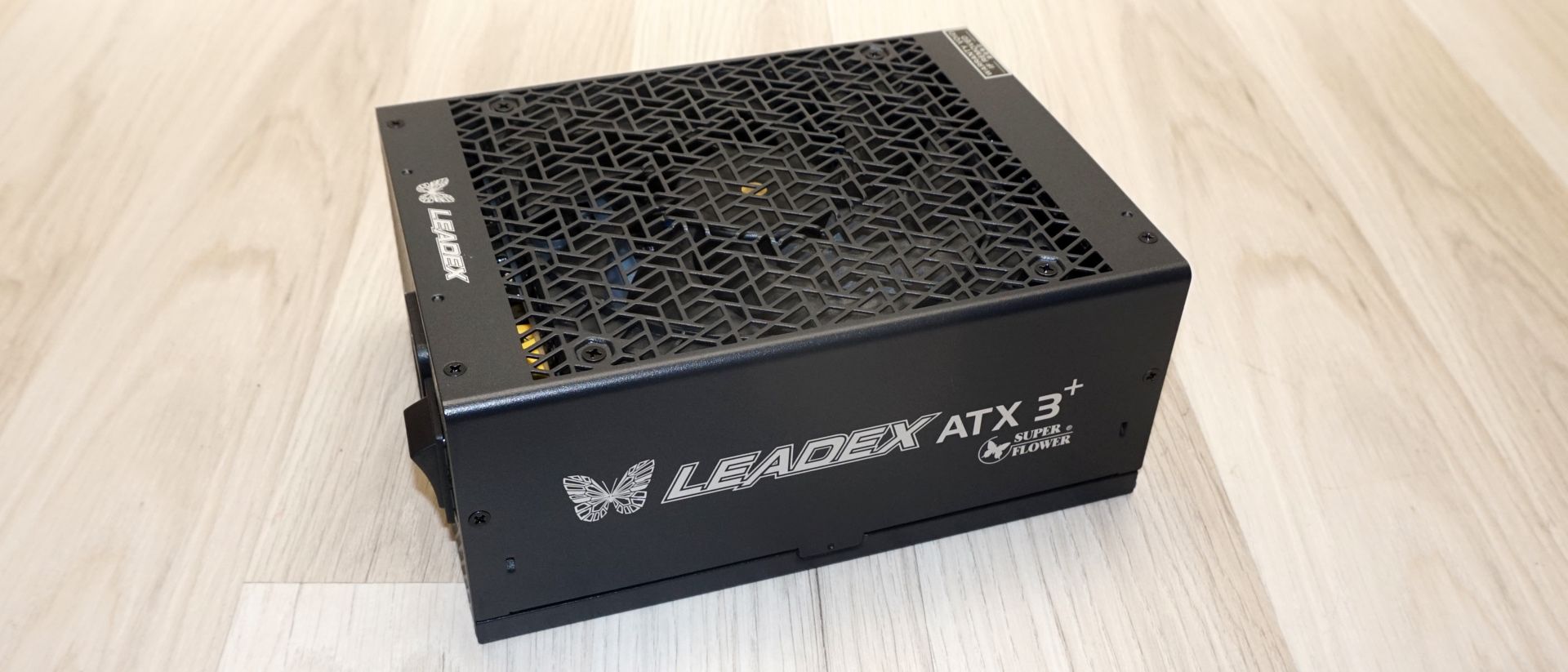
(Image credit: Tom's Hardware) (Image credit: Tom's Hardware) The front panel holds a large on/off rocker switch alongside the NEMA C19 AC receptacle. The rear panel hosts the full array of modular connectors, each accompanied by a subtle white printed legend. The overall impression is that of a product designed by engineers who are also paying attention to graceful aesthetics, even if aesthetics were not the primary concern.
(Image credit: Tom's Hardware) (Image credit: Tom's Hardware) Internal Design Cooling is handled by a ZLC ZFB142512D 140mm fan using a fluid dynamic bearing engine. Fluid dynamic bearings remain the preferred solution for balancing acoustic output against service life, offering better longevity than sleeve bearings and quieter operation than dual ball bearings. The rated maximum speed is 3000 RPM, which is unusually high for a 140mm fan. It is, however, not unreasonable given the thermal load this unit must manage at full output, where waste heat alone approaches the total power draw of a typical desktop PC. There is no zero-RPM mode. The fan runs at all times, though it operates at very low speed under normal loads and is effectively inaudible below approximately 1000 watts of output.
There is no hidden OEM here. Super Flower designs, develops, and manufactures these units entirely in-house, and the Leadex 2800W demonstrates that capability fully. If one were to describe this design very plainly, “two 1400W units in parallel” would not be an entirely wrong assessment.
(Image credit: Tom's Hardware) (Image credit: Tom's Hardware) Input filtering is substantial: eight Y capacitors, four X capacitors, and two filtering inductors. A single bridge rectifier is present but serves only the 5VSB circuit. The main power path bypasses it entirely, as the APFC stage uses a bridgeless topology that operates directly on AC voltage.
This is a more complex and more efficient design approach than the conventional bridged APFC found in most units. Eight Infineon 60R070F7 MOSFETs handle the APFC function, paired with four D1065C5 diodes on vertical daughterboards. The heatsinks are notably small, which directly reflects on the efficiency of the Infineon products. Two large encased inductors and three Nippon Chemi-Con 790 μF bulk capacitors round out the APFC stage, providing the capacitance reserves that a 2800-watt design demands.
The primary inversion stage uses eight Infineon 60R070F7 MOSFETs in a dual full-bridge configuration with LLC resonant conversion. These run on vertical daughterboards with no heatsink beyond the PCB itself, which speaks to the efficiency margins these MOSFETs operate within. LLC resonant converters allow the switching transistors to operate at zero-voltage switching conditions, dramatically reducing switching losses compared to hard-switching topologies and contributing directly to the efficiency figures observed in testing.
(Image credit: Tom's Hardware) (Image credit: Tom's Hardware) The 12V secondary rail uses sixteen Infineon 014N04LS MOSFETs in a dual synchronous rectification topology across two vertical PCBs. The 3.3V and 5V rails are produced by DC-to-DC converters on a separate daughterboard, which is the correct approach for maintaining tight minor rail regulation independent of 12V loading. All secondary-side electrolytic capacitors come from Rubycon and Nippon Chemi-Con. Solid-state capacitors are sourced entirely from Nippon Chemi-Con. Both manufacturers are at the top of the industry for quality consistency and long-term reliability. There are no cost-cutting compromises in the component selection.
For the testing of PSUs, we are using high precision electronic loads with a maximum power draw of 2700 Watts, a Rigol DS5042M 40 MHz oscilloscope, an Extech 380803 power analyzer, two high precision UNI-T UT-325 digital thermometers, an Extech HD600 SPL meter, a self-designed hotbox and various other bits and parts.
(Image credit: Tom's Hardware) (Image credit: Tom's Hardware) (Image credit: Tom's Hardware) (Image credit: Tom's Hardware) (Image credit: Tom's Hardware) Due to the output capacity of this unit, our standard electronic load equipment required supplementation with additional high-capacity resistive loads to draw more than 2400 watts from the 12V rail alone. As the Leadex 2800W is specified for 200 to 240 VAC input, all testing was conducted at 230 VAC. At that input voltage, average nominal load efficiency reaches 94.5% – a breath away from the Diamond certification. At the time of this review, the unit holds Cybenetics Titanium certification, with no current CLEAResult (80Plus) or PPLP certification on record.
Efficiency is outstanding across the entire nominal load range. It peaks at approximately 40% load and remains stable and well-behaved through most of the operating range before declining moderately at the highest load points. Low-load efficiency is also strong. The fan is inaudible at first startup and remains effectively silent below 1000 watts, which is already a substantial load, well beyond what a single high-end GPU system typically demands at idle or moderate gaming. Above 1000 watts, fan speed increases sharply and the unit becomes progressively louder. At full rated output, acoustic output is significant. This is expected and unavoidable for a unit of this capacity. Thermal performance under cold ambient conditions is excellent, with no signs of stress.
Elevated ambient temperature produces only minor degradation. Average nominal load efficiency at 230 VAC drops to 93.8%, a reduction of 0.7% relative to cold testing. This is a small and entirely acceptable figure. There are no signs of thermal stress. Internal temperatures are elevated, as expected, but the unit does not approach its over-temperature protection threshold under sustained high-load testing.
(Image credit: Tom's Hardware) (Image credit: Tom's Hardware) (Image credit: Tom's Hardware) (Image credit: Tom's Hardware) (Image credit: Tom's Hardware) Fan behavior is somewhat more aggressive than in cold testing. Maximum fan speed is reached at approximately 80% load rather than at the ceiling. Above 1500 watts under these conditions, acoustic output becomes very significant. To put this in context, 1500 watts already exceeds the maximum output of most consumer PSUs currently on the market, including most units equipped with connectors for dual high-end GPUs. The noise at this load level is a consequence of physics, not a design deficiency.
Voltage regulation is outstanding across all rails. The 12V rail holds within 0.8% across the full load range. The 5V rail regulates to within 0.5%, and the 3.3V rail to within 0.4%. These are reference-class figures by any standard. Ripple filtering is even more impressive. The 12V rail peaks at 28 mV, the 5V at 22 mV, and the 3.3V at 20 mV. All figures sit well inside the ATX specification limits and represent genuinely clean output from a unit operating at power levels that are unfathomable by typical products.
During our routine evaluation, we examine the fundamental protection features of all power supply units we review, including Over Current Protection (OCP), Over Voltage Protection (OVP), Over Power Protection (OPP), and Short Circuit Protection (SCP). OCP and OPP figures deserve a practical note: the measured OCP and OPP limits during hot testing reflect the constraints of our lab's power outlet rather than the absolute limits of the unit itself. With the MCB theoretically rated at 3680 watts and even with its natural trip delay under sustained overload, drawing beyond 4000-4200 watts causes the outlet’s MCB to interrupt testing before the PSU's own protection circuits engage. The 3.3V OCP triggered at 152% of rating and the 5V at 148%. The 12V OCP engaged at 130%. Hot OPP was measured at 134%
The Super Flower Leadex 2800W occupies a category by itself. There is no comparable retail product at this output level, and the performance figures justify that position entirely. Efficiency is exceptional, power quality is reference-class, the component selection is unimpeachable, and the build quality is among the best we have examined. Super Flower has used this unit to demonstrate what the company is capable of when the brief is maximum performance without cost constraint. It is, in every measurable sense, the best power supply unit we have tested.
What makes that statement meaningful is not the wattage rating alone. High wattage claims are easy to print on a box. What Super Flower has delivered here is a unit where every subsystem is engineered to match the stated output rather than merely survive it. The advanced topologies, the top-quality active components, and the exclusive use of Rubycon and Nippon Chemi-Con capacitors throughout are not marketing decisions. They are engineering decisions made by a company that has been building serious power electronics for over three decades and knows precisely what a 2800-watt platform demands internally to operate with the voltage regulation and ripple figures we recorded. Those figures, in turn, are not academic. Clean and stable power delivery at extreme current levels directly influences the stability and longevity of the hardware connected to it, which, in the systems this unit is designed for, represents a very significant financial investment.
Criticism exists but is narrow. The unit requires a 200 to 240 VAC power feed to operate usefully. At 115–120 VAC, it functions, but a standard North American outlet limits usable output to less than 1700 watts, which renders the remaining capacity inaccessible and makes the purchase largely pointless for that use case. For USA-based users, a dedicated 240 V AC circuit is required for this power supply to operate at maximum capacity. The unit should be connected using an appropriate high-current connector, such as a NEMA 6-15 or NEMA 6-20 outlet, depending on the circuit rating. Standard 120 V outlets are not sufficient. The case requirements are equally restrictive; at 200mm, the unit will not fit in many typical cases and demands a chassis designed specifically for workstation or extreme gaming hardware. These are not flaws in the product so much as hard physical constraints that any prospective buyer must resolve before purchasing.
The fan noise at loads above 1500 watts is considerable and increases steeply toward the unit's output ceiling, where it becomes genuinely loud. This is an honest consequence of the thermal energy involved rather than a fan selection or tuning failure. At full rated output, the waste heat alone rivals the total power draw of a conventional PC, and moving that heat out of a 200mm chassis on a unit with barely any heatsinks at all inevitably requires airflow. The absence of a zero-RPM mode is a minor inconvenience. The fan is effectively inaudible at low loads, and any system drawing enough power to justify this unit will generate enough of its own acoustic output to render the PSU fan irrelevant to the overall noise profile.
At an MSRP of $1000 and a street price of approximately $800, the Leadex 2800W is inaccessible to the overwhelming majority of buyers. It does not need to be accessible. It exists for extreme workstation and multi-GPU builds where total system power demand approaches or exceeds what any other retail PSU can supply, and for those builds it is the correct and, for now, practically the only serious answer. For everyone else, Super Flower's broader Leadex lineup offers the same engineering heritage at outputs and prices that fit a wider range of budgets and cases. But if the build truly demands 2800 watts and the operator demands that those watts be delivered cleanly, quietly at moderate load, and with genuine protection margins, this unit practically stands alone.
Dr. E. Fylladitakis has been passionate about PCs since the 8088 era, beginning his PC gaming journey with classics like Metal Mutant and Battle Chess. Not long after, he built his first PC, a 486, and has been an enthusiast ever since. In the early 2000\u2019s, he delved deeply into overclocking Duron and Pentium 4 processors, liquid cooling, and phase-change cooling technologies. While he has an extensive and broad engineering education, Dr. Fylladitakis specializes in electrical and energy engineering, with numerous articles published in scientific journals, some contributing to novel cooling technologies and power electronics. He has been a hardware reviewer at AnandTech for nearly a decade. Outside of his professional pursuits, he enjoys immersing himself in a good philosophy book and unwinding through PC games. ","collapsible":{"enabled":true,"maxHeight":250,"readMoreText":"Read more","readLessText":"Read less"}}), "https://slice.vanilla.futurecdn.net/13-4-24/js/authorBio.js"); } else { console.error('%c FTE ','background: #9306F9; color: #ffffff','no lazy slice hydration function available'); } E. Fylladitakis Contributing Editor Dr. E. Fylladitakis has been passionate about PCs since the 8088 era, beginning his PC gaming journey with classics like Metal Mutant and Battle Chess. Not long after, he built his first PC, a 486, and has been an enthusiast ever since. In the early 2000’s, he delved deeply into overclocking Duron and Pentium 4 processors, liquid cooling, and phase-change cooling technologies. While he has an extensive and broad engineering education, Dr. Fylladitakis specializes in electrical and energy engineering, with numerous articles published in scientific journals, some contributing to novel cooling technologies and power electronics. He has been a hardware reviewer at AnandTech for nearly a decade. Outside of his professional pursuits, he enjoys immersing himself in a good philosophy book and unwinding through PC games.
Air2004 🎶OPP, now how can I explain it, I'll take you frame by frames it🎶 Sorry, I couldn't resist. Reply
Stomx Great review. Good PSU for any dual processor motherboards. Zero noise actually even at close to full load Reply
call101010 Stomx said: Great review. Good PSU for any dual processor motherboards. Zero noise actually even at close to full load Dual CPU Systems rarely use ATX PSU Reply
Stomx It is their problem or matter of preference. Manufacturers of such motherboards do not specify the PSU to use with them. Reply
call101010 Stomx said: It is their problem or matter of preference. Manufacturers of such motherboards do not specify the PSU to use with them. It is not a problem … it is server standards .. they dont use full ATX psu. ATX PSU are for Desktops only. and i dont see who would buy this product. too much power for any desktop system even with two CPUs . Reply
Key considerations
- Investor positioning can change fast
- Volatility remains possible near catalysts
- Macro rates and liquidity can dominate flows
Reference reading
- https://www.tomshardware.com/pc-components/power-supplies/SPONSORED_LINK_URL
- https://www.tomshardware.com/pc-components/power-supplies/super-flower-leadex-2800w-atx-3-1-power-supply-review#main
- https://www.tomshardware.com
- SpaceX admits it can't find enough chips for orbital AI yet, requires 'significantly more than are currently available to us' — firm's risk factors in IPO paper
- Save $170 on this lightning-fast, premium 3D printer combo featuring CoreXZ kinematics — Creality's Ender-3 V3 is on sale for just $419 right now with a multico
- Testing GPU Safeguard+ on the MSI MPG Ai1600TS PSU – solution aims to tame melting 16-pin connectors
- Best Buy has slashed $1,000 off this RTX 5070 OLED gaming laptop with Intel Core Ultra 9 275HX — Lenovo Legion Pro now just $1,749, includes 32GB of RAM and 1TB
- Super Flower Leadex 2800W ATX 3.1 power supply review: Top-notch build quality, exceptional efficiency
Informational only. No financial advice. Do your own research.