
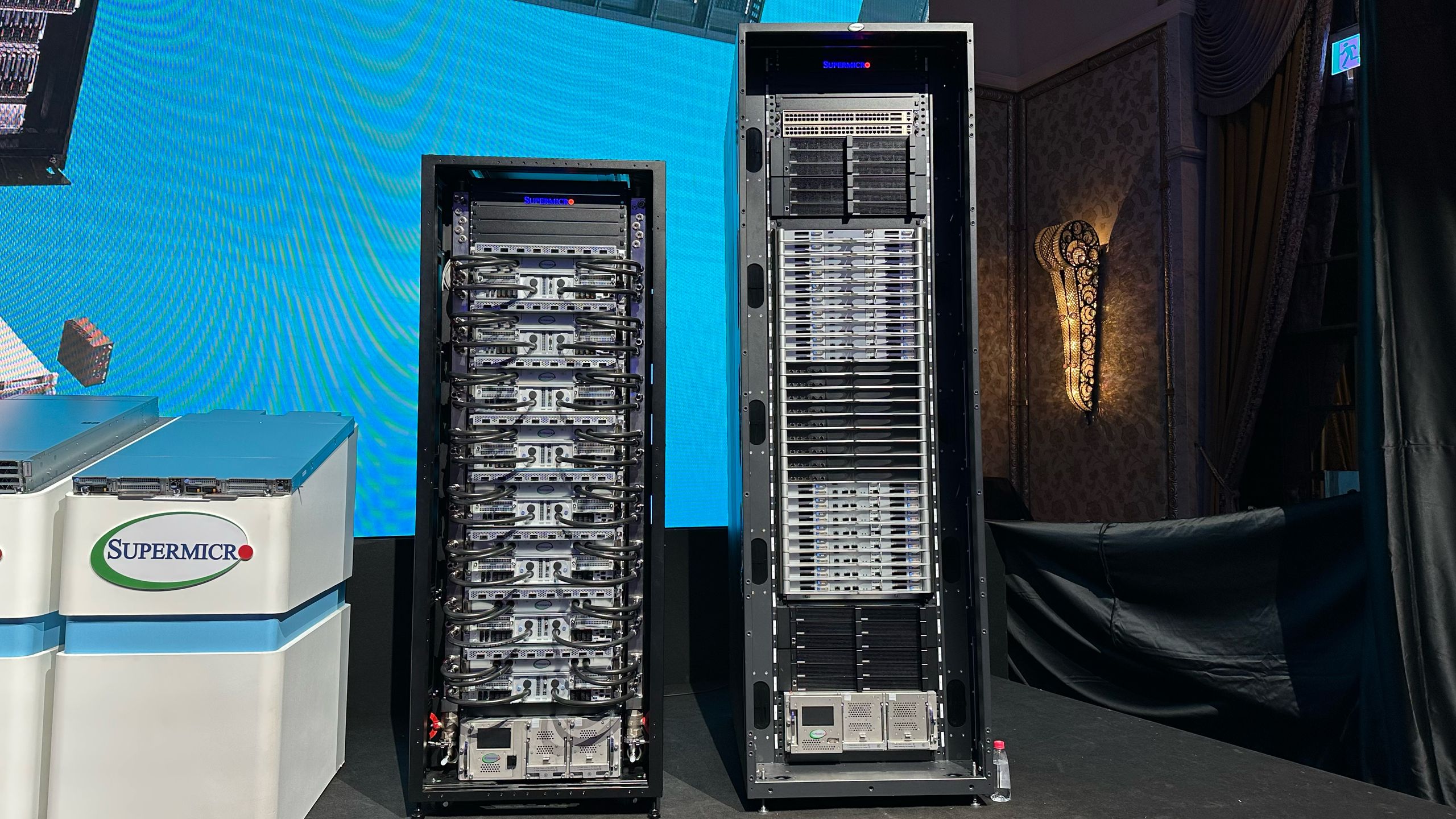
“Our new coolant [uses a new] formula [and] reaches up to 1,000 times higher electrical impedance than a standard cooler,” said Charles Liang, chief executive of Supermicro, during his keynote speech at Computex . “In case there are small leaks, when you have a high electrical impedance, the system will not [shut down] [and will] keep running.”
Conventional water-based coolants used in direct liquid cooling systems have electrical conductivity (albeit lower than water), so if coolant leaks onto a motherboard, GPU, power delivery circuitry, or connectors, it can create leakage currents or even short circuits. A coolant with 1000 times higher electrical impedance is far more resistant to current flow, which reduces the likelihood that a minor leak will immediately shut down a system or damage electronic components. This is important as modern rack-scale AI solutions like Nvidia’s VR200 NVL72 are rumored to cost around $8 million, so their protection is crucial. Also, reducing downtime in AI data centers is important as these machines must make money for their owners.
Nvidia unveils details of new 88-core Vera CPUs positioned to compete with AMD and Intel
Examining Nvidia's 60 exaflop Vera Rubin POD — how seven chips underpin company's 40 rack AI factory supercomputer
Price of Nvidia's Vera Rubin NVL72 racks skyrockets to as much as $8.8 million apiece, but server makers' margins will be tight
Unfortunately, Supermicro’s claim is difficult to evaluate because the company does not disclose specifications of the coolant, such as conductivity (µS/cm), resistivity (MΩ·cm), or dielectric strength (kV/mm). It also remains tight-lipped about the baseline coolant used for comparison. Since modern water-glycol coolants are already fairly resistant, a 1000-fold improvement sounds significant, but without the actual details, it is impossible to determine the practical magnitude of the advancement. What Supermicro claims is that a minor coolant leak would be less likely to force an immediate server shutdown, which means lower downtime risk in large AI deployments. However, we have no idea whether the new coolant behaves more like a dielectric fluid and less like water-glycol coolants.
The new coolant will be used in all new liquid-cooled systems from Supermicro, including the upcoming AMD Helios and Nvidia VR200 NVL72 machines. Given that Nvidia nowadays does not leave many ways for its partners to differentiate, the coolant with 1000 times higher electrical impedance than conventional coolants will likely be among the key selling points of Supermicro’s Nvidia-based offerings.
Speaking of Nvidia’s AI systems, Supermicro is on track to release its Vera Rubin-based systems in the second half of this year, just like other makers. Supermicro intends to offer both NVL72-rack-scale machines based on Nvidia’s Vera CPUs and Rubin GPUs, as well as Rubin DGX systems with different processors.
As for AMD’s side of matters, Supermicro is also on track to release MI455X-based Helios rack-scale solutions in the second half of the year, though the company does not disclose whether these use UALink or UALink over Ethernet interconnections. In addition, Supermicro is also on track with 1-way and 2-way servers based on AMD’s 6 th Generation EPYC ‘Venice’ processors that are made using TSMC’s N2 process technology. These machines are also expected to hit the market in 2026.
Get Tom's Hardware's best news and in-depth reviews, straight to your inbox.
Key considerations
- Investor positioning can change fast
- Volatility remains possible near catalysts
- Macro rates and liquidity can dominate flows
Reference reading
- https://www.tomshardware.com/desktops/servers/SPONSORED_LINK_URL
- https://www.tomshardware.com/desktops/servers/supermicro-shows-off-vera-rubin-nvl72-rack-with-all-new-type-of-coolant-company-claims-coolant-offers-1-000-times-higher-electrical-impedance-over-standard-cooling#main
- https://www.tomshardware.com
- NVIDIA CEO Jensen Huang at Dell Technologies World: ‘Demand Is Going Parabolic, Utterly Parabolic’
- AMD promises 13% uplift with new EXPO ‘Ultra Low Latency’ overclocking on DDR5 DIMMs — automatic memory overclocking delivers 4% improvement over standard EXPO,
- 256GB of dual-channel RAM hits mass market thanks to Origin Code — quad-rank CUDIMM packs 128GB of DDR5-8000 into a single module
- NVIDIA Levels Up Local AI Agents Across RTX PCs and DGX Spark
- Huawei chairman thanks the US for export restrictions on chips, says it supercharged China’s semiconductor industry — Washington’s export controls encouraged Ch
Informational only. No financial advice. Do your own research.