
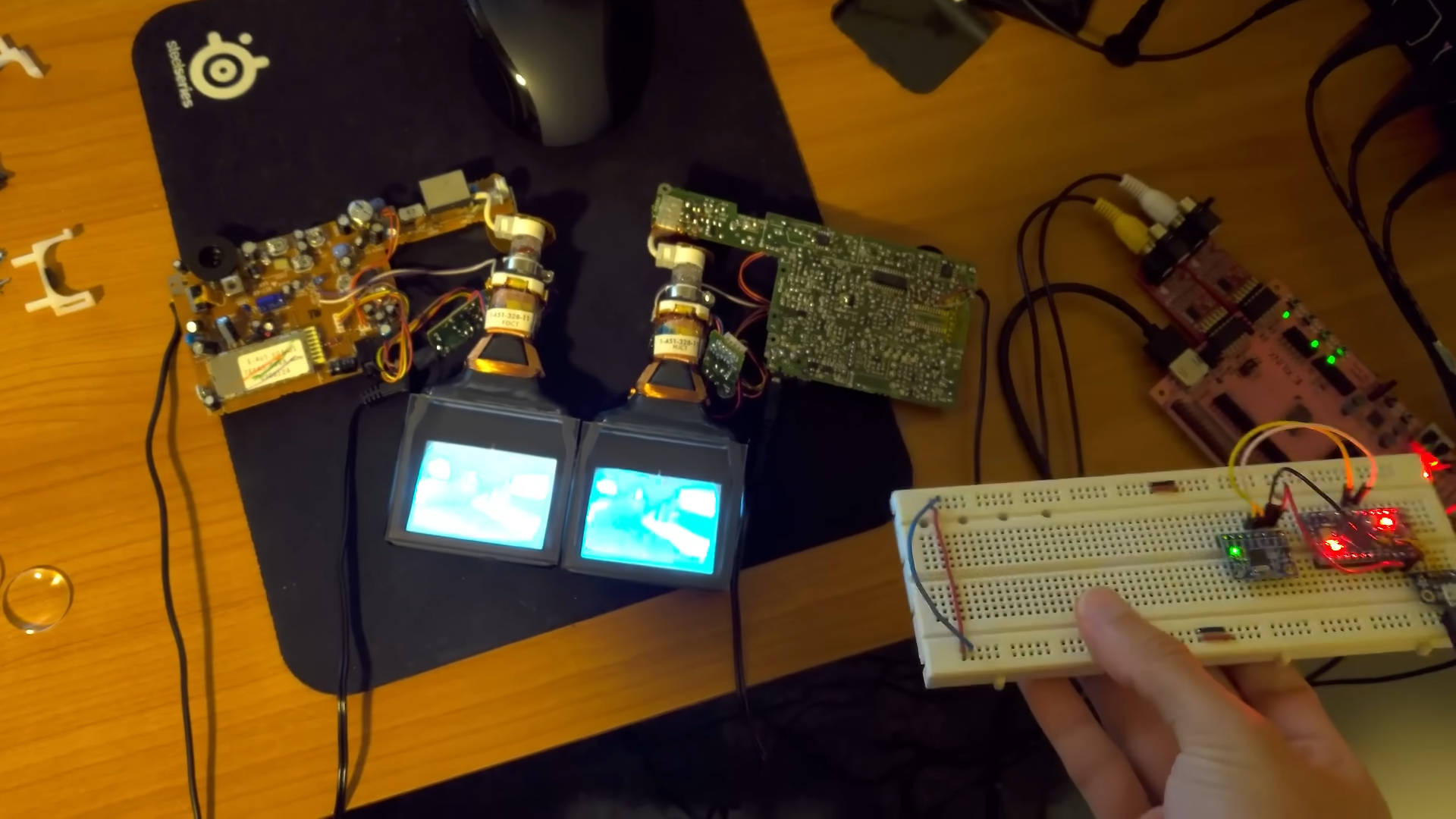
The project itself doesn't go any further with a 3D-printed shell or other refinements because according to dooglehead, the resulting CRT VR headset was not the most impressive thing ever. The YouTuber includes a 3-minute gameplay segment going through various VR titles that include driving, shooting, role playing, and more, while showing the CRT screen in action. It looks exactly like you'd expect — a greyish luminescent image with some character.
Dooglehead's first comment was that he wished the screen was in color because in some games it made it hard to distinguish between certain elements. Secondly, the screens felt blurry: not due to the 640×480 (per eye) resolution, but because the electron beam wasn't perfectly in focus. The fact that it was then hitting the screen at a perpendicular angle just exacerbated this issue.
The biggest positive to using the CRTs was the lack of screen door effect (SDE) since they have a natural anti-aliased look that blends pixels to its advantage. VR screens are especially susceptible to SDE, since they're so close to our eyes.
The YouTuber closed out the video by saying he won't switch to this DIY CRT VR headset mainly because he prefers a color screen. He was glad to have experienced this mashup of retro and modern tech, but it's simply too outdated to use on a daily basis. CRT shaders can likely emulate a similar look, and manufacturers keep shipping insanely high-res displays on VR headsets these days that combat the SDE. But we have to commend dooglehead for seeing this crazy idea all the way through to the end.
Follow Tom's Hardware on Google News , or add us as a preferred source , to get our latest news, analysis, & reviews in your feeds.
Hassam Nasir is a die-hard hardware enthusiast with years of experience as a tech editor and writer, focusing on detailed CPU comparisons and general hardware news. When he\u2019s not working, you\u2019ll find him bending tubes for his ever-evolving custom water-loop gaming rig or benchmarking the latest CPUs and GPUs just for fun. ","collapsible":{"enabled":true,"maxHeight":250,"readMoreText":"Read more","readLessText":"Read less"}}), "https://slice.vanilla.futurecdn.net/13-4-17/js/authorBio.js"); } else { console.error('%c FTE ','background: #9306F9; color: #ffffff','no lazy slice hydration function available'); } Hassam Nasir Social Links Navigation Contributing Writer Hassam Nasir is a die-hard hardware enthusiast with years of experience as a tech editor and writer, focusing on detailed CPU comparisons and general hardware news. When he’s not working, you’ll find him bending tubes for his ever-evolving custom water-loop gaming rig or benchmarking the latest CPUs and GPUs just for fun.
edzieba VR screens are especially susceptible to SDE, since they're so close to our eyes. Utter nonsense. The reason SDE is common for VR displays is because they are spread over a massive field of view, which means pixel density (pixels per degree subtended angle) is extremely low. Since you do not view the display without the optical engine in front of it, the display density of the panel itself, and the physical distance of the panel itself from your eyes, are irrelevant. For example, with a 90° horizontal FoV, a 1920×1080 panel will only have 12 pixels per degree. For example, the Quest 3 has the display panels less than half the distance from your eyes as the Rift DK1. But the SDE is dramatically reduced on the Quest 3 compared to the DK1. What really affects SDE is the fill factor of a display: the ratio of area of emitting pixels – the bits that emit light (for OLEDs, or the non-aperture-masked areas of a CRT, or the translucent areas of an LCD – to the dark areas (the support electronics between pixels in an LCD or OLED, or the aperture mask in a CRT, or the gaps between scan lines in a CRT). The lower the fill factor, the worse the SDE. Reply
Key considerations
- Investor positioning can change fast
- Volatility remains possible near catalysts
- Macro rates and liquidity can dominate flows
Reference reading
- https://www.tomshardware.com/virtual-reality/SPONSORED_LINK_URL
- https://www.tomshardware.com/virtual-reality/tinkerer-builds-vr-headset-with-crts-repurposed-from-sony-watchman-makeshift-vr-rig-isnt-the-sharpest-but-eliminates-screen-door-effect#main
- https://www.tomshardware.com
- Nvidia's N1/N1X chips leak once again, this time tipped for release in first half of 2026 — hotly-anticipated chips to reportedly debut on Dell and Lenovo lapto
- Trump tariff turbulence risks handing TSMC a win over American chip manufacturers — prior exemptions for onshoring manufacturing may hinder the likes of Intel
- ASML makes breakthrough in EUV chipmaking tech, plans to increase speed by 50% by 2030 — new 1,000-watt light source fires three lasers at 100,000 tin droplets
- Survey Reveals AI Advances in Telecom: Networks and Automation in Driver’s Seat as Return on Investment Climbs
- From Radiology to Drug Discovery, Survey Reveals AI Is Delivering Clear Return on Investment in Healthcare
Informational only. No financial advice. Do your own research.