
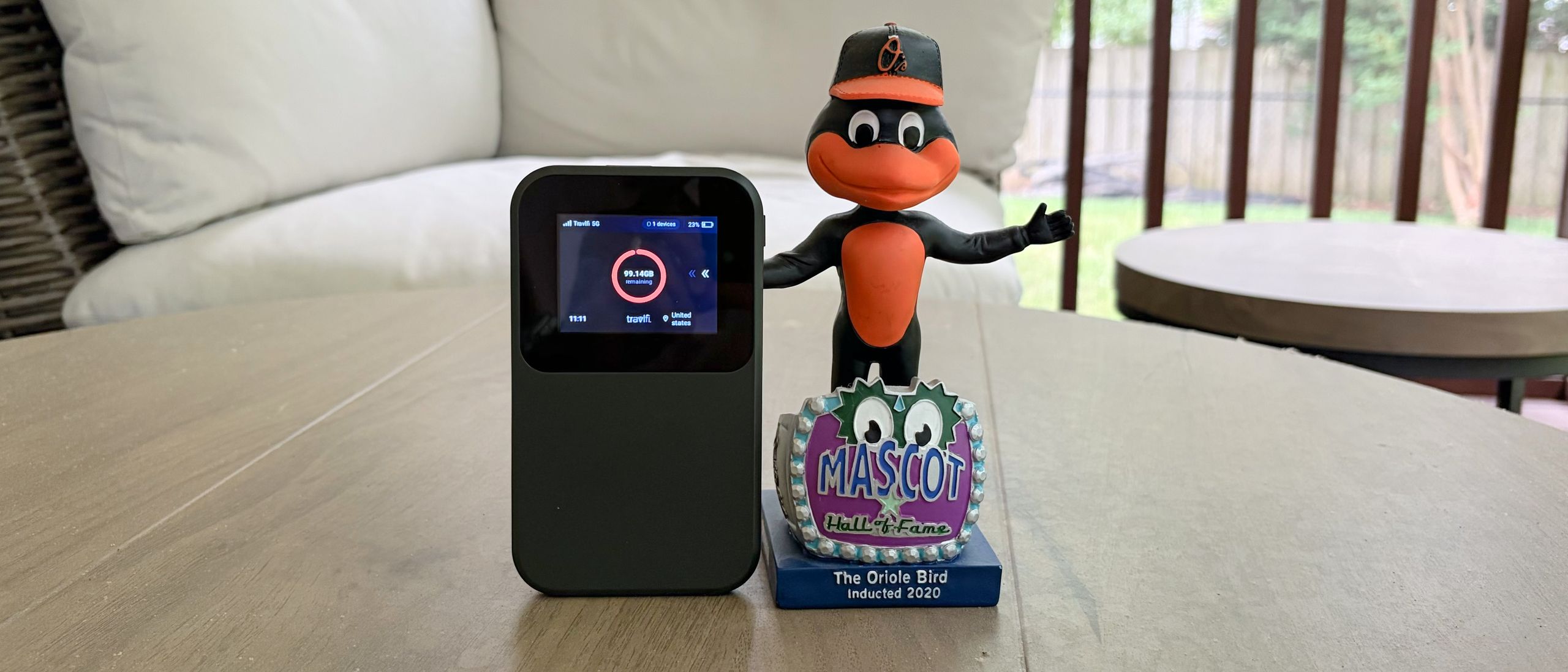
Below the data allowance windows, you’ll find Wi-Fi Info, where you’ll see your current Wi-Fi SSD and password. Next, you’ll see TowerSync, which allows the device to scan for a stronger signal from a nearby tower.
Despite the use of an eSIM, the JourneyGo 5G lacks an eSIM Marketplace, which is the true “killer app” for the Nighthawk M7. It remains to be seen if that type of functionality will arrive with the unreleased Travlfi smartphone app.
Our review unit came with the 100GB data plan, which costs $89 per month. However, if your mobile hotspot needs aren’t as data hungry, the 2GB plan costs $19 per month. Travlfi also offers an unlimited plan for $129/month, although it’s currently running a promotion that drops it to $99/month.
The JourneyGo 5G uses a MediaTek MT8791 SoC that incorporates two Arm Cortex-A78 cores, six Arm Cortex-A55 cores, an integrated 5G NR sub-6 GHz modem (4G CAT 18), and dual-band Wi-Fi 6. Our review unit is using its eSIM rather than the physical SIM onboard, which is connecting to T-Mobile’s wireless network.
Travlfi claims that the JourneyGo 5G offers typical download speeds of 25 to 150 Mbps with a peak of 180 Mbps using a 5G cellular connection. When connecting to a 4G network, typical download speeds range from 15 to 40 Mbps with peaks reaching 60 Mbps.
The JourneyGo 5G is supposed to support USB tethering directly to a device, but I couldn’t get it to work on a Mac or a Windows device. When plugging the hotspot into a computer using the included USB-C cable, the JourneyGo 5G would confirm that USB tethering was enabled and that a device was connected. However, neither the Mac nor the Windows device would recognize an active internet connection via USB.
It remains to be seen whether the forthcoming Travlfi smartphone app will address the tethering woes, although we can only go off what’s available right now. In addition, it’s frustrating that you can’t change the Wi-Fi SSID or password from the default provided by Travlfi. Again, this is something that could be easily addressed with an app, given the tiny display, which makes input challenging.
When it comes to pricing, the Travlfi JourneyGo 5G definitely gets your attention at $299. That seems like an absolute steal compared to the Netgear Nighthawk M7's $499 price. And the fact that Travlfi was able to squeeze 20 hours of runtime out of this tiny device is quite amazing.
However, things quickly fall apart from there. All interactions must be performed with the small 2.4-inch touch screen; you cannot change the Wi-Fi SSID or password, and you can’t enable the 2.4 GHz and 5 GHz bands simultaneously. In addition, the promised smartphone app (mentioned in the user manual) is not available for download on iOS or Android. And from a functional standpoint, the USB tether mode didn’t even work. The final blow is that, despite a 5G connection, download speeds were roughly a third of what we saw with the Nighthawk M7.
In its current state, the JourneyGo 5G might be an impulse buy at $299, but it’s not a wise buy.
Brandon Hill is a senior editor at Tom's Hardware. He has written about PC and Mac tech since the late 1990s with bylines at AnandTech, DailyTech, and Hot Hardware. When he is not consuming copious amounts of tech news, he can be found enjoying the NC mountains or the beach with his wife and two sons. ","collapsible":{"enabled":true,"maxHeight":250,"readMoreText":"Read more","readLessText":"Read less"}}), "https://slice.vanilla.futurecdn.net/13-4-24/js/authorBio.js"); } else { console.error('%c FTE ','background: #9306F9; color: #ffffff','no lazy slice hydration function available'); } Brandon Hill Social Links Navigation Senior Editor Brandon Hill is a senior editor at Tom's Hardware. He has written about PC and Mac tech since the late 1990s with bylines at AnandTech, DailyTech, and Hot Hardware. When he is not consuming copious amounts of tech news, he can be found enjoying the NC mountains or the beach with his wife and two sons.
TheWerewolf Seems like an obvious question… but since most (if not all) phones can also be WiFi routers and provide hotspot features… and you're going to be taking your phone with you anyway with a working SIM/eSIM and can have a roaming data plan… what's the logic in having a dedicated device like this? It seems to me picking up a low end regular cell phone would make way more sense. Reply
Key considerations
- Investor positioning can change fast
- Volatility remains possible near catalysts
- Macro rates and liquidity can dominate flows
Reference reading
- https://www.tomshardware.com/networking/routers/SPONSORED_LINK_URL
- https://www.tomshardware.com/networking/routers/travlfi-journeygo-5g-mobile-hotspot-review#main
- https://www.tomshardware.com
- Linux developers are using AI vibe coding to keep vintage AMD GPUs alive — R600 driver cleaned up with GitHub Copilot gives HD 2000 to HD 6000 series a new leas
- NVIDIA Partners With Microsoft on Unified Stack for Agentic AI Deployment, From Windows Devices to Cloud to Local
- For Robotaxis, Safety Must Be Built In, Not Bolted On
- China drafts $295 billion plan to build national AI data center grid running on 80% homemade silicon — projected 2028 timeline could run into limits of local ch
- AI is set to consume up to 600 billion gallons of water by 2030 — rising energy consumption primarily to blame as data center power demands rise
Informational only. No financial advice. Do your own research.