
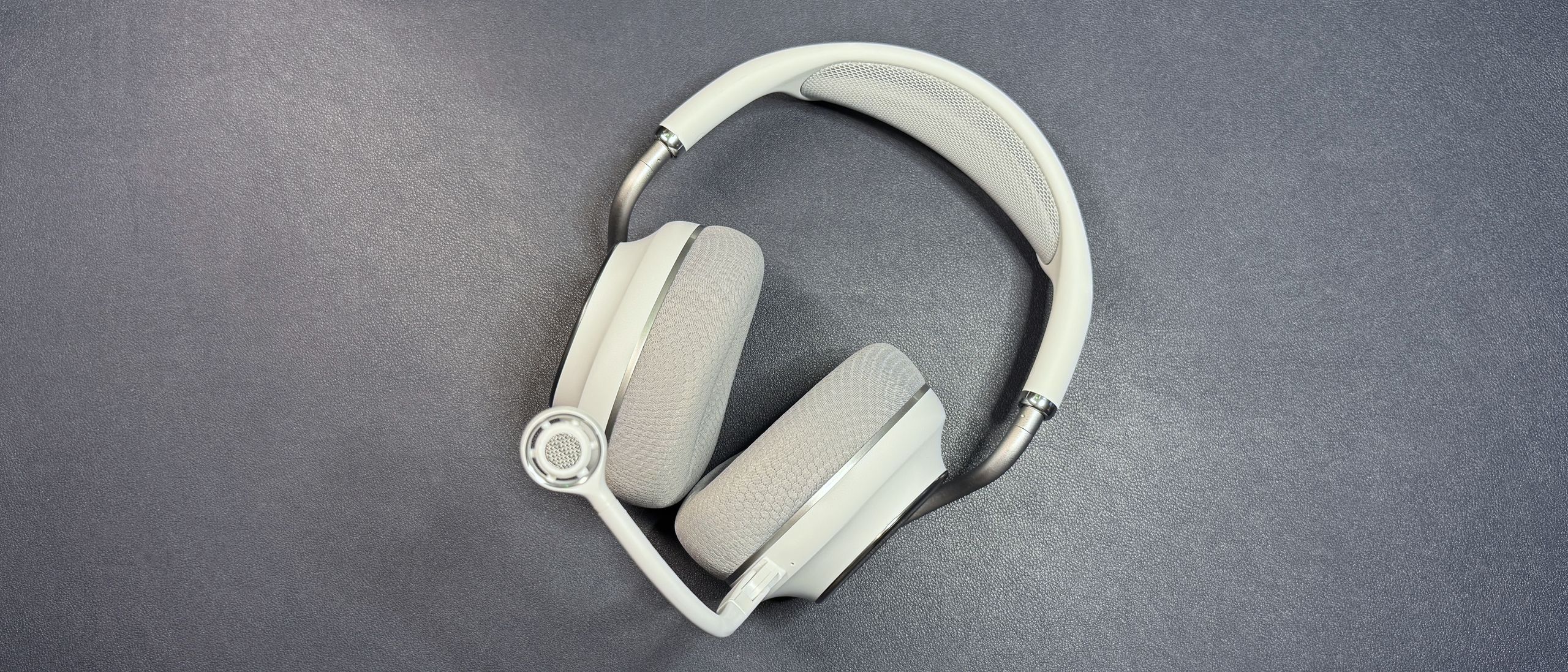
(Image credit: Tom's Hardware) (Image credit: Tom's Hardware) The Stealth Pro 2 comes in a nice, sturdy, zipped carrying case, which is rigid on the outside and has custom cut foam on the inside. It comes with a wireless USB-A transmitter, a battery charger (that also acts as a second transmitter) and extra battery pack, a detachable boom mic, and a 6.5-foot (2m) USB-C to USB-A cable.
The Stealth Pro II sports Turtle Beach's 60mm "Eclipse" dual dynamic drivers, which have a frequency response range of 10 – 40,000 Hz — wider than the average gaming headset, which usually sticks close to the standard 20 – 20,000 Hz range of human hearing, but not quite as wide as the Audeze Maxwell 2 (10 – 50,000 Hz). These drivers are both larger (at 60mm, versus other headsets' 50 or 40mm) and feature a design with distinct woofers and tweeters for "vastly improved audio detail over conventional drivers," according to Turtle Beach.
I was impressed with how both music and games sounded on the Stealth Pro II — there was plenty of detail in atmospheric games such as Where Winds Meet and God of War: Ragnarok , and the sound stage sounded wider than I'm used to on closed-back gaming headsets. Music on the Stealth Pro II was also bright, punchy, and detailed — I could hear the full flow of the timpani in the beginning of Lorde's Royals , as well as the deep nuanced bass in Hans Zimmer's Time , with very good clarity. While the bass on this headset was solid, the highs were a little too turned up out of the box: Footsteps and gunshots in games were unnecessarily present, and the strings at the beginning of Britney Spears' Toxic were close to being painful.
The headset sounded decent with the ANC turned on — ANC tends to affect sound negatively, and while the Stealth Pro II wasn't an exception, the difference wasn't unbearable in gaming (it was more noticeable with music). As far as noise cancellation, the ANC did an excellent job of canceling out ambient noises, such as the low hum of my computer fans. But the earpads also did an excellent job of passive noise cancellation, so much so that the ANC almost seemed superfluous.
Usability is always a bit of a concern when it comes to multi-device headsets, but the Stealth Pro II felt pretty intuitive and straightforward. I appreciated the dedicated Bluetooth volume wheel for dual-simultaneous wireless connections, and switching between USB connections was fairly quick and painless. While there are a few different headsets with base stations that let you connect to more than one device at a time, the Stealth Pro II's multiple wireless dongles means you can connect to devices that aren't within USB-cable-range of each other — not necessarily in separate rooms, but just further away than standard 6.5-foot cables will let you reach (plus, it's neater). Turtle Beach says you can connect up to four sources via CrossPlay, but it only includes two connections (the transmitter dock/battery charging station, and one USB-A dongle) in the box.
The Stealth Pro II has a detachable 9mm flip-to-mute boom microphone as well as beam-forming mics built into the earcups. The boom mic has a floating design that uses spokes to suspend the microphone away from the boom arm for "pristine vocal clarity," according to the company.
It sounds good — very good, for a headset mic — but it didn't blow me away, as many headset mics these days are pretty impressive. My voice came across full and warm and close to (but not quite) broadcast quality over the boom mic, but everyone I spoke to over voice chat could tell I was wearing a headset. As always, I love Turtle Beach's flip-to-mute system — it's the perfect system, and the only one that's never confused me. I wasn't sure how muting the inline mics worked, however, as there's no dedicated mute button out of the box, but I also couldn't get the inline mics to work at all (…maybe that's the trick). I can only assume this is something that might need to be set up or switched to in Turtle Beach's Swarm II software, but I also couldn't get that to work — at least not by time of writing (I'll revisit this a couple of days after launch to see if anything has changed).
The Stealth Pro II works with Turtle Beach's Swarm II universal peripheral software, which has never worked smoothly for me and certainly wasn't about to start with this review. While I was able to perform an initial firmware/software update, the software continued to prompt me with "Update Available" — blocking me from accessing other parts of the app, of course — but simply giving me a "you are up-to-date" message when I tried to update. Presumably, Swarm II will let you do things like change settings, adjust things such as noise gate and mic monitoring, and access audio and microphone EQs. This is also where you can program the programmable button/dial on the headset, and where you can (god willing) update your firmware.
Luckily, not being able to actually see the software wasn't too much of a setback for me, as I long ago realized that it seems to have some sort of personal vendetta against me. The Stealth Pro II works very well out of the box, and while the EQ and mic EQ would be nice to access, they're not absolutely necessary (for now). Let's hope the firmware updater is working by the time these get into consumers' hands, though.
Turtle Beach rates the Stealth Pro II at 80+ hours of battery life if you take advantage of its hot-swappable battery system. It comes with two 40-hour batteries that can be hot-swapped — similar to the previous Stealth Pro.
(Image credit: Tom's Hardware) (Image credit: Tom's Hardware) (Image credit: Tom's Hardware) This isn't really the most convenient system for traveling, but it's a pretty solid system for a gaming headset that will live primarily on your desk, as it means you can swap out the battery in just a few seconds without having to worry about any downtime, basically. (Although, I guess simply plugging your headset into a charging dock while you play isn't really that much of a hassle, either, if you're already tied to your desk.) Forty hours is a big improvement over the original Stealth Pro , which had two 24-hour swappable batteries.
Turtle Beach's Stealth Pro II is a big improvement over its original Stealth Pro in both design and functionality — it's sleek and pretty (I wasn't a big fan of the original Stealth Pro's design), comfortable, and it connects wirelessly to multiple devices simultaneously. Switching between my PC and my PS5 was pretty seamless, though I did have a few wireless hiccups when I was signing onto the staff morning meeting, and the simultaneous Bluetooth playback worked very smoothly. The Astro A50 X did manage to do the device switching just the tiniest bit better, but the Stealth Pro II's wireless connectivity is definitely a game-changer. At $350, the Stealth Pro II isn't cheap, but it's cheaper than similarly multi-tasking headsets, such as the $400 Astro A50 X or the $600 SteelSeries Arctis Nova Elite.
Sarah Jacobsson Purewal is a senior editor at Tom's Hardware covering peripherals, software, and custom builds. You can find more of her work in PCWorld, Macworld, TechHive, CNET, Gizmodo, Tom's Guide, PC Gamer, Men's Health, Men's Fitness, SHAPE, Cosmopolitan, and just about everywhere else. ","collapsible":{"enabled":true,"maxHeight":250,"readMoreText":"Read more","readLessText":"Read less"}}), "https://slice.vanilla.futurecdn.net/13-4-23/js/authorBio.js"); } else { console.error('%c FTE ','background: #9306F9; color: #ffffff','no lazy slice hydration function available'); } Sarah Jacobsson Purewal Social Links Navigation Senior Editor, Peripherals Sarah Jacobsson Purewal is a senior editor at Tom's Hardware covering peripherals, software, and custom builds. You can find more of her work in PCWorld, Macworld, TechHive, CNET, Gizmodo, Tom's Guide, PC Gamer, Men's Health, Men's Fitness, SHAPE, Cosmopolitan, and just about everywhere else.
Key considerations
- Investor positioning can change fast
- Volatility remains possible near catalysts
- Macro rates and liquidity can dominate flows
Reference reading
- https://www.tomshardware.com/peripherals/gaming-headsets/SPONSORED_LINK_URL
- https://www.tomshardware.com/peripherals/gaming-headsets/turtle-beach-stealth-pro-ii-review#main
- https://www.tomshardware.com
- NVIDIA Spectrum-X — the Open, AI-Native Ethernet Fabric — Sets the Standard for Gigascale AI, Now With MRC
- Why building a quiet PC is harder than you think — what to know, and how to make your rig quieter
- China's next-gen CPUs and GPUs prepare to challenge last-gen Intel and AMD in 2027 — Loongson 3B6600 and 9A1000 aim to match Intel's 12th Gen and AMD's RX 550
- Intel announces McLaren F1 partnership, will battle AMD-powered Mercedes — deal includes chips for aerodynamic analysis, vehicle-dynamics simulation, race strat
- NVIDIA Spectrum-X — the Open, AI-Native Ethernet Fabric — Sets the Standard for Gigascale AI, Now With MRC
Informational only. No financial advice. Do your own research.