
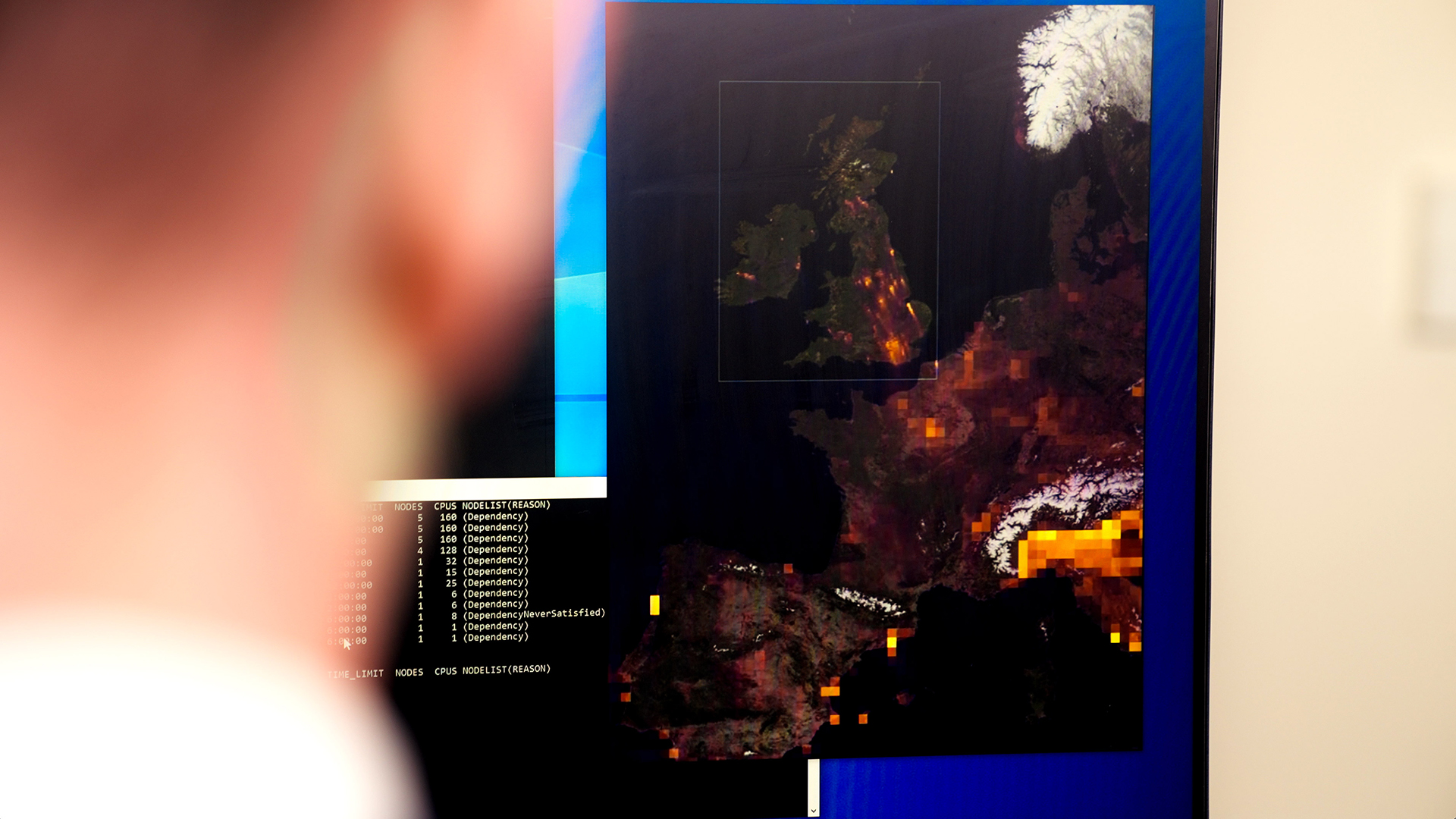
Another potential application is proactive air quality insights for healthcare organizations. Topping envisions a scenario where regional and national healthcare services could reach out to patients with conditions like asthma to let them know that air pollution is going to be high in their area tomorrow, or next week.
The team is also exploring how the air pollution model could pair with data from edge AI devices to ingest real-time air quality data and drive real-time decision making, such as in the event of a wildfire.
“The fact that this model trained in two days on Isambard-AI — and can now run on a DGX Spark sitting on a desk — changes who can do this science and how quickly,” said Niall Robinson, developer relations manager for weather and climate at NVIDIA. “We’re just at the beginning of what these open workflows can do globally.”
“The ability to switch from one NVIDIA framework to another was really impressive,” said Hao Zhang, a doctoral student at the University of Manchester who trained StormCast on Isambard-AI. “We’re only just starting to explore how to use these frameworks in different ways to model complex pollution fields.”
To retrain the Earth-2 model for air pollution, Topping and the team used a year’s worth of U.K. pollution data simulated at hourly intervals to generate a detailed, U.K.-wide pollution model at a resolution of 2-3 square kilometers.
Running on a single, eight-GPU node on Isambard-AI — the U.K.’s most powerful AI supercomputer, packed with 5,448 NVIDIA GH200 Grace Hopper Superchips delivering 21 exaflops of AI performance — the process took just two days.
“Earth-2 CorrDiff has shown an incredibly efficient use of the world-class NVIDIA hardware inside Isambard-AI,” said Simon McIntosh-Smith, director of the Bristol Centre for Supercomputing at University of Bristol and cofounder of Isambard-AI. “It’s fitting that, for a climate-based project, the GPU hours used were relatively low, requiring less power from the supercomputer to run the workloads.”
In addition to providing a look back at air pollution over the past year, the model can help predict future air pollution scenarios for the U.K. The team plans to further increase the resolution of its model by incorporating additional open data, enabling researchers to understand air pollution at street scale.
The same generative pollution workflow also runs on the NVIDIA GB10 Grace Blackwell superchip-powered DGX Spark desktop AI system for inference and smaller training runs. Topping now has an DGX Spark system in his office retraining models.
“You can now invest a few thousand dollars to get started developing powerful AI models,” Topping said.
The team plans to release open source training data and workflows for the pollution models will be released so that similar models can be trained for other countries and regions.
“Our aim is to offer this workflow to the entire world,” he said. “We hope that every global country and every major city with a small burst of supercomputer AI time will be able to produce their own detailed pollution models with their own local data.”
Looking five years out, Topping sees the endpoint as something simpler still: an agentic interface where a clinician or government agency asks the question and the chain of models handles everything else.
“With better open access to air quality observations, someone could ask our pollution model running on DGX Spark: what’s the pollution going to be like in this neighborhood tomorrow?” he said. “And a whole chain of interactions will deliver an answer, grounded on the science these frameworks represent.”
Hear more from Topping in the webinar, AI for Science: From the Lab to the Frontier , taking place September 30.
Learn more about NVIDIA Earth-2 climate and weather AI.
Key considerations
- Investor positioning can change fast
- Volatility remains possible near catalysts
- Macro rates and liquidity can dominate flows
Reference reading
- https://blogs.nvidia.com/blog/uk-air-pollution-research-earth-2/#primary
- https://blogs.nvidia.com/blog/author/ishasalian/
- https://blogs.nvidia.com/blog/uk-air-pollution-research-earth-2/#disqus_thread
- Nvidia, Palantir, and others restrict advanced AI model usage over privacy concerns, report claims — 'paranoia' rising over customer intellectual property
- Minecraft Legacy gets rewritten in C++ for PS2 and Wii ports — code is tuned so it works well even on the PS2’s meager 32MB of RAM
- NVIDIA Vera Rubin NVL72 Delivers Leading Performance in MLPerf Inference v6.1 Debut
- Bill Gates compares AI to alien intelligence in movies where ‘magically the US and China’ solve the problem together — warns world governments that they’re not
- Anthropic says AI can boost U.S. GDP by 32%, up to $44.4 trillion in four years — economics model predicts that displaced employees 'may have to switch to jobs
Informational only. No financial advice. Do your own research.