
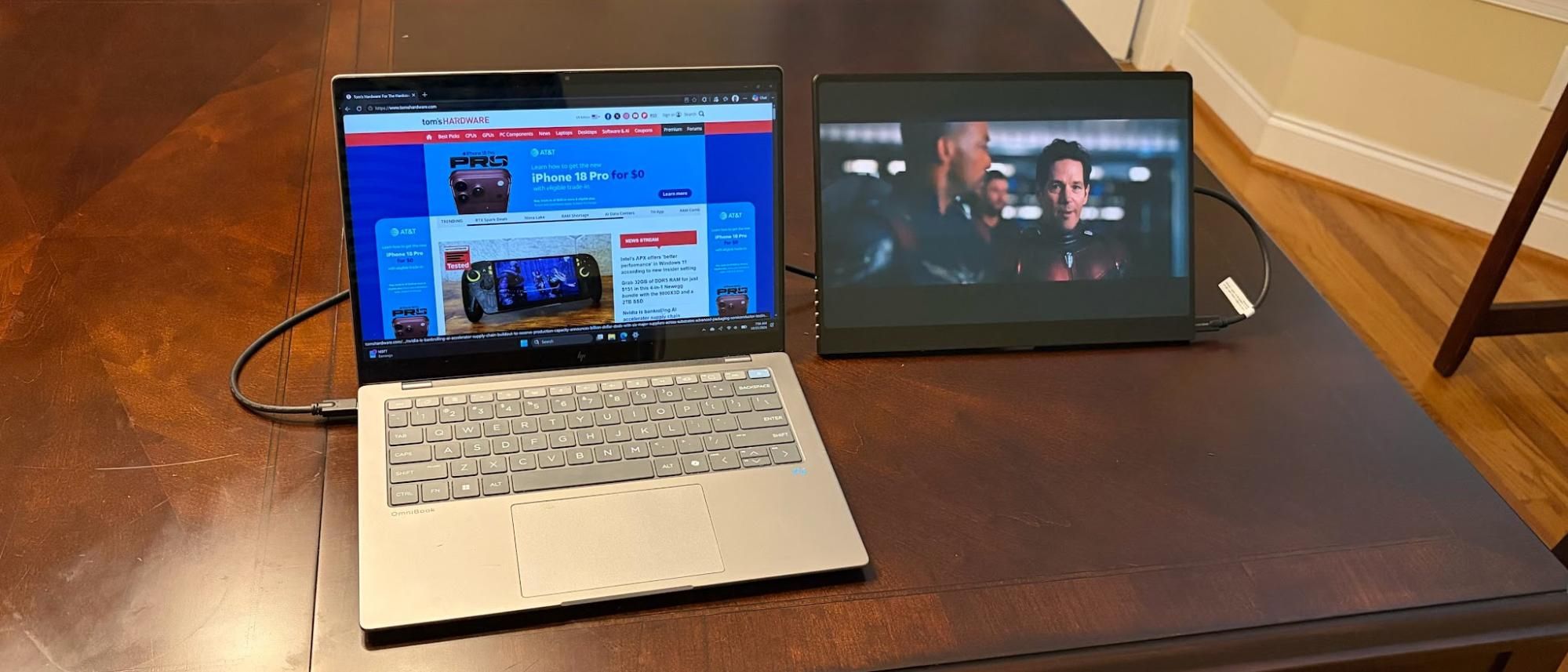
The GR14BU features a 14-inch display with a dense-for-its-size 2880 x 1600 resolution, in a 16:10 aspect ratio. That pixel-dense panel is backed by a 120 Hz refresh rate, which is twice that of most portable monitors, along with multi-touch support in Windows 11.
UPERFECT claims that the GR14BU has a maximum brightness of 500 nits, but we measured a maximum of 368.6 nits when plugged in at 100 percent. While well short of the manufacturer’s claim, this is clsoe to peers like the Asus ZenScreen OLED MQ16AH (369.4 nits) and ViewSonic ColorPro VP16-OLED (369.8 nits).
Our instrumented tests also showed similar color performance to the Asus and ViewSonic. The GR14BU measured 132.2 percent coverage of the DCI-P3 color space, while sRGB coverage came in at 186.6 percent.
For my usual productivity tasks, I was really disappointed that I couldn’t use the GR14BU in portrait mode, which is probably the biggest miss for me. I like having that versatility to switch between portrait and landscape modes at will.
I also tested out the 120 Hz refresh rate at native resolution for gaming. I played Battlefield 6 with the GR14BU hooked up to my desktop computer via HDMI and had no trouble until there was heavy action on the screen. It was then that frame rates momentarily dipped into the 90 fps range, and I noticed a bit of screen tearing. The GR14BU doesn’t support any kind of Adaptive-Sync technology, like FreeSync or G-Sync.
UPERFECT includes a pair of tinny speakers integrated into the GR14BU. There is quite a bit of audio distortion once you get past 75 percent, but if you keep the volume at a moderate level, the quality is passable. There’s no bass, and music sounds flat (I tried various genres, ranging from Jay-Z to Susanne Sundfør to Jai Wolf). You’re better off relying on your laptop’s built-in speakers than relying on the pair included on the GR14BU.
I came in expecting a lot from the UPERFECT GR14BU, given its specs. However, there are plenty of caveats. The GR14BU has a bright and colorful 3K OLED panel, along with a 120 Hz refresh rate. It even includes an integrated kickstand and internal speakers.
However, the kickstand doesn’t allow the monitor to be used in portrait mode, and the 120 Hz maximum refresh rate doesn’t have the backing of Adaptive-Sync. There are also some quality lapses, like the woefully cheap OSD buttons.
However, much of this can be overlooked considering the price. The GR14BU can be had right now for $299 from Amazon , making it an incredible value given the specs. For comparison, we recently reviewed the Asus ZenScreen OLED (MQ16FC) , which has a 16.1-inch 1200p OLED non-touch display with a 60 Hz refresh rate. The GR14BU outclasses the MQ16FC in color performance, brightness, and specs while only commanding a $30 premium and including touch. That’s an impressive feat, despite its design and build deficiencies.
Brandon Hill Social Links Navigation Senior Editor Brandon Hill is a senior editor at Tom's Hardware. He has written about PC and Mac tech since the late 1990s with bylines at AnandTech, DailyTech, and Hot Hardware. When he is not consuming copious amounts of tech news, he can be found enjoying the NC mountains or the beach with his wife and two sons.
Key considerations
- Investor positioning can change fast
- Volatility remains possible near catalysts
- Macro rates and liquidity can dominate flows
Reference reading
- https://www.tomshardware.com/monitors/portable-monitors/SPONSORED_LINK_URL
- https://www.tomshardware.com/monitors/portable-monitors/uperfect-gr14bu-portable-monitor-review#main
- https://futureplc.com/privacy-policy/
- Thin, Light and Built for Everything: NVIDIA RTX Spark Windows Laptops Gain New Models, Agent Tools and Games
- Boost your Nintendo Switch 2's storage for Zelda: Ocarina of Time with these microSD Express deals, starting at $48
- Marvell to buy Lumentum in $115 billion all-stock deal
- Bambu Lab H3C 3D printer review: A nine-tool monster
- China deploys 'world's first' 800-volt DC power system for massive AI data center
Informational only. No financial advice. Do your own research.