
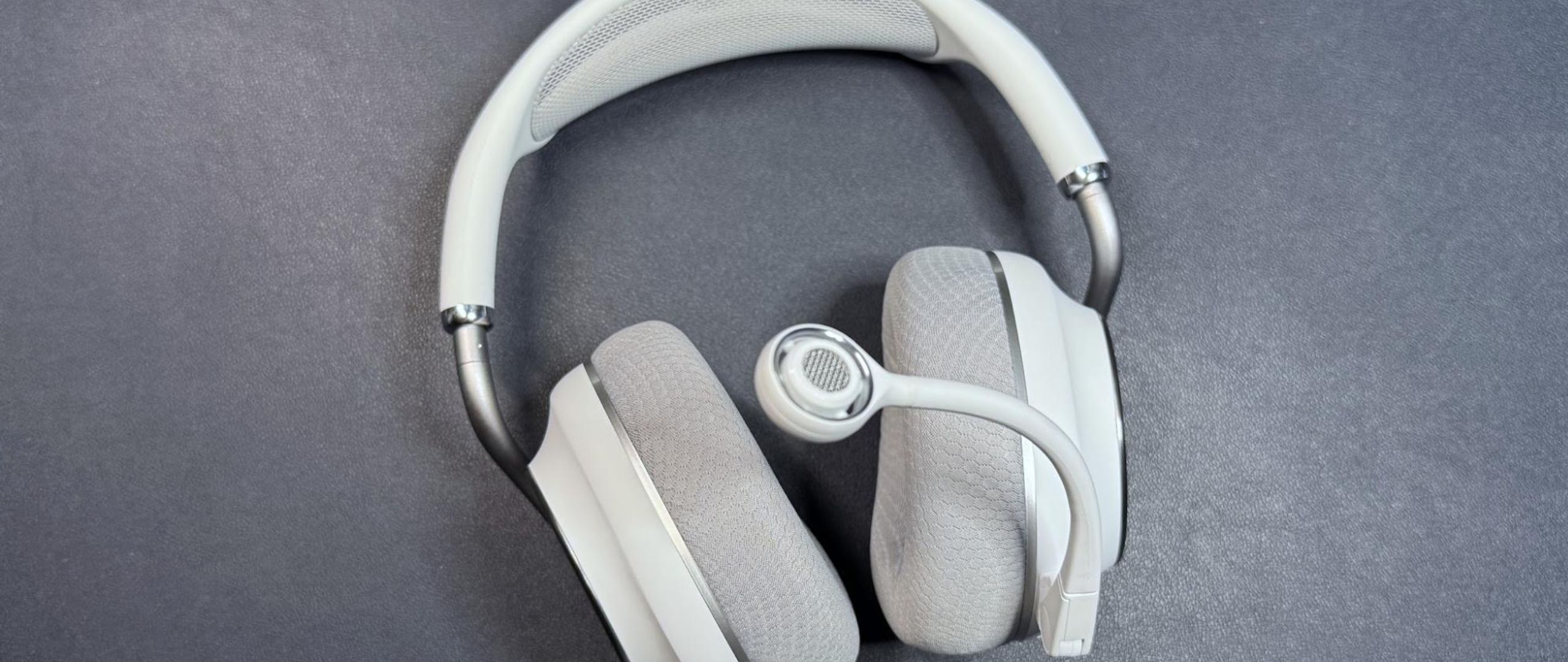
Gaming headsets, on the other hand, are packed with technology to make your life easier. Headsets like the Turtle Beach Stealth Pro II and the Razer BlackShark V3 Pro let you connect to multiple devices and switch between them seamlessly, listen to two audio sources simultaneously, and quickly cycle through game-ready EQ presets. Gaming headsets try to put as many controls as possible at your fingertips, from on-ear dials and buttons to detailed app-based EQ tuning to separate desktop base stations (such as the one included with the HyperX Cloud Alpha 2 Wireless ).
Even wired gaming headsets often include multiple ways to connect to various devices. For instance, the HyperX Cloud Alpha Air is wired, but it comes with a standard 3.5mm analog cable for plugging into a standard audio jack, a USB-C extension (with USB-A converter) for plugging into a USB-C/USB-A port, and a PC headset extension for plugging into separate audio/mic jacks.
The wireless gaming headsets from the audiophile sector that have these features still manage to implement them in a way that is… well, inconvenient. Audeze's Maxwell and Maxwell 2 allow for dual-wireless connectivity but do not give you a way to manually switch between the two. Instead, Bluetooth always takes precedence over 2.4GHz wireless — full stop. It's infuriating, and it's one of my only real grievances with those headsets.
A standalone USB gaming mic will almost always make you sound better than a built-in headset mic. But that doesn't mean that you should ignore headset mics or how gaming headsets implement other features that help you communicate with others, whether they're team members or stream viewers, while gaming. (Besides, some headsets, such as the Razer BlackShark V2 Pro (2023) , have microphones that actually can rival the best USB gaming mics.)
If you go with an audiophile headset — or headphones — you'll likely need to invest in a separate gaming mic regardless. There's more to communication than just the mic, though. Many gaming headsets, such as SteelSeries' Arctis Nova series , have built-in ChatMix, which lets you channel your game audio and your chat audio through different channels and mix them together on your headset. This lets you dial up (or dial down) chat if you need to hear what's being said over whatever epic music or sound effects are playing in the game. Gaming headsets are also backed by peripheral software that, while often frustrating , is, ultimately, designed around the needs of gamers. Software-based noise reduction/cancellation, microphone EQs, and sidetone are all particularly useful communication tools that you won't find on most audiophile headsets.
At the end of the day, audiophile headsets tend to focus on audio above everything, which is exactly what audiophiles want. But it's not really what most gamers want. A great gaming headset does have to sound good, but that's not all it has to do.
There are, of course, gaming headsets from audiophile companies, such as the Audeze Maxwell and Maxwell 2, as well as headsets from gaming companies that implement audiophile features, such as the open-back Corsair Virtuoso Pro . And while a headset like the Audeze Maxwell 2 does a decent job of bridging the gap between audiophile and gaming, it makes some sacrifices; it's a very heavy headset (thanks in part to its large, 90mm planar magnetic drivers), though it is relatively comfortable for its weight. It sounds great, but it doesn't do the best job of implementing the gamer side of things — while it has a wide soundstage and decent spatial immersion , that's not the same as pinpoint spatial accuracy when you're listening for footsteps and gunshots.
And while the much pricier Audeze LCD-GX sounds incredible, it's basically the perfect example of how an audiophile headset focuses on sound at the expense of all else, as its gaming features are… mostly non-existent. The only thing that really makes the LCD-GX gamer-friendly is the fact that you can plug it directly into a PC because it comes with a 3.5mm cable and a PC (dual 3.5mm headphone/mic) converter.
So, should you get an audiophile headset in lieu of a gaming headset? Probably not. If you need a gaming headset for its gaming features: multi-device connectivity, super accurate positional audio for tactical advantage in shooting games, the ability to mix chat and game audio on the spot, convenient microphone, connection, and volume controls at your fingertips, or physical comfort for a marathon gaming session, definitely not. Yes, you will give up some audio fidelity and quality by picking a gaming headset over an audiophile one, but you aren't going to miss that when you're arguing over voice chat while trying to determine how far away the enemy is.
Sarah Jacobsson Purewal Social Links Navigation Senior Editor, Peripherals Sarah Jacobsson Purewal is a senior editor at Tom's Hardware covering peripherals, software, and custom builds. You can find more of her work in PCWorld, Macworld, TechHive, CNET, Gizmodo, Tom's Guide, PC Gamer, Men's Health, Men's Fitness, SHAPE, Cosmopolitan, and just about everywhere else.
Key considerations
- Investor positioning can change fast
- Volatility remains possible near catalysts
- Macro rates and liquidity can dominate flows
Reference reading
- https://www.tomshardware.com/peripherals/headphones-headsets/SPONSORED_LINK_URL
- https://www.tomshardware.com/peripherals/headphones-headsets/why-you-dont-need-an-audiophile-headset-for-gaming-comfort-convenience-and-a-good-mic-win-over-pure-audio-fidelity#main
- https://www.tomshardware.com/my-account
- Score a budget gaming monitor with a blistering 200Hz refresh rate for just $79
- Russian military satellite closes from 200 miles to 3 miles of US radar craft aiding Ukraine
- Intel asks FCC for waiver to buy foreign robots
- U.S. Army developing program that would deploy AI agents to autonomously seek and destroy targets in enemy digital infrastructures
- 4TB Samsung 990 Pro M.2 SSD falls 27%, hits 20 cents per gigabyte
Informational only. No financial advice. Do your own research.