
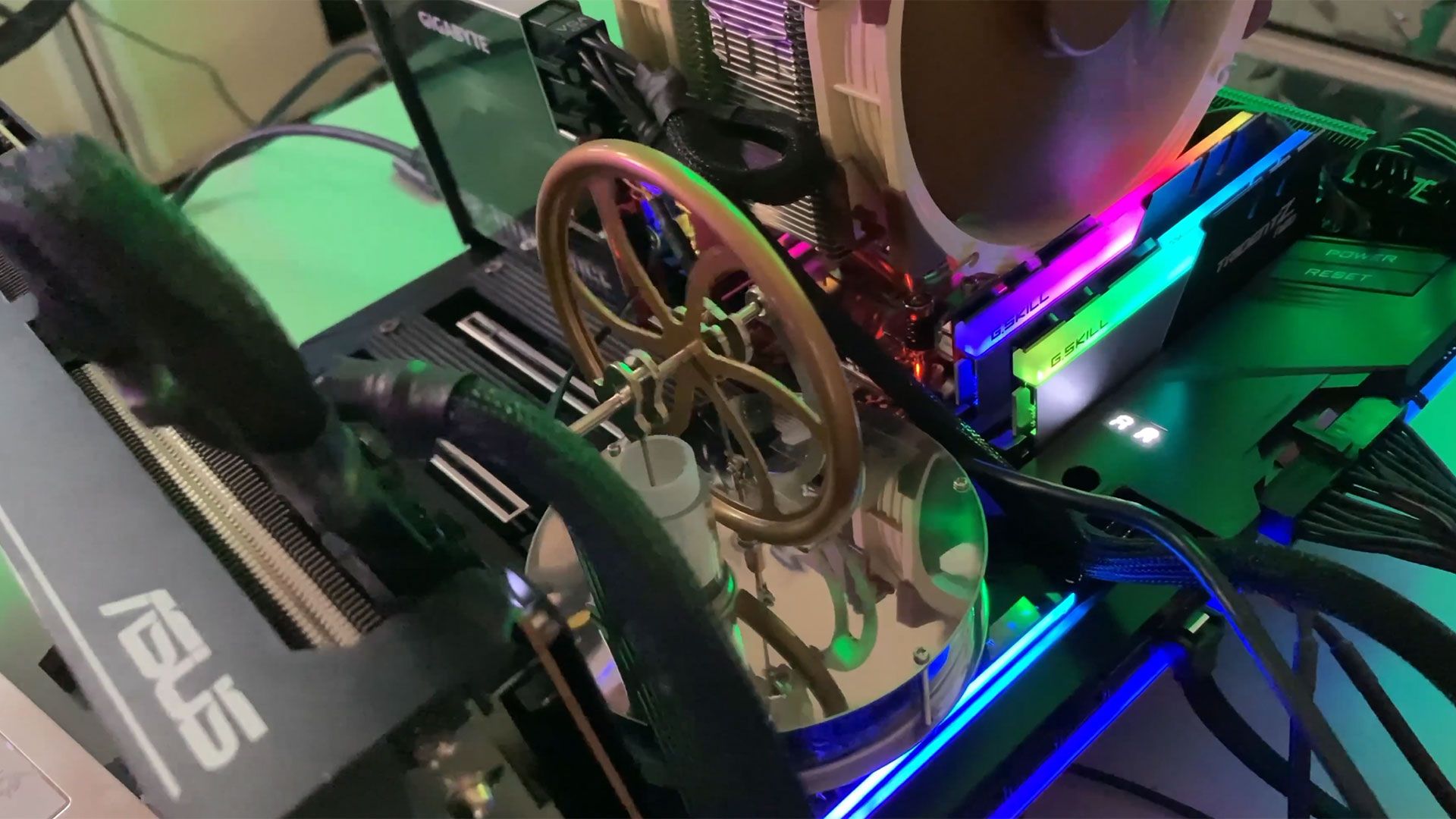
Patented in 1816, the Stirling Engine is now more typically found in solar power, CHP, and submarine applications than in computer chipset cooling.
When you purchase through links on our site, we may earn an affiliate commission. Here’s how it works .
Cooling my Threadripper chipset with a Stirling Engine! pic.twitter.com/2JG6i70zBn July 3, 2026
Patented in 1816 by Robert Stirling, the eponymous engine was positioned as a safer alternative to the steam engines of the day. It found some niche applications in water pumping and domestic tasks. Nowadays, the technology is useful in the fields of solar power, CHP, cryocooling, and submarine applications.
Briefly, a Stirling Engine converts heat energy to mechanical work. A heat source causes its gas piston (attached to a heatsink here) to expand, and that turns the flywheel, cooling the gas (reducing pressure). Momentum continues the flywheel cycle, and we get quite an efficient energy conversion going on. “The Stirling engine is characterized by its closed-cycle process involving a fixed amount of gas. The basic components include a heat source, a heat sink, a power piston, and a displacer piston,” explains Modern Physics , somewhat more scientifically. “The engine operates in four main phases: isothermal expansion, cooling at constant volume, isothermal compression, and heating at constant volume.”
You can see Plummer get the flywheel started right at the beginning of the video to help the process begin. In the Amazon listing for the Sunnytech Low Temperature Stirling Engine Motor Steam Heat Education Model Toy Kit For mechanical skills (LT001), you can see what looks like an identical item perched atop a hot beverage, as its power source. The listing suggests that the flywheel will spin up to about 200 RPM in a 20C/68F environment when placed on top of a hot cup of coffee. One Amazon user reports that the engine is sensitive enough to spin up from just the heat of your hand. In that case, a Threadripper motherboard chipset should definitely be enough.
We’d like to see Plummer share some chipset temperature details from before and after the Stirling Engine ‘installation.’ Also, we can see him running Cinebench on his 32-core, 64-thread AMD Threadripper 3970X right at the beginning of the video clip. Did it improve his benchmark scores? I guess we will probably find out in a longer-form video on the legendary dev Dave’s Garage YouTube channel.
Ingenious modder converts countertop ice machine into an RTX 3060 GPU cooler with a beer fridge thermostat
Enthusiast creates Peltier thermoelectric cooler from scratch
Key considerations
- Investor positioning can change fast
- Volatility remains possible near catalysts
- Macro rates and liquidity can dominate flows
Reference reading
- https://www.tomshardware.com/pc-components/cooling/SPONSORED_LINK_URL
- https://www.tomshardware.com/pc-components/cooling/windows-guru-uses-stirling-engine-to-cool-amd-threadripper-3970x-waste-heat-energy-spins-the-engines-flywheel#main
- https://www.tomshardware.com/subscription
- Hannah Montana Linux gets modern remaster after nearly two decades — ‘Sweet niblets,’ new v26 is built on Debian with a re-skin of KDE Plasma
- Claude Meets Blackwell Ultra: Anthropic’s Models Now Run on NVIDIA GB300 in Azure
- Windows guru uses 19th-century Stirling Engine tech for auxiliary cooling on AMD Threadripper 3970X system — waste heat energy spins the $40 engine's flywheel
- Reviewer tests 'RTX 4080M' desktop graphics card powered by salvaged laptop silicon — performs worse than slightly more expensive RX 9070 GRE but draws only 100
- RAMpocalyse pricing prompts maker to construct his own memory using ancient Apollo-era tech — USB drive resurrects hand-threaded magnetic core memory using salv
Informational only. No financial advice. Do your own research.