
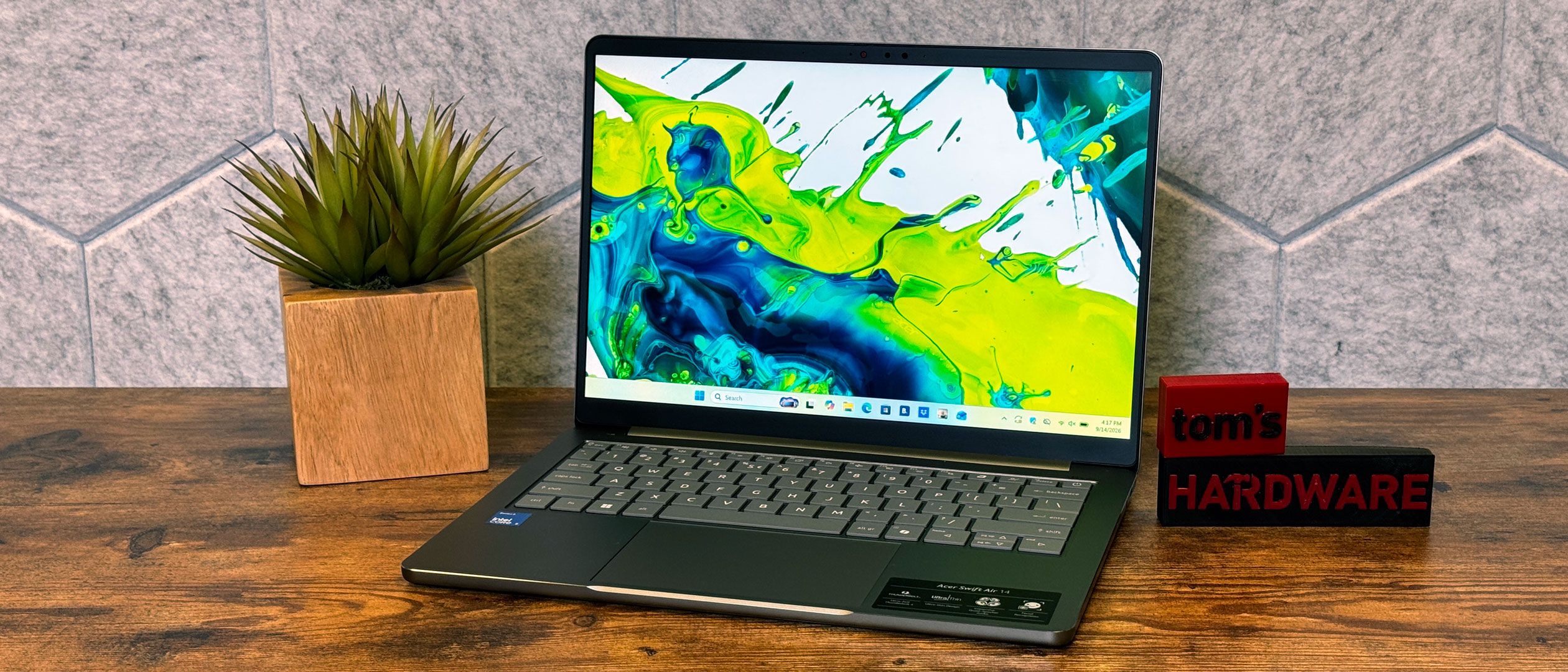
The Intel Core 5 320, 8GB of RAM, and 512GB PCIe Gen 3 SSD make the Acer Swift 14 a decent (but not startling) performer that's best for a few simple tasks at a time.
(Image credit: Tom's Hardware) (Image credit: Tom's Hardware) (Image credit: Tom's Hardware) Image 1 of 3 View Original
On Geekbench 6, the Swift Air notched a single-core score of 2,613 and a multi-core score of 7,977, putting it in close proximity to the Dell XPS 13, which uses the same chip. The Chuwi UniBook, with an Intel Core 3 304, was the lowest on the charts, while the MacBook Neo with its Apple A18 Pro was the fastest performer.
The Swift 14 outperformed on Handbrake, transcoding a 4K video to 1080p in 10 minutes, just 3 seconds behind the Macbook Neo. The Swift was a surprising 38 seconds faster than the XPS with the same chip.
On our file transfer test, the Swift Air copied 25GB of files at a rate of 677.24 MBps, slightly faster than the MacBook Neo, but significantly slower than the XPS 13.
Usually, we stress test productivity laptops running Cinebench 2026. But like some other Wildcat Lake-based laptops, the Swift Air wouldn’t run that benchmark. Instead, to get some speeds, we opted to measure while running Handbrake. While transcoding a 4K video to 1080p, the Core 5 320's two P cores ran at 3.3 GHz, while the four low-power E cores ran at just over 3 GHz.
Acer's 14-inch, 1920 x 1200 screen is colorful enough for its price, but I sure wish it were a bit brighter.
While I watched the trailer for Avengers: Endgame , I found myself reaching for the button to raise the brightness even in decently lit scenes (like a group gathering in Avengers Tower), only to find the brightness was turned all the way up. In darker scenes, like those taking place in the X-Mansion, shadows were overwhelming. At least the blacks were deep.
On our testing, we found that the Swift Air 14 covered 107% of the sRGB color gamut and 75.8% of DCI-P3. That's within range of both the MacBook Neo and the Dell XPS 13. But both of those laptops have more luminous panels (the XPS 13's is also higher resolution, at 2560 x 1600) that make the colors look better than on the Swift Air.
The keyboard on the Swift Air 14 is fine, but it has some flex while you type, and the keycaps are a little slippery. In fact, they're cheap-feeling. There's more travel than I would have expected, but with the flex, I'm not sure it mattered.
On monkeytype.com , I hit 108 words per minute, which isn't bad, but I'm usually faster. I hit that at 98% accuracy.
The touchpad has a shallow click outside of the very far corners (and also causes the system to flex), but its smooth, glass, and Windows gestures work seamlessly.
For a laptop in its class, the battery life on the Acer Swift Air 14 is fantastic. The system lasted 16 hours and 52 minutes on our battery test, which includes web browsing, video streaming, and light OpenGL work with the screen set to 150 nits.
That was the longest of the group by more than 2 hours. The next highest, the Dell XPS 13, lasted 14:26 on the test, while the Neo brought up the rear at 13 hours and 28 minutes.
The speakers on Acer's colorful 14-incher are just OK. The quad-speaker system doesn't offer a ton of depth. It's fine at $699.99, but not impressive.
Alice Merton's "Ignorance is Bliss" just filled my living room, but wasn't as loud as I would like. The artist's vocals were a bit hollow, though the song's guitars and snappy drums sounded decent for the price.
You can make adjustments in the DTS:X Ultra app, though I stuck to the default music mode. (Switching to voice made vocals louder, but drowned everything else out). There's also a custom EQ with three preset slots if you want to set the speakers to your liking. Taking some time to tweak, I was able to get the vocals and treble a bit closer to my liking.
There are four Torx screws on the bottom of the Acer Swift Air 14. While the bottom of the laptop is metal, it's very thin, and the clips holding it to the rest of the chassis are made of plastic. I had to go very slowly around the edges with a prying tool to get inside.
The two major components that you can remove are the SSD and the battery. There's only one SSD slot.
Usually, we measure how hot a laptop gets during our strenuous Cinebench gauntlet. Because this system couldn't run that test, we stepped down to measuring with Handbrake video encoding.
During that test, the keyboard hit 96 degrees Fahrenheit, while the touchpad was a cool 84.1 F. The hottest point on the bottom of the laptop reached 96.9 F. None of these indicate an overheating laptop, but that's also because we couldn't run more difficult workloads.
Internally, the CPU measured 74.8 degrees Celsius while running the same test.
Key considerations
- Investor positioning can change fast
- Volatility remains possible near catalysts
- Macro rates and liquidity can dominate flows
Reference reading
- https://www.tomshardware.com/laptops/SPONSORED_LINK_URL
- https://www.tomshardware.com/laptops/acer-swift-air-14-review#main
- https://www.tomshardware.com/membership
- Poland lost $230 million in cryptocurrency trying to buy Venezuelan oil in 2023 — USB drives with crypto handed directly to scammers
- Chinese state media counters Anthropic's call to put brakes on AI development — paper says move is ‘a response to Chinese competition’
- Solo dev enables running CUDA on AMD hardware in Windows, getting multiple CUDA libraries running on a gaming Radeon RX 9060 XT GPU in Windows — CUDA-exclusive
- University of Manchester Uses NVIDIA Earth-2 to Forecast Air Pollution Across the UK
- Hackers find encryption keys stored on stolen Flock camera despite company's denials — group extracts more than 27,000 clips, 1.6 million images captured in a s
Informational only. No financial advice. Do your own research.