
a]:text-inherit [&>a]:underline">
When you purchase through links on our site, we may earn an affiliate commission. Here’s how it works .
Conventional CPUs have hardware that “rediscovers, at runtime, which instructions actually depend on each other.” Multicore designs also need deep cache hierarchies and coherence protocols, which keep every core’s view of shared memory consistent, but scale poorly and cost area and power. Architect Labs’ alternative is what it calls “multithreading for free,” where the program itself exposes the parallel work, without threads, locks, or out-of-order hardware required for that discovery.
Frostbite’s programs are compiled to interaction nets, a model of computation from 1990 in which a program is a graph of nodes and computation happens by rewriting pairs of connected nodes, and the chip is designed around this distinct paradigm. Pairs of nodes being rewritten never overlap, so they can run in any order, or all at once, and arrive at the same result. Every value is also used exactly once, so data can stay in small local memories instead of large shared caches.
An example of the difference given by the team is a 5×5 chess-like board with five queens, placed so none can attack another. A typical program searches for solutions one board at a time. As an interaction net, the same search breaks into 3,183 small operations, and the longest chain that has to run in order is only 262 steps, so on average about 12 operations are ready to run at once at each step. Nothing about the program was rewritten to get there, as the parallel work was already intrinsic.
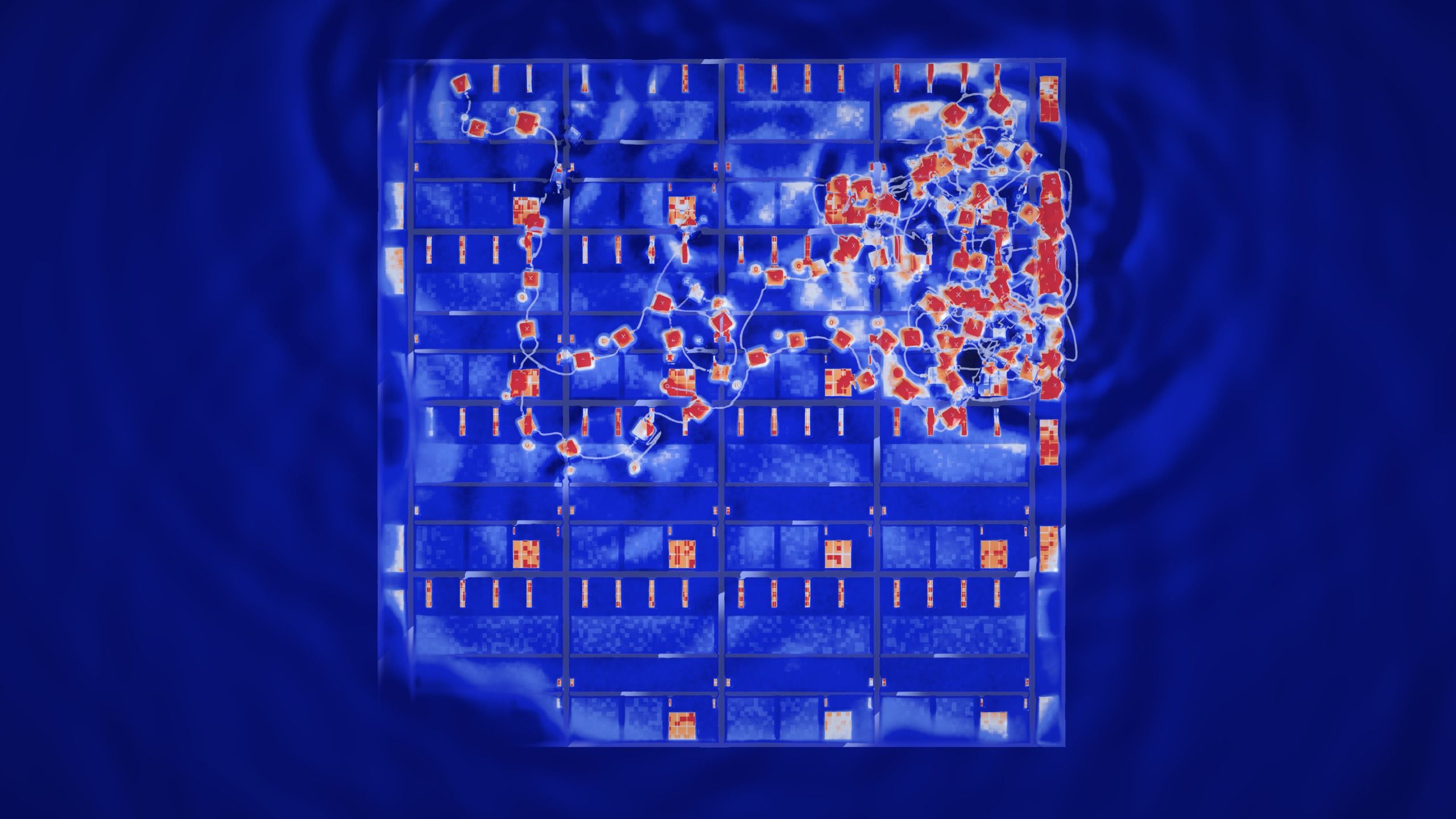
Each of the chip’s tiles, small identical processing units linked by an on-chip network, has its own small local memory. Four tiles, plus four L3 nodes, form the cluster that’s benchmarked against the conventional core for the performance claims, but the full layout has 16 tiles. The design reached 800 MHz in early synthesis but ended up at 500 MHz in the final layout. The cluster also averaged 8.77 times the comparison core’s performance per area, and the table below shows how its performance per watt varies by workload.
Arm says its AGI CPU delivers nearly 2X the performance per rack of AMD EPYC 9755 in new agentic AI CPU tests
Nuvacore reveals unconventional Core First CPU IP design strategy
Key considerations
- Investor positioning can change fast
- Volatility remains possible near catalysts
- Macro rates and liquidity can dominate flows
Reference reading
- https://www.tomshardware.com/tech-industry/semiconductors/SPONSORED_LINK_URL
- https://www.tomshardware.com/tech-industry/semiconductors/ai-agents-design-an-entirely-new-cpu-architecture-from-scratch-startup-claims-frostbite-posts-4-59x-the-performance-per-watt-of-an-in-order-core-in-pre-silicon-tests#main
- https://futureplc.com/terms-conditions/
- Lenders back SpaceX's $43 billion Nvidia GPU deal but worry the collateral could end up in orbit, making them impossible to reclaim if Musk defaults
- One gigabyte of Wikipedia losslessly compressed to 105.39MB with self-learning AI transformer model
- NVIDIA DGX Spark Developer Kit Turns a Desk Into a Supercomputing Lab
- One of the best gaming headsets plummets to just $78 at Amazon in unmissable Black Friday deal
- This week on Tom's Hardware Premium: 21 November 2026
Informational only. No financial advice. Do your own research.