
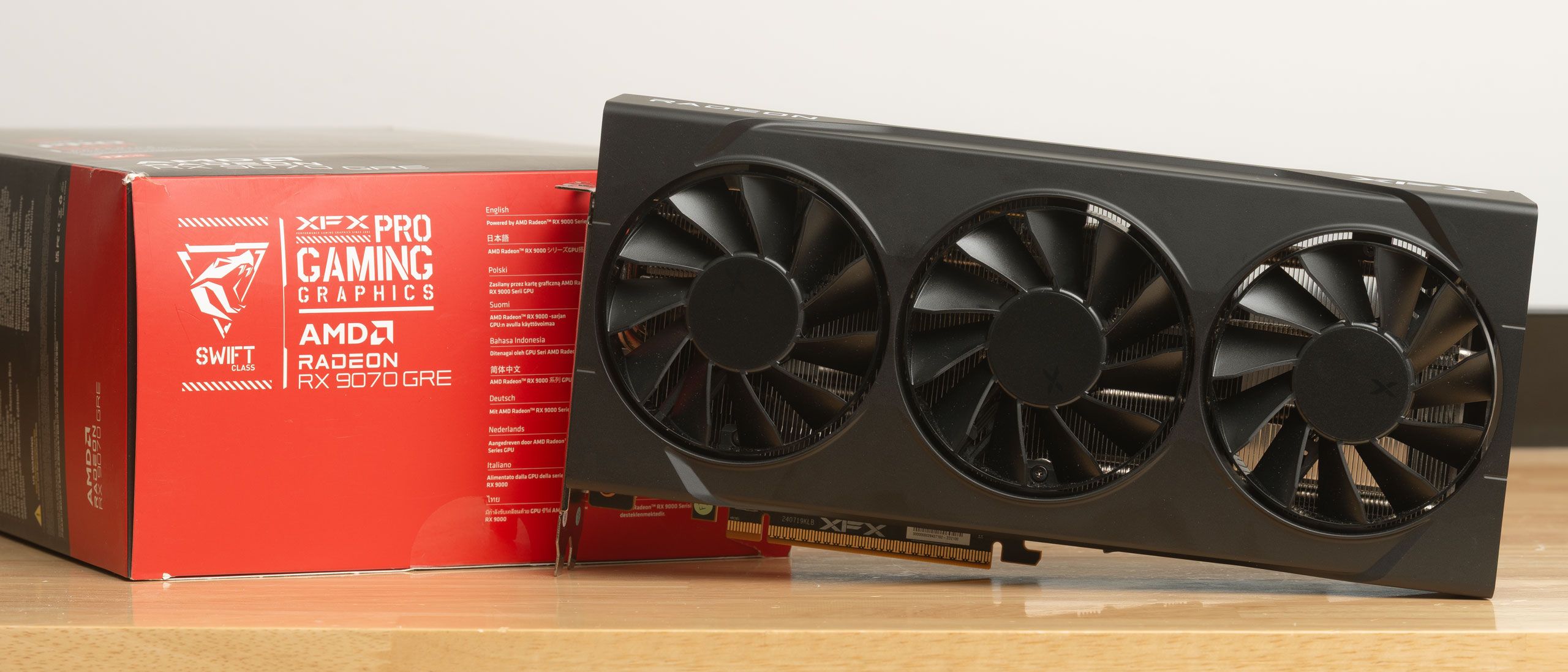
The RX 9070 GRE uses the same large Navi 48 GPU as the RX 9070 and RX 9070 XT, but it's the most cut-down version of that chip thus far, with only 48 RDNA 4 compute units of a possible 64. That downsizing has the expected downstream consequences for texture sampling throughput, pixel fill rate, and raw FLOPS compared to higher-end RDNA 4 cards.
AMD has also decked out the GRE with slower GDDR6 memory and less of it compared to its higher-end stablemates. This card offers 12GB of GDDR6 running at 18 Gbps on a 192-bit bus, which is good for 432 GB/s of raw memory bandwidth. (The RX 9070 and 9070 XT use 20 Gbps GDDR6, as does the RX 9060 XT.)
All of those cuts are clearly meant to thread the performance gap between the RX 9060 XT 16GB and the RX 9070. In terms of raw FLOPS, the GRE isn't that far behind the RX 9070, but its slower GDDR6 clocks and narrower bus both mean that vital memory bandwidth is down a whole 33% compared to the 9070 and 9070 XT. And just 12GB of GDDR6 means this card will be less well suited to RT and 4K gaming versus its two higher-end stablemates.
All that suggests it might have been good for AMD to be bolder with the RX 9070 GRE's price. With just 12GB of VRAM and relatively low memory bandwidth, this card is less appealing for local AI trailblazers than the higher-end 9070 and 9070 XT might be, and as we'll see, its gaming performance isn't so close to the 9070 that it would threaten to cannibalize sales of that product.
But a $479 9070 GRE (or even a $499 one) would probably kill every current RX 9060 XT 16GB card dead — or at least force prices back down, both of which are outcomes that AMD's board partners would likely be unhappy with in today's wild market and constrained upstream supply conditions.
But another angle here is that hardware is just the beginning of evaluating a given graphics card in 2026. You don't just plug one into a PC and install occasional driver updates for it any longer. Modern gaming requires a GPU vendor to conduct ongoing investment in a multi-part software stack encompassing upscaling, frame generation, and RT denoising, and to effectively evangelize that stack to developers and get it into games.
Thanks to Nvidia's sustained investment in the DLSS ecosystem, owning a GeForce card means that you can generally trust that you'll enjoy either day-one support for the latest DLSS versions in games or an easy override using the Nvidia App. And Multi Frame Generation on Blackwell has matured to the point that early tradeoffs with input latency are basically ironed out in the latest titles. That all means that you have a wide range of freedom to tune performance, smoothness, and image quality to taste on GeForces.
AMD certainly has competitive AI-powered upscaling options in FSR 4 and 4.1, both of which are major improvements over FSR 3 and earlier. And you can enable them in many games with driver overrides, just as with the Nvidia App. But community surveys have still shown a strong preference for the output of DLSS, so AMD still has work to do on its upscaling models.
And for those who want to embrace the smoothness boost of framegen, AMD is clearly behind. FSR 4 ML Frame Generation is still limited to a 2X multiplier, and it's only supported in a handful of games compared to DLSS MFG. Even Intel has enabled higher 3x and 4x framegen multipliers for its Arc products.
And AMD's Ray Regeneration RT denoiser is only available in a couple of titles, while you can usually find DLSS Ray Reconstruction alongside titles that are pushing the state of path-traced effects forward. Ray Reconstruction is a key feature in titles like Resident Evil Requiem , Pragmata , Indiana Jones and the Great Circle , Doom: The Dark Ages , and more. In fact, AMD cards are locked out of path-traced effects entirely in Resident Evil Requiem and Pragmata .
Whatever the cause of these divergent experiences on GeForces and Radeons, the fact of the matter is that Nvidia has the money and developer relations muscle to make sure its DLSS features make their way into practically every new game, whereas AMD apparently does not, and that gap seems to grow wider with every AAA release.
All that is to say that if you choose a Radeon today, you are likely going to encounter more inconsistent feature support, fewer cutting-edge options for eye candy, and a less flexible performance tuning experience compared to GeForces.
And that all means that AMD likely needs to be more aggressive on pricing to get gamers back into its camp (and perhaps funnel some of its AI cash back into developer relations to stoke broader adoption of its tech). It's tough to admit that you're behind on these features and their adoption, to be sure, but pricing is a powerful way to make up some of the difference.
Current page: Introducing the Radeon RX 9070 GRE
Key considerations
- Investor positioning can change fast
- Volatility remains possible near catalysts
- Macro rates and liquidity can dominate flows
Reference reading
- https://www.tomshardware.com/pc-components/gpus/SPONSORED_LINK_URL
- https://www.tomshardware.com/pc-components/gpus/amd-radeon-rx-9070-gre-review#main
- https://www.tomshardware.com
- Watch Intel's Computex 2026 keynote here — CEO Lip-Bu Tan takes the stage in Taipei at 10:30pm PT on June 1
- AMD is considering a potential Ryzen 5 9600X3D — company says six-core Zen 5 X3D chip 'maybe something we look at doing… later this year'
- Taiwan’s Industry Titans Turbocharge World’s AI Infrastructure Buildout With NVIDIA
- Hands-on with Asus’ ROG Harpe II Extreme Edition 20 gaming mouse – 24K gold and a 65K sensor
- NVIDIA Research Advances Robotics From Simulation to the Real World
Informational only. No financial advice. Do your own research.