
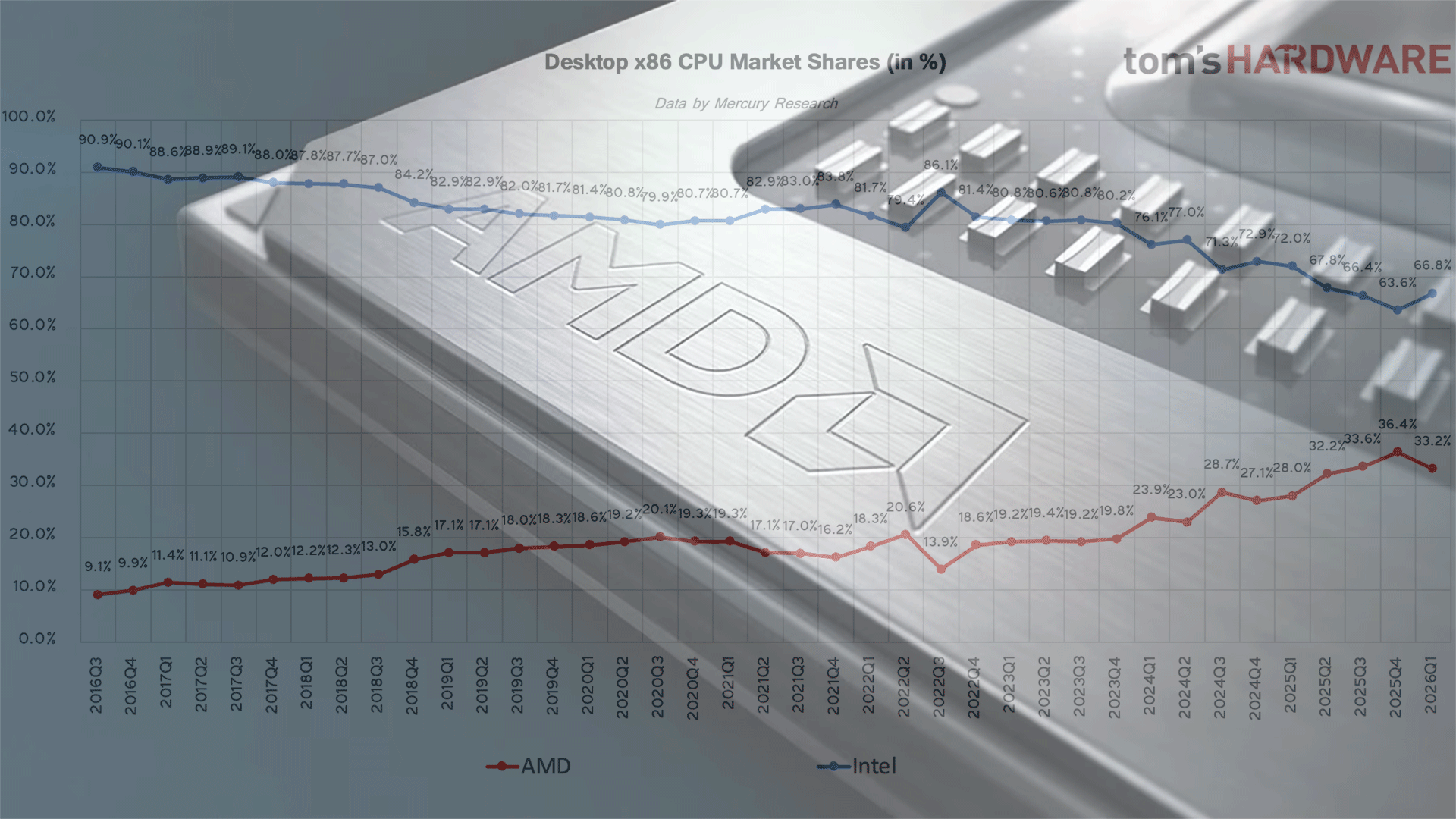
In the mobile PC segment, AMD delivered its strongest result ever as it managed to once again increase its share and set its highest share in laptops ever.
AMD's mobile CPU unit share climbed to 28.3% in Q1 2026, up from 26% in Q4 2025 and from 22.5% a year earlier, the best quarter ever for the company's mobile processors. For obvious reasons, Intel commanded the lion's share of the market — 71.7% — though its lead narrowed further as AMD increased its share by improving availability and expanding its footprint in segments (e.g., business and commercial notebooks) traditionally dominated by Intel.
As for revenue share, AMD's progress was even more impressive. The company’s mobile CPU revenue share rose to 28.9%, an increase from 24.9% in Q4 2025 and from 22.2% in Q1 2025, which reflects stronger sales of higher-value notebook processors. Intel continued to control the majority of notebook CPU revenue overall (71.7%, down from 77.5% in Q1 2025), but AMD's ability to approach 28.9% revenue share clearly indicates its increasing competitiveness in higher-margin premium laptops that historically favored Intel almost exclusively.
‘CPUs are cool again,' Intel and AMD reporting spikes in CPU demand due to agentic AI
AMD's market cap hits all-time high, Intel hits 25-year high on Agentic AI's insatiable demand for CPUs
AMD expects 20% decline in gaming revenue from 'higher component costs' in the second half of 2026
While the first quarter was good for AMD's mobile processors, it was exceptional for AMD's EPYC CPUs for servers. The company not only set a record in terms of unit share, but it has also managed to skyrocket its revenue share by 5% in a single quarter.
AMD's server processor unit share climbed to 33.2%, up from 28.8% in Q4 2025 and 27.2% a year earlier, the data by Mercury Research shows. Intel still shipped the majority of server processors with a 66.8% share, but its position weakened both sequentially and year-over-year as EPYC adoption continued to expand across hyperscale cloud providers, enterprise deployments, and AI/HPC infrastructure.
On the revenue side, AMD's performance was even more striking: the company's server CPU revenue share reached a record 46.2%, which means that AMD now commands nearly half of all x86 server CPU revenue while shipping roughly one-third of units. This gap between unit share and revenue share reflects significantly higher average selling prices of AMD's processors in general and the popularity of the company's high-core-count premium configurations. While Intel generated more server CPU revenue than AMD, ASPs of its Xeon products were lower compared to those of EPYCs, which is in line with market performance in prior quarters.
AMD started 2026 on a strong note: it expanded its share in both client and server CPUs and set new records for overall x86 CPU revenue share, according to Mercury Research.
The company posted particularly strong gains in notebooks and servers, where EPYC adoption pushed AMD’s server revenue share close to half of the entire x86 server market. While AMD's desktop CPU share declined sequentially after an exceptionally strong holiday quarter, it remained well above year-ago levels, so the strong momentum for the company continues.
In general, AMD continues to strengthen its positions in the most profitable parts of the x86 CPU market, while Intel retains shipment leadership but loses further ground in revenue share and premium segments.
Follow Tom's Hardware on Google News , or add us as a preferred source , to get our latest news, analysis, & reviews in your feeds.
Anton Shilov is a contributing writer at Tom\u2019s Hardware. Over the past couple of decades, he has covered everything from CPUs and GPUs to supercomputers and from modern process technologies and latest fab tools to high-tech industry trends. ","collapsible":{"enabled":true,"maxHeight":250,"readMoreText":"Read more","readLessText":"Read less"}}), "https://slice.vanilla.futurecdn.net/13-4-23/js/authorBio.js"); } else { console.error('%c FTE ','background: #9306F9; color: #ffffff','no lazy slice hydration function available'); } Anton Shilov Social Links Navigation Contributing Writer Anton Shilov is a contributing writer at Tom’s Hardware. Over the past couple of decades, he has covered everything from CPUs and GPUs to supercomputers and from modern process technologies and latest fab tools to high-tech industry trends.
usertests Is "consumer" PC market share counting corporate/office desktops? That's where Intel shines. In PCs that get dumped onto the used market for cheap. Reply
DS426 usertests said: Is "consumer" PC market share counting corporate/office desktops? … I think it is in this context, though I'd love to see x86 business desktop and laptop/mobile broken out from true consumer products. I'm still assuming that AMD is making slower progress in the business world as the old stuffies just stick with Intel "because why not?" Reply
TechieTwo It's all good for customers that they can purchase the best CPUs for less than Intel's pricing. Reply
hotaru251 and server is where both truly care about as thats where the actual profit is. Fact intel managed to have an effective monopoly on server and dropped ball so hard should be enoguh to never let them sit idle again. Reply
usertests DS426 said: I think it is in this context, though I'd love to see x86 business desktop and laptop/mobile broken out from true consumer products. I'm still assuming that AMD is making slower progress in the business world as the old stuffies just stick with Intel "because why not?" Intel's offerings aren't even bad. If you compare a Core Ultra 5 245 (65W) to a Ryzen 7 Pro 9745, the CPU performance should be about the same. The Arrow Lake CPUs also have a faster iGPU, which is what most office PCs will use. Intel's main failings are not having an answer to X3D, which is relevant to gamers but not most office PCs, and the lack of AVX-512 support in mainstream CPUs, which is also niche but holding everyone back. Both of these could be fixed by Nova Lake. They just need to avoid any future degradation incidents. Reply
ekio Can’t wait to see arm laptops becoming the too obvious efficiency choice and see x86 sells collapsing. Maybe the MacBook neo will teach the world that they can get good hardware leaving this old crap. Reply
usertests ekio said: Can’t wait to see arm laptops becoming the too obvious efficiency choice and see x86 sells collapsing. Maybe the MacBook neo will teach the world that they can get good hardware leaving this old crap. ARM's purported efficiency benefits are always overrated by proponents, and AMD and Intel aren't sitting still on efficiency. They'll probably put "LP" core clusters in every desktop and laptop CPU within the next few years. You can wait, because it's not happening soon. Qualcomm and Microsoft dropped the ball yet again, and Nvidia's attempt has been massively delayed. Reply
Key considerations
- Investor positioning can change fast
- Volatility remains possible near catalysts
- Macro rates and liquidity can dominate flows
Reference reading
- https://www.tomshardware.com/pc-components/cpus/SPONSORED_LINK_URL
- https://www.tomshardware.com/pc-components/cpus/amd-reaches-46-percent-of-server-x86-cpu-revenue-intel-still-controls-70-percent-of-the-consumer-pc-market-share#main
- https://www.tomshardware.com/subscription
- AMD expands its Ryzen 9000 PRO lineup with six new SKUs, now featuring 3D V-Cache for the first time — new workstation CPUs have up to 170W TDPs, available with
- ‘Your Career Starts at the Beginning of the AI Revolution,’ NVIDIA CEO Tells Graduates
- Save a huge $229 on a two-year NordVPN subscription and get three extra months free — massive 73% saving for privacy-focused VPN with no-logs policy unlocks acc
- Grab a big $250 savings on this RTX 5070 Ti and 9850X3D combo deal for your next 4K gaming PC build — Newegg discount brings together one of AMD's fastest X3D g
- Trump administration reportedly debating ban on Chinese cellular modules in expansion of FCC crackdown — potential restrictions could impact everything from sma
Informational only. No financial advice. Do your own research.