
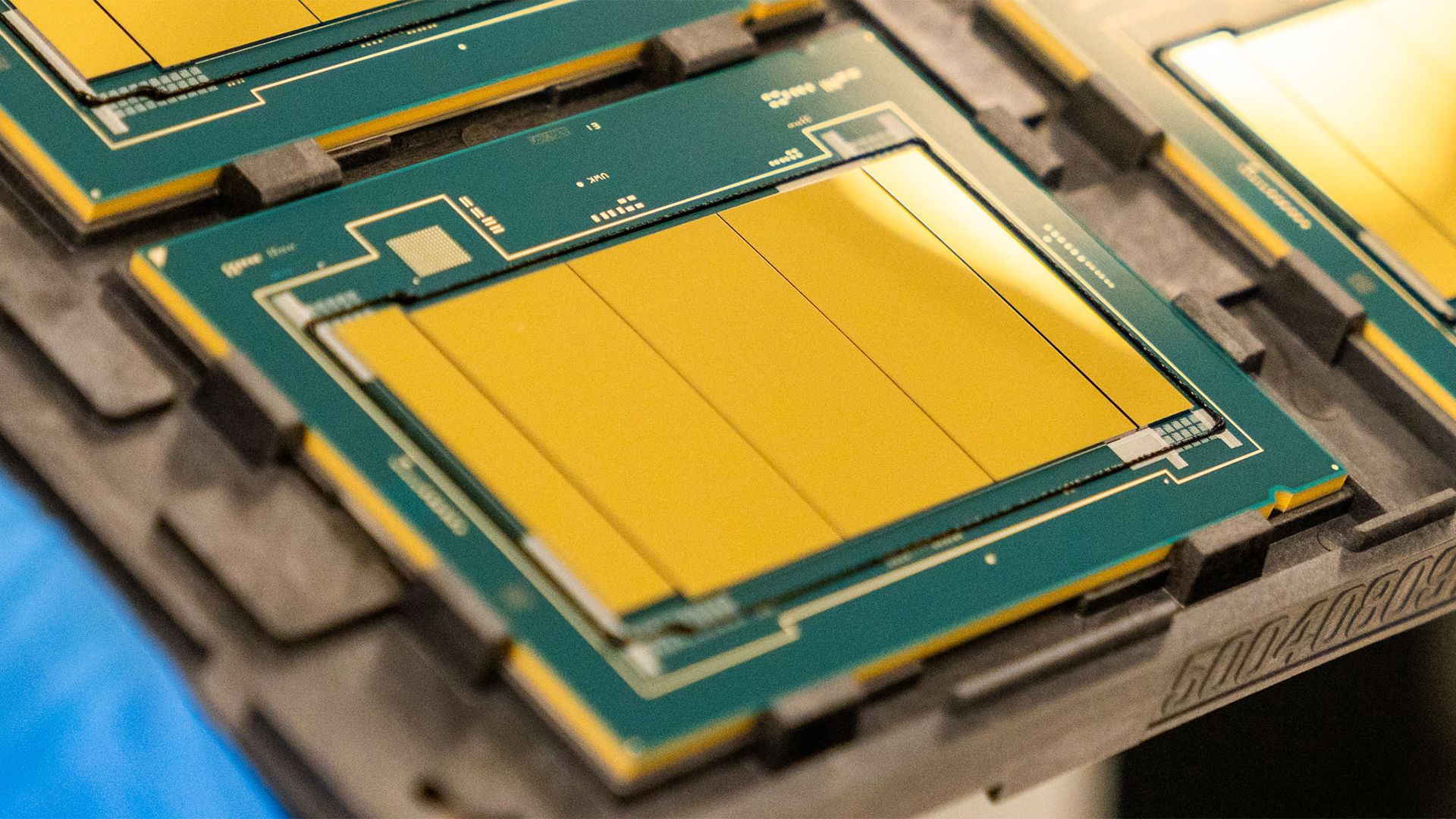
For now, the most advanced and yet production-proven Foveros 2.5D technology is Foveros-S . This packaging technology places multiple chiplets on a silicon interposer and currently supports packages up to four reticles in size, which is below what TSMC offers with CoWoS-S (up to 5.5X reticles). Since Foveros-S is essentially an evolution of the original Foveros from 2019, Intel legitimately says that it has been in volume production since 2019. Yet, going forward, Foveros-S will be evolving in multiple directions, which includes larger package sizes, interconnect density, and interconnect power efficiency.
Foveros-R removes the silicon interposer altogether and uses fan-out RDL technology to optimize cost and interconnect density. Intel says the implementation can use up to three redistribution layers. The method is designed to offer a balance between cost and interconnect density and enable heterogeneous integration of chiplets from different sources through UCIe. Like the other members of Intel's current Foveros 2.5D family, the technology uses 36 µm microbump pitches, but is designed to support pitches below 25 µm as well as bump density scaling from 772 to 1,600/mm² and chip-to-chip interconnect power of 0.15 pJ/bit. Intel says Foveros-R will be production-ready in 2027.
Foveros-B extends the concept toward larger and more complex AI/HPC designs. Instead of relying on a full silicon interposer, the technology combines RDLs with local active or passive silicon bridges that provide high-density connections only where they are needed. This potentially gives Intel an intermediate option between an RDL-only implementation and a large silicon interposer, as well as a direct competitor for TSMC's CoWoS-R.
Note that Intel does not explicitly say that Foveros-B uses EMIB bridges, though given similar microbump pitch sizes and the plan to use active local bridges in the future, Foveros-B's bridges are likely to closely resemble EMIB-M and EMIB-T bridges. If Foveros-B can indeed use EMIB bridges, future Foveros-B designs could also incorporate cache disaggregation, integrated voltage regulators (IVRs), or MIM capacitors.
As for interconnection densities and power, Foveros-B is listed as designed to support pitches below 25 µm, bump density scaling up to 1,600/mm², and chip-to-chip interconnect power of 0.15 pJ/bit. Meanwhile, Intel has not disclosed when Foveros-B will be ready for commercial production, so its actual specifications remain to be seen.
With EMIB and the Foveros 2.5D portfolio, Intel can address a broad range of applications, but Intel's scaling is not stopping. In addition to 2.5D lateral scaling enabled by EMIB or Foveros 2.5D, it can stack chiplets on top of each other using its Foveros 3D and EMIB 3.5D packaging technologies.
Unlike simple package-on-package stacking, which has existed for decades, densely interconnected 3D stacking essentially turns separate dies into parts of the same tightly coupled chip, increasing bandwidth, reducing latency, cutting interconnect power, and shrinking footprint. The challenge is manufacturing thousands of extremely fine connections between dies while maintaining yield, power delivery, signal integrity, and — perhaps most importantly — removing heat from chips buried inside the stack.
The biggest architectural step in Intel's Foveros roadmap is Foveros Direct 3D, which moves from microbump-based connections toward direct copper-to-copper hybrid bonding. Conventional microbumps cannot shrink forever, as solder bumps need sufficient dimensions to maintain manufacturing yield and reliability, while the solder itself introduces additional resistance and parasitic effects. Foveros Direct 3D eliminates solder altogether and directly bonds copper pads on one die to those on another, which enables an interconnect pitch below 10 µm — up to 10 times finer than conventional microbump technology.
Row 0 – Cell 0 Foveros Direct 3D 1st Gen
Key considerations
- Investor positioning can change fast
- Volatility remains possible near catalysts
- Macro rates and liquidity can dominate flows
Reference reading
- https://www.tomshardware.com/tech-industry/semiconductors/SPONSORED_LINK_URL
- https://www.tomshardware.com/tech-industry/semiconductors/analyzing-intels-emib-and-foveros-advanced-packaging-roadmaps-how-intel-plans-to-scale-chips-in-every-direction#main
- https://www.tomshardware.com/my-account
- Productive, Durable, Fungible: How NVIDIA AI Factories Maximize Return on Investment
- Coder creates NvidiaWatch tracker site that monitors hundreds of GPU driver bugs
- Nintendo stands by physical games as Sony embraces a digital-only future
- Contain the Chaos: ‘CONTROL Resonant’ Launches on GeForce NOW
- Jev-like decision models are flooding the AI market, after researcher claims TypeSafe copied their research
Informational only. No financial advice. Do your own research.